Endomembrane system | Structure of a cell | Biology | Khan Academy
TL;DR
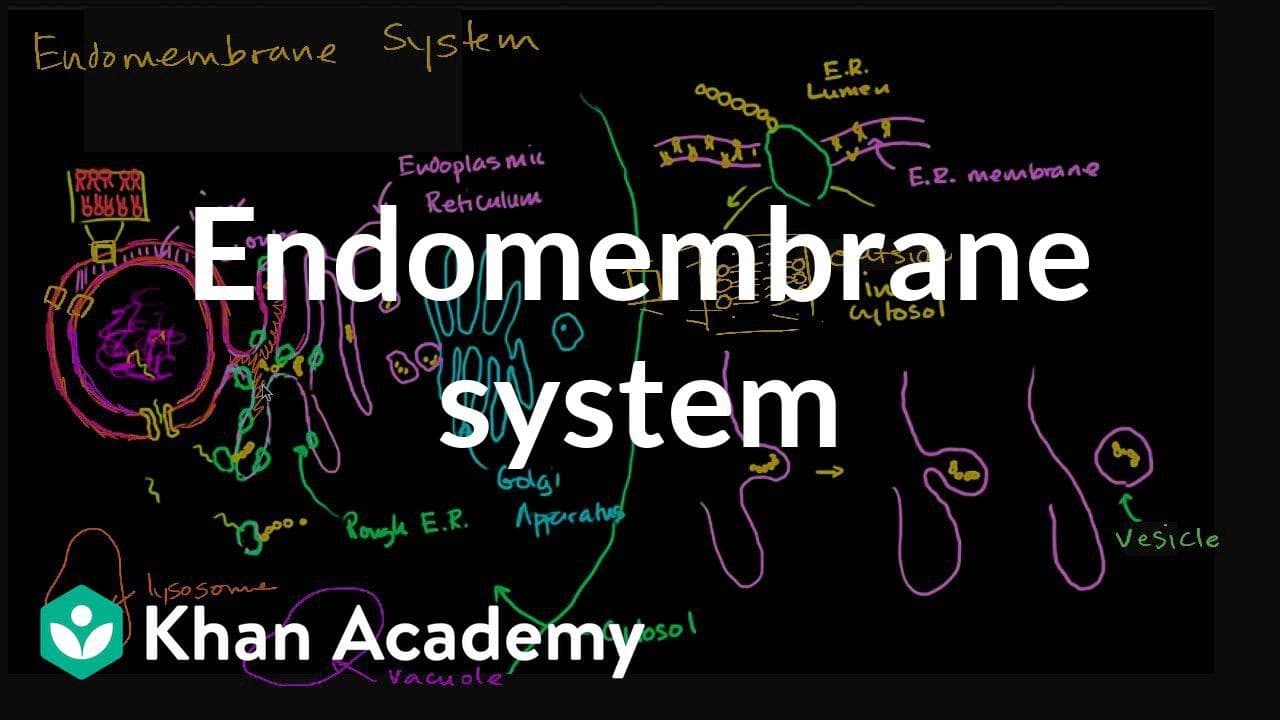
The endomembrane system in eukaryotic cells consists of various membranes that interact with each other, including the cell membrane, nuclear envelope, endoplasmic reticulum, Golgi apparatus, vacuoles, and lysosomes.
Transcript
- [Voiceover] What I wanna do in this video is give an overview of the endomembrane system in eukaryotic cells. Endomembrane system. And at a very high level, the endomembrane system is all of the membranes that interact with each other inside of a cell. So what membranes are we talking about? Well, you can start off by talking about the cell membr... Read More
Key Insights
- 💦 The endomembrane system in eukaryotic cells is a complex network of membranes that work together to carry out various functions.
- 💁 Phospholipids form the bilayers of membranes in the endomembrane system, providing a barrier that separates different compartments within the cell.
- ❓ Proteins can be synthesized, processed, and transported within the endomembrane system, which includes the endoplasmic reticulum and Golgi apparatus.
- 🌱 Vacuoles in plant cells and lysosomes in animal cells are additional components of the endomembrane system that have specific functions, such as storage and recycling.
Install to Summarize YouTube Videos and Get Transcripts
Explore YouTube Video Summarizer or Get YouTube Transcript Extractor
Questions & Answers
Q: What is the endomembrane system in eukaryotic cells?
The endomembrane system is a network of membranes that interact with each other inside eukaryotic cells, including the cell membrane, nuclear envelope, endoplasmic reticulum, Golgi apparatus, vacuoles, and lysosomes. These membranes work together to carry out various functions within the cell.
Q: What are phospholipids?
Phospholipids are a type of lipid molecule that make up the bilayers of membranes in the endomembrane system. They have hydrophilic heads that face outwards and hydrophobic tails that face inwards, creating a barrier that separates the inside and outside of the cell.
Q: How are proteins synthesized in the endomembrane system?
Proteins can be synthesized in the endoplasmic reticulum, where ribosomes on the rough ER synthesize proteins directly into its lumen. These proteins can then be further processed and matured in the Golgi apparatus before being transported to their final destinations within the cell.
Q: What is the function of lysosomes in the endomembrane system?
Lysosomes are membrane-bound organelles that serve as the cell's recycling centers. They contain enzymes that can break down and digest molecules, which allows for the recycling of materials and the maintenance of cellular function.
Summary & Key Takeaways
-
The endomembrane system is a network of membranes in eukaryotic cells that work together to carry out various functions.
-
The membranes in the endomembrane system, such as the cell membrane, nuclear envelope, endoplasmic reticulum, and Golgi apparatus, are made up of bilayers of phospholipids.
-
Proteins and other molecules can be synthesized and processed in different parts of the endomembrane system, including the endoplasmic reticulum, Golgi apparatus, vacuoles, and lysosomes.
Read in Other Languages (beta)
Share This Summary 📚
Summarize YouTube Videos and Get Video Transcripts with 1-Click
Try YouTube Summary with ChatGPT & Claude or YouTube Transcript Generator
Explore More Summaries from Khan Academy 📚



Summarize YouTube Videos and Get Video Transcripts with 1-Click
Try YouTube Summary with ChatGPT & Claude or YouTube Transcript Generator