Area of Koch snowflake (part 2) - advanced | Perimeter, area, and volume | Geometry | Khan Academy
TL;DR
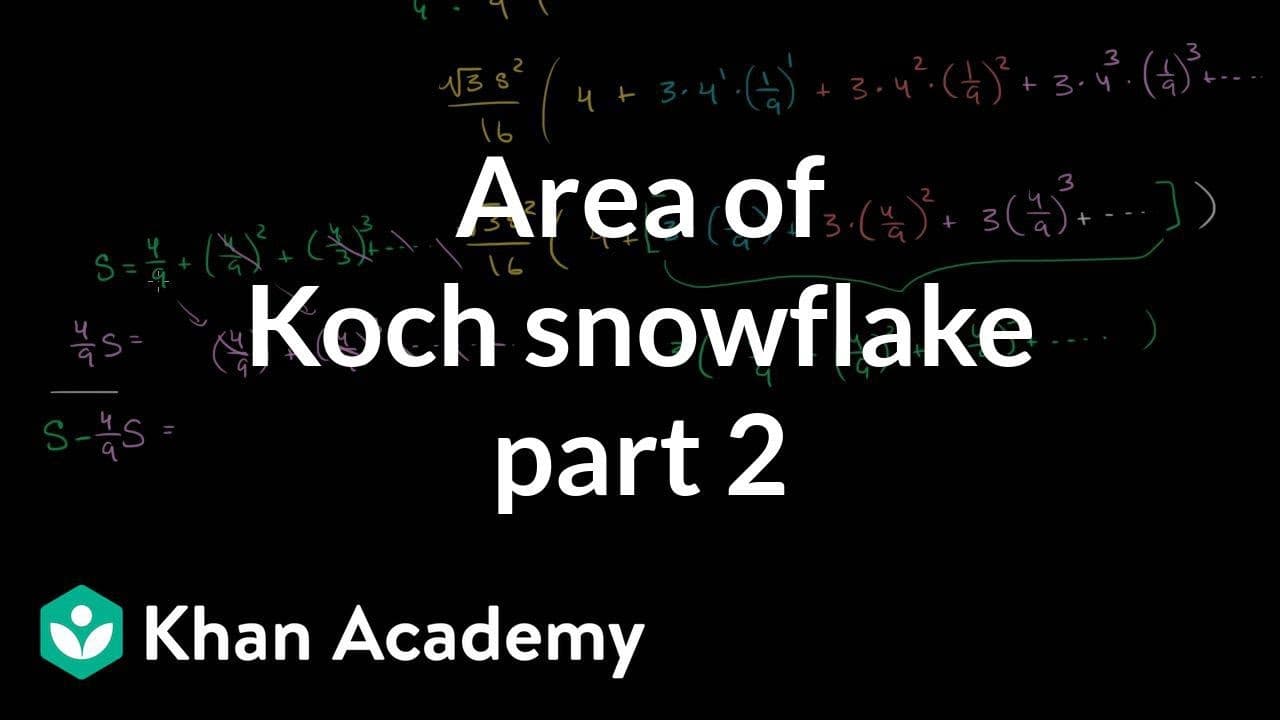
The video explains how to simplify the area formula for the Koch snowflake, showing that it is equal to two times the square root of three times S squared over five.
Transcript
In the last video we got as far as figuring out that the area of this Koch snowflake This thing that has an infinite perimeter, can be expressed as this infinite sum over here So our job in this video is to try to simplify this, and hopefully get a finite value Let's do our best to actually simplify this thing right over here So the easiest part of... Read More
Key Insights
- 😑 The area formula for the Koch snowflake can be expressed as an infinite sum.
- 😑 The speaker simplifies the formula by expressing a part of it as an infinite geometric series.
- ⌛ By solving the equation, the speaker finds that the area is equal to two times the square root of three times S squared over five.
- 💠 The simplified formula demonstrates that a shape with an infinite perimeter can still have a finite area.
- 🍉 The process of simplifying the formula involves multiplying and subtracting terms to find a value for S.
- 🎮 The equation used in the video does not rely on magical formulas but rather on logical mathematical operations.
- 🙃 The final result is achieved by canceling out terms and multiplying both sides of the equation by the inverse.
Install to Summarize YouTube Videos and Get Transcripts
Explore YouTube Video Summarizer or Get YouTube Transcript Extractor
Questions & Answers
Q: How does the speaker simplify the area formula for the Koch snowflake?
The speaker starts by bracketing off a specific part of the formula and expressing it as an infinite geometric series. By carefully subtracting terms, the speaker finds that this part simplifies to four ninths.
Q: What is the equation that the speaker uses to simplify the formula?
The speaker defines a sum (S) as four ninths plus four ninths squared plus four ninths to the third power, continuing to infinity. By multiplying S by four ninths and subtracting the result from S, the speaker finds that S is equal to four fifths.
Q: What is the final simplified formula for the area of the Koch snowflake?
The simplified formula is two times the square root of three times S squared divided by five. If the initial equilateral triangle has a side-length of one, the area would be two square roots of three over five.
Q: Why is it significant that the area of the Koch snowflake can be simplified?
The Koch snowflake has an infinite perimeter, but the simplified formula allows for a finite value of the area. This mathematical result is intriguing and highlights the relationship between infinite and finite quantities.
Summary & Key Takeaways
-
The video aims to simplify the area formula for the Koch snowflake, which has an infinite perimeter.
-
The speaker focuses on simplifying a specific part of the formula by expressing it as an infinite geometric series.
-
By solving the equation, the speaker demonstrates that the area of the Koch snowflake is equal to two times the square root of three times S squared over five.
Read in Other Languages (beta)
Share This Summary 📚
Summarize YouTube Videos and Get Video Transcripts with 1-Click
Try YouTube Summary with ChatGPT & Claude or YouTube Transcript Generator
Explore More Summaries from Khan Academy 📚



Summarize YouTube Videos and Get Video Transcripts with 1-Click
Try YouTube Summary with ChatGPT & Claude or YouTube Transcript Generator