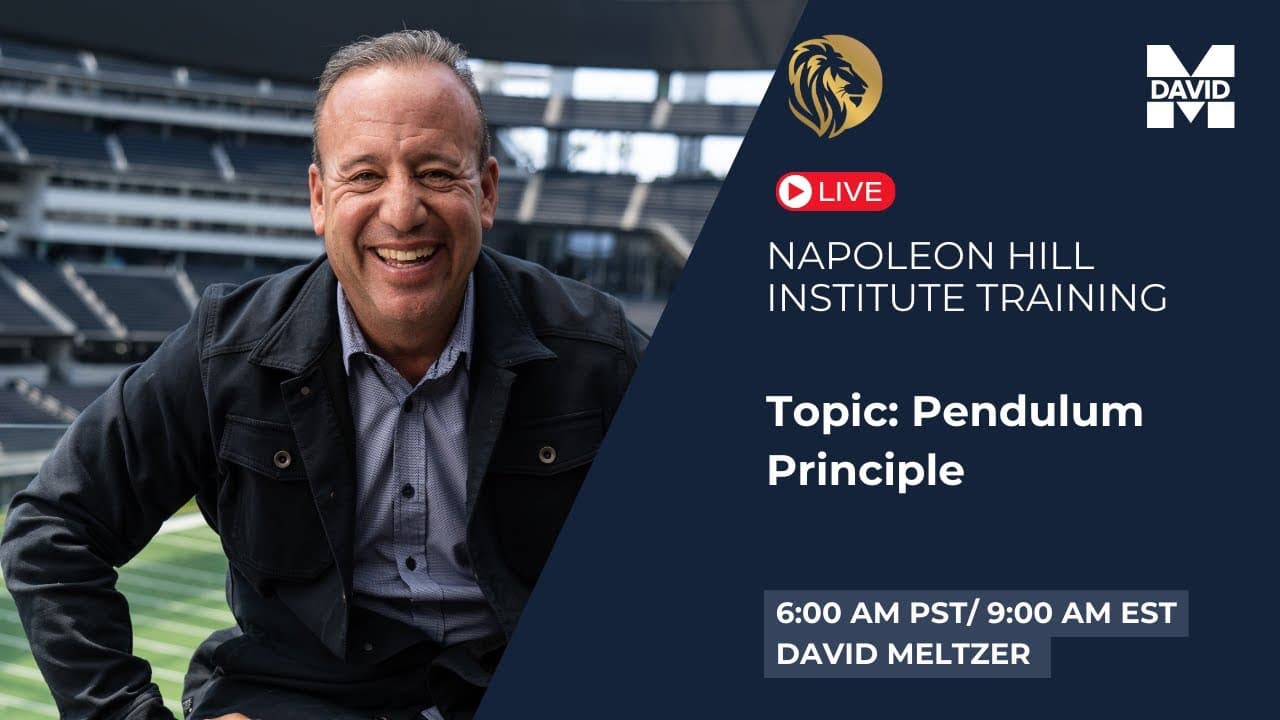
Napoleon Hill Institute Training: Pendulum Principle
TL;DR
Embrace the pendulum principle to achieve lasting success.
Transcript
They discovered it. They read it. And they applied it. It's the golden thread that connects the titans of the self-development industry. The source that spawned millions of millionaires. The original blueprint to success. Think and Grow Rich by Napoleon Hill. Think and Grow Rich. Napoleon Hill. Think and Grow Rich. It's a classic. A classic. And I ... Read More
Key Insights
- The pendulum principle highlights the balance between force and counterforce, emphasizing the importance of embracing resistance rather than avoiding it.
- Gratitude, forgiveness, accountability, and inspiration are key principles to hold tightly while keeping personal preferences flexible.
- Building a legacy involves creating systems and processes that outlast individual contributions, rather than relying on heroes.
- Leadership should focus on service and value, converting observers into participants to reduce friction and widen impact.
- Non-negotiable and negotiable behaviors should be defined to maintain momentum and address future uncertainties effectively.
- Appreciating differences and being more interested than interesting fosters understanding and collaboration.
- The pendulum principle serves as a guide to converting resistance into insights, creating opportunities for growth and learning.
- Effective communication and collaboration are essential in solving problems and creating value, leading to sustainable success.
Install to Summarize YouTube Videos and Get Transcripts
Explore YouTube Video Summarizer or Get YouTube Transcript Extractor
Questions & Answers
Q: What is the pendulum principle?
The pendulum principle is a concept that highlights the balance between force and counterforce. It suggests that for every action, there is an equal and opposite reaction, much like a pendulum. The principle encourages embracing resistance as a source of data and growth, rather than avoiding it, and using it to navigate challenges effectively.
Q: Why is it important to hold principles tight and preferences light?
Holding principles tight and preferences light is important because it allows individuals to remain grounded in their core values while staying flexible in their approaches. This mindset helps prevent polarization and encourages open-mindedness, enabling leaders to adapt to changing circumstances and learn from diverse perspectives, ultimately leading to more effective decision-making and growth.
Q: How can building a legacy be achieved according to the content?
Building a legacy can be achieved by creating systems and processes that endure beyond individual contributions. Instead of relying on heroes, leaders should focus on empowering others and establishing structures that facilitate continuous growth and impact. This involves documenting best practices, creating continuity drills, and fostering an environment where collaboration and value creation are prioritized.
Q: What role does service play in leadership according to the training?
Service plays a crucial role in leadership by converting observers into participants and reducing friction in achieving goals. By leading with service and value, leaders can widen their impact and build a community of individuals who support and empower each other. This approach emphasizes collaboration and problem-solving, ultimately creating a more inclusive and effective leadership style.
Q: How can anxiety be managed according to the pendulum principle?
According to the pendulum principle, anxiety can be managed by focusing on non-negotiable and negotiable behaviors that align with one's goals. By defining small, actionable steps and prioritizing near-term activities, individuals can create a sense of certainty and control. This approach helps dissipate anxiety, which often stems from future uncertainties, and promotes a more focused and effective path forward.
Q: What is the significance of appreciating differences in the content?
Appreciating differences is significant because it fosters understanding and collaboration. By being more interested than interesting, leaders can learn from diverse perspectives and convert resistance into insights. This approach encourages open-mindedness and empathy, enabling individuals to find common ground and work together towards shared goals, ultimately leading to more effective problem-solving and value creation.
Q: How does the pendulum principle guide converting resistance into insights?
The pendulum principle guides converting resistance into insights by viewing counterforce as data rather than doom. By embracing resistance and understanding its underlying causes, individuals can identify areas for growth and improvement. This mindset encourages learning from challenges and using them as opportunities to refine strategies, ultimately leading to more informed decision-making and sustainable success.
Q: What is the importance of effective communication in the pendulum principle?
Effective communication is important in the pendulum principle because it facilitates collaboration and problem-solving. By articulating value and service clearly, leaders can reduce resistance and foster a more inclusive environment. This approach emphasizes transparency and openness, enabling individuals to work together more effectively and create solutions that address the needs and concerns of all stakeholders.
Summary & Key Takeaways
-
The pendulum principle emphasizes the balance between force and counterforce, encouraging leaders to embrace resistance as a source of data and growth. By holding principles like gratitude and forgiveness tightly, while keeping preferences flexible, individuals can navigate challenges effectively.
-
Building a lasting legacy involves creating systems and processes that endure beyond individual contributions. Leaders should focus on service and value, converting observers into participants to widen their impact and reduce friction in achieving goals.
-
Defining non-negotiable and negotiable behaviors helps maintain momentum and address future uncertainties. By appreciating differences and fostering collaboration, leaders can convert resistance into insights, creating opportunities for growth and sustainable success.
Read in Other Languages (beta)
Share This Summary 📚
Summarize YouTube Videos and Get Video Transcripts with 1-Click
Try YouTube Summary with ChatGPT & Claude or YouTube Transcript Generator
Explore More Summaries from David Meltzer 📚


Summarize YouTube Videos and Get Video Transcripts with 1-Click
Try YouTube Summary with ChatGPT & Claude or YouTube Transcript Generator