Events and Outcomes 2
TL;DR
The probability of rolling doubles on two six-sided dice is 1/6.
Transcript
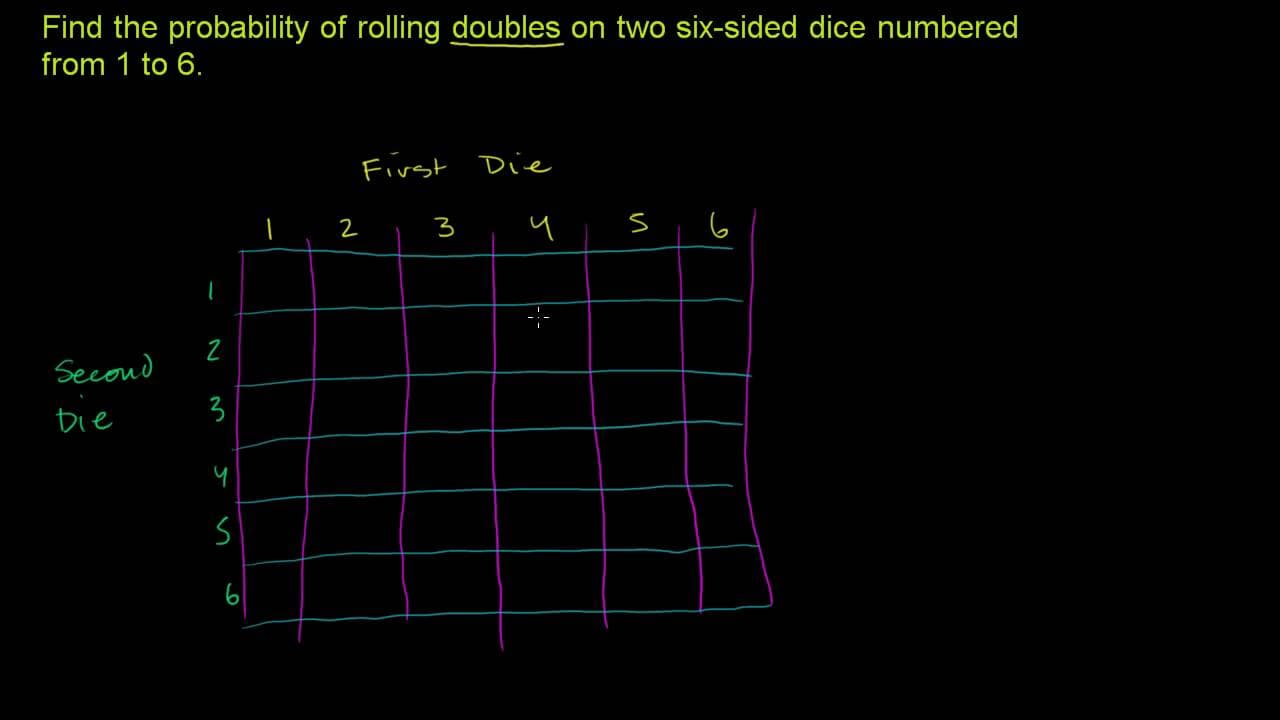
Find the probability of rolling doubles on two six-sided dice, numbered from 1 to 6. So let's just think about it. Let's think about all of the outcomes, all of the possible outcomes, and then what fraction of those outcomes represent us getting doubles. We want to roll doubles. So let's make a little table here that'll give us all of our outcomes.... Read More
Key Insights
- 🤣 There are 36 possible outcomes when rolling two six-sided dice.
- 🤣 Out of these outcomes, 6 satisfy the condition of rolling doubles.
- 🤣 The probability of rolling doubles is 1/6.
- 🎲 The first die can be any number, while the second die must match the number on the first die.
- #️⃣ The probability can be calculated by dividing the number of outcomes with doubles (6) by the total number of outcomes (36).
- 🤣 Rolling doubles is equally likely for any combination of numbers on the dice.
- 🤣 The probability of rolling doubles remains the same regardless of the number on the first die.
Install to Summarize YouTube Videos and Get Transcripts
Explore YouTube Video Summarizer or Get YouTube Transcript Extractor
Questions & Answers
Q: How many possible outcomes are there when rolling two six-sided dice?
There are 36 possible outcomes when rolling two six-sided dice, as there are 6 outcomes for the first die and 6 outcomes for the second die.
Q: How many outcomes involve rolling doubles?
There are 6 outcomes that involve rolling doubles, where the number on the first die is the same as the number on the second die.
Q: What is the probability of rolling doubles?
The probability of rolling doubles when rolling two six-sided dice is 1/6. This is determined by dividing the number of outcomes that give us doubles (6) by the total number of possible outcomes (36).
Q: Can the probability of rolling doubles be calculated differently?
Yes, another way to calculate the probability is by considering that the first die can be any number, but the second die must match the number on the first die. Since there are 6 possible numbers on each die, the probability of the second die matching the first die is 1/6.
Summary & Key Takeaways
-
There are 36 possible outcomes when rolling two six-sided dice.
-
Out of these outcomes, 6 of them satisfy the condition of rolling doubles.
-
Therefore, the probability of rolling doubles is 1/6.
Read in Other Languages (beta)
Share This Summary 📚
Summarize YouTube Videos and Get Video Transcripts with 1-Click
Try YouTube Summary with ChatGPT & Claude or YouTube Transcript Generator
Explore More Summaries from Khan Academy 📚



Summarize YouTube Videos and Get Video Transcripts with 1-Click
Try YouTube Summary with ChatGPT & Claude or YouTube Transcript Generator