Otto Cycle of Internal Combustion Engines, Gamma vs Compression Ratio, Adiabatic Processes - Physics
TL;DR
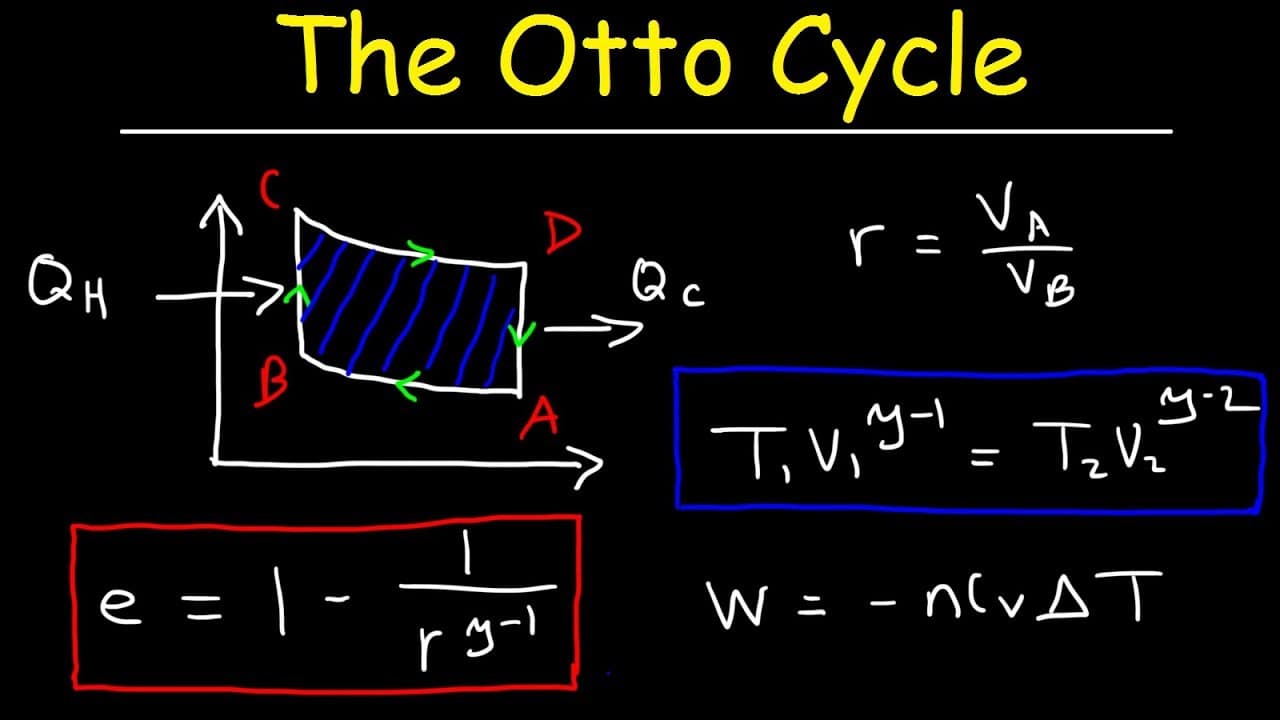
This video provides a detailed explanation of the auto cycle of an internal combustion engine, including solving basic problems and discussing the PV diagram.
Transcript
in this video we're going to focus on the auto cycle of an internal combustion engine first we're going to work on solving some basic problems and then we're going to discuss the pv diagram of an auto cycle so in this example we have an auto cycle of an internal combustion engine and it has a compression ratio of 8 represented by the symbol r and a... Read More
Key Insights
- 🥳 The efficiency of an internal combustion engine can be calculated using the compression ratio and gamma ratio.
- 🥳 The compression ratio determines the ratio between the initial and final volume in the auto cycle.
- 🥵 The gamma ratio represents the ratio between the molar heat capacity at constant pressure and the molar heat capacity at constant volume.
- 🚗 The PV diagram of the auto cycle consists of adiabatic compression, isochoric processes, and adiabatic expansion.
- 🥵 Heat energy is added during the isochoric process and leaves the system during the last step of the cycle.
- 💦 The work done in one cycle can be calculated by finding the area enclosed by the PV diagram.
Install to Summarize YouTube Videos and Get Transcripts
Explore YouTube Video Summarizer or Get YouTube Transcript Extractor
Questions & Answers
Q: How is the efficiency of an internal combustion engine calculated?
The efficiency is calculated using the formula 1 - (1/r)^(gamma-1), where r is the compression ratio and gamma is the gamma ratio. In this example, the efficiency is calculated to be 56%.
Q: How do you calculate the compression ratio of an engine using the given efficiency?
To calculate the compression ratio, you can use the formula 1/(1 - efficiency)^(1/(gamma-1)). For example, if the efficiency is 45%, the compression ratio would be approximately 4.5.
Q: How do you calculate the gamma ratio of the working substance based on the given compression ratio and efficiency?
The formula to calculate the gamma ratio is 1 - ln(1 - efficiency) / ln(compression ratio). For instance, if the compression ratio is 9.2 and efficiency is 52%, the gamma ratio would be approximately 1.33.
Q: How can the molar heat capacity at constant pressure be calculated using the gamma ratio and the molar heat capacity at constant volume?
The molar heat capacity at constant pressure (Cp) can be calculated by multiplying the gamma ratio with the molar heat capacity at constant volume (Cv). In this example, if Cv is 21.47, then Cp would be approximately 28.6.
Summary & Key Takeaways
-
The video discusses the auto cycle of an internal combustion engine, focusing on solving problems related to compression ratio and gamma ratio.
-
The efficiency of the engine is calculated using the formula 1 - (1/r)^(gamma-1), where r is the compression ratio and gamma is the gamma ratio.
-
The video also explains how to calculate the compression ratio and gamma ratio of an engine using the given efficiency.
Read in Other Languages (beta)
Share This Summary 📚
Summarize YouTube Videos and Get Video Transcripts with 1-Click
Try YouTube Summary with ChatGPT & Claude or YouTube Transcript Generator
Explore More Summaries from The Organic Chemistry Tutor 📚



Summarize YouTube Videos and Get Video Transcripts with 1-Click
Try YouTube Summary with ChatGPT & Claude or YouTube Transcript Generator