Varnas and the Caste System | World History | Khan Academy
TL;DR
The caste system in Hinduism initially referred to social classes but eventually became a hereditary caste system that dictated one's social status and limited opportunities.
Transcript
- [Instructor] In any textbook overview of Hinduism you will quickly encounter the caste system, and the caste system is the notion that people are born into the roles that they have to play in society. Now the reason why I put this in quotes is because they're associated this notion from the various Hindu scripture of Varnas, but the best translat... Read More
Key Insights
- 🏛️ The caste system in Hinduism originated from the concept of Varnas, which referred to social classes but eventually became entrenched as a hereditary caste system.
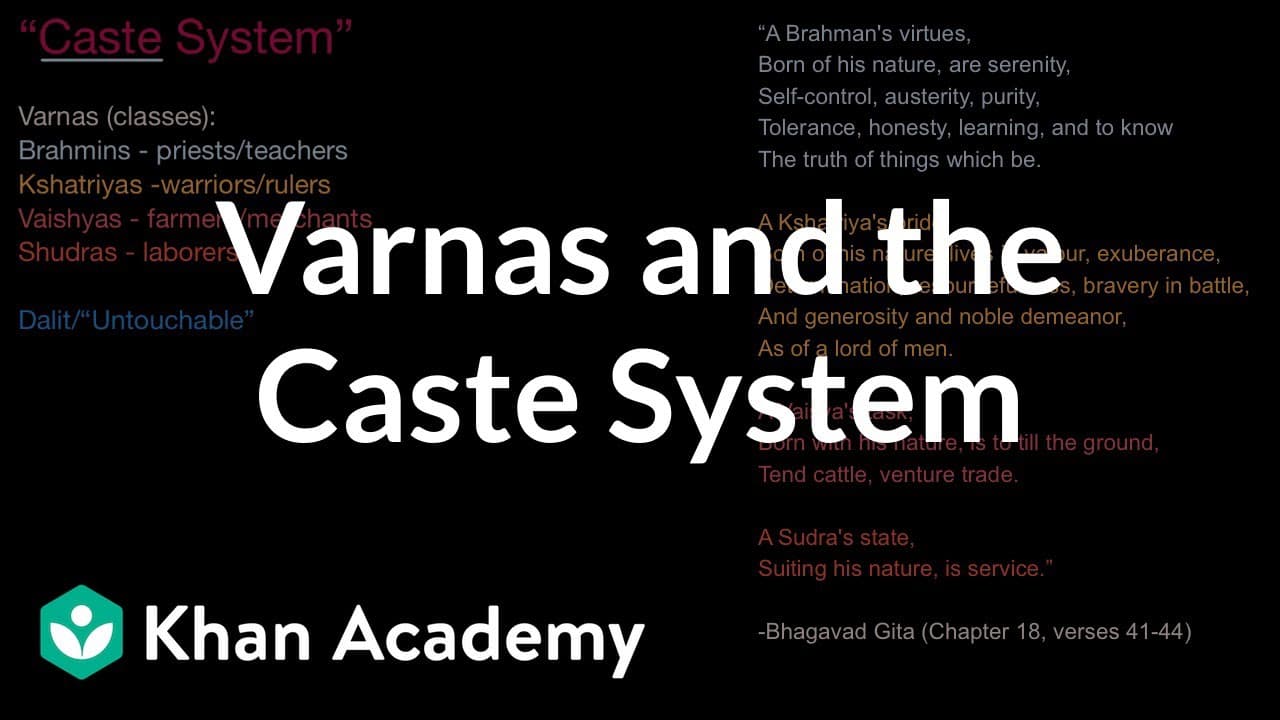
- ❓ The four Varnas mentioned in Hindu scripture are Brahmins (priests), Kshatriyas (warriors), Vaishyas (merchants), and Shudras (laborers).
- 😣 Dalits, or untouchables, faced severe discrimination and exclusion from traditional Hindu society.
- 🫵 The interpretation of the caste system varies among modern Hindus, with some viewing it as a part of the past and others still adhering to its principles.
Install to Summarize YouTube Videos and Get Transcripts
Explore YouTube Video Summarizer or Get YouTube Transcript Extractor
Questions & Answers
Q: Was the caste system in Hinduism originally intended to be just social classes or hereditary classes?
It is unclear whether the Varnas were intended to represent social classes or hereditary classes. The scripture references suggest the existence of different classes in society, but the notion of being "born of his nature" implies an innate tendency towards a specific caste.
Q: How does the Bhagavad Gita describe the different castes?
The Bhagavad Gita describes the virtues and tasks associated with each caste. Brahmins are characterized by serenity and knowledge, Kshatriyas by valor and leadership, Vaishyas by trade and agriculture, and Sudras by service to others.
Q: Did the caste system become hereditary over time?
Yes, over the last few hundred years, the caste system in India became hereditary. Children inherited the caste of their parents, and intermarriage between different castes was often discouraged.
Q: Is the caste system still relevant in modern India?
While many modern Hindus claim that they do not take the caste system seriously, discrimination and inequality based on caste still persist in rural areas and villages. Inter-marriage between different castes is often frowned upon, and Dalits continue to face systemic discrimination and exclusion.
Summary & Key Takeaways
-
The caste system in Hinduism is based on the idea that individuals are born into specific roles in society.
-
The four Varnas (classes) described in Hindu scripture are the Brahmins (priests and teachers), Kshatriyas (warriors and rulers), Vaishyas (farmers and merchants), and Shudras (laborers).
-
People outside of these four classes, referred to as Dalits or untouchables, faced discrimination and were excluded from temples and resources.
Read in Other Languages (beta)
Share This Summary 📚
Summarize YouTube Videos and Get Video Transcripts with 1-Click
Try YouTube Summary with ChatGPT & Claude or YouTube Transcript Generator
Explore More Summaries from Khan Academy 📚



Summarize YouTube Videos and Get Video Transcripts with 1-Click
Try YouTube Summary with ChatGPT & Claude or YouTube Transcript Generator