Graphing a shifted and stretched absolute value function
TL;DR
Learn how to graph a transformed absolute value function by shifting it left, stretching it vertically, and shifting it up.
Transcript
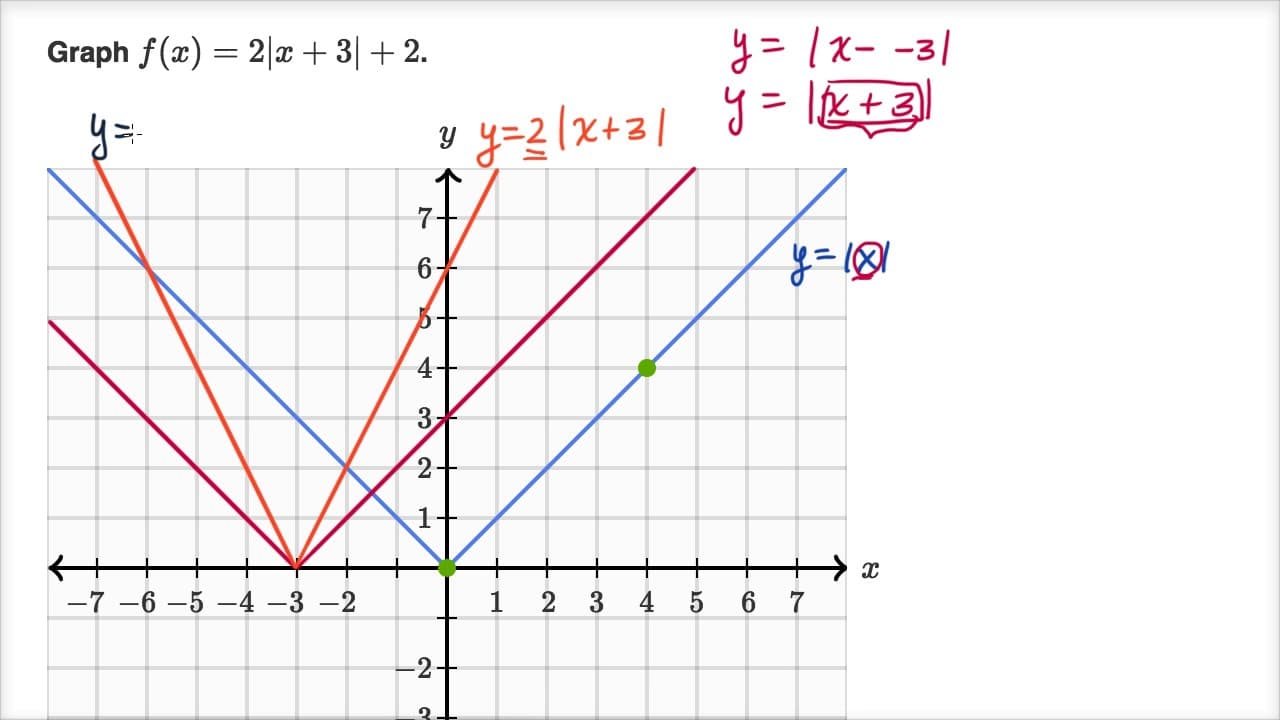
- [Instructor] So we're asked to graph f of x is equal to two times the absolute value of x plus three, plus two. And what they've already graphed for us, this right over here, this is the graph of y is equal to the absolute value of x. So let's do this through a series of transformations. So the next thing I wanna graph, let's see if we can graph ... Read More
Key Insights
- 👈 Replacing x with x + 3 shifts the graph of an absolute value function to the left by the amount being subtracted.
- 🫥 A negative value within the absolute value sign results in a downward-sloping line.
- 🧑🏭 Multiplying the absolute value function by a factor stretches it vertically, changing the slopes.
- 😀 Adding a constant to the y-values shifts the entire function vertically.
- 📈 Graphing a transformed absolute value function involves combining multiple transformations.
- 🪈 Different transformation order can be used to achieve the same final graph.
- 🍃 Shifting left, stretching vertically, and shifting up are common transformations in graphing absolute value functions.
Install to Summarize YouTube Videos and Get Transcripts
Explore YouTube Video Summarizer or Get YouTube Transcript Extractor
Questions & Answers
Q: How does replacing x with x + 3 shift the absolute value function?
Replacing x with x + 3 shifts the graph of an absolute value function three units to the left. The value being subtracted determines the amount of horizontal shift.
Q: What happens if the value inside the absolute value sign is negative?
If the value inside the absolute value sign is negative, the graph will have a slope of -1. This results in a downward-sloping line.
Q: How does multiplying by 2 affect the absolute value function graph?
Multiplying an absolute value function by 2 stretches the graph vertically, making it steeper. The slopes of the graph are multiplied by the same factor.
Q: What is the purpose of adding 2 to the y-values?
Adding 2 to the y-values of an absolute value function shifts the graph vertically two units up. This creates an upward translation.
Summary & Key Takeaways
-
The graph of y = |x| represents the absolute value of x.
-
To graph y = |x + 3|, shift the graph of y = |x| three units to the left.
-
When graphing y = 2|x + 3|, multiply the slopes by 2 and create a steeper graph.
-
Add 2 to the y-values of y = 2|x + 3| to shift the graph two units up and obtain the final function, f(x).
Read in Other Languages (beta)
Share This Summary 📚
Summarize YouTube Videos and Get Video Transcripts with 1-Click
Try YouTube Summary with ChatGPT & Claude or YouTube Transcript Generator
Explore More Summaries from Khan Academy 📚

Summarize YouTube Videos and Get Video Transcripts with 1-Click
Try YouTube Summary with ChatGPT & Claude or YouTube Transcript Generator