How to Calculate Amounts in Quantitative Electrolysis
TL;DR
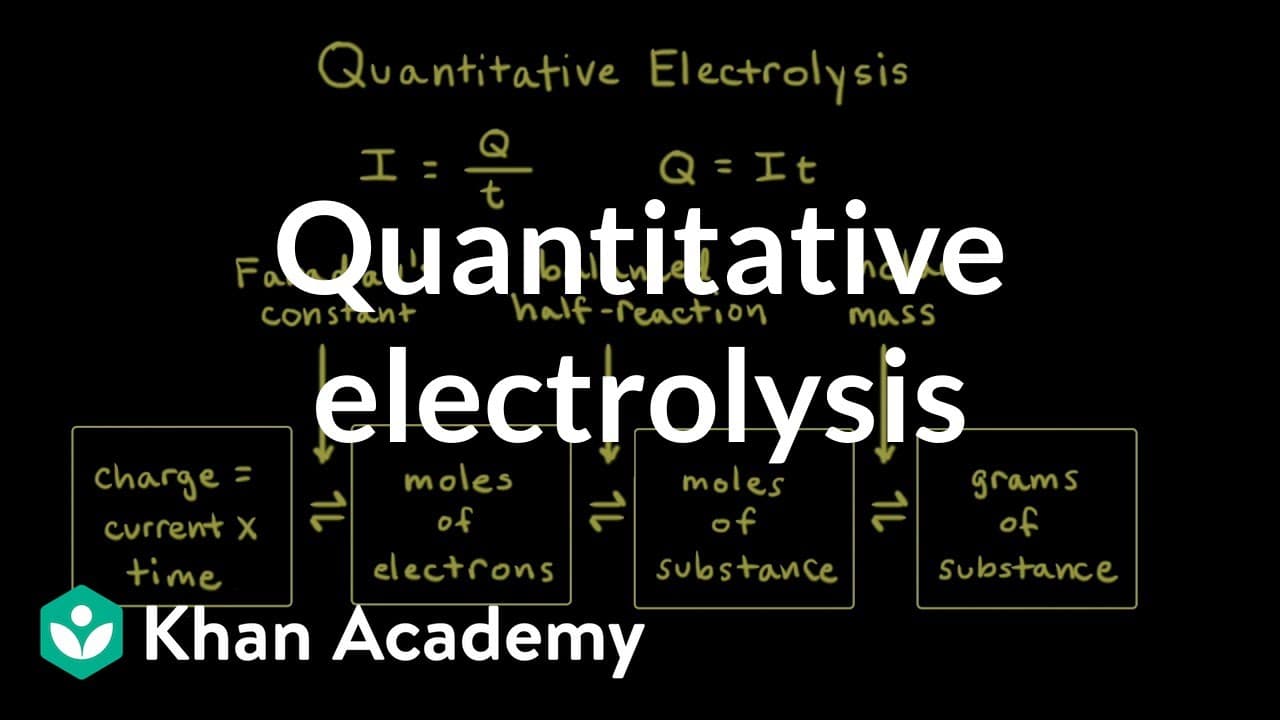
To determine the amount of substance produced in quantitative electrolysis, calculate charge using current and time, then convert to moles of electrons using Faraday's constant. Finally, apply stoichiometry to find the mass of the substance formed.
Transcript
- [Instructor] We already know that in an electrolytic cell, current or movement of electrons is used to drive a redox reaction. And if we look at a generic reduction half-reaction, the stoichiometry of the half reaction shows how many electrons are needed to reduce a generic metal ion. For example, if we say that our generic metal ion is M2+, it t... Read More
Key Insights
- 🪛 Electrons are used to drive redox reactions in electrolytic cells.
- 💁 Stoichiometry of half-reactions provides information on the number of electrons required to reduce metal ions.
- 🧭 Faraday's constant relates moles of electrons to the charge passed through the cell.
- 💹 A conversion chart or dimensional analysis can be used to solve quantitative electrolysis problems.
Install to Summarize YouTube Videos and Get Transcripts
Explore YouTube Video Summarizer or Get YouTube Transcript Extractor
Questions & Answers
Q: How is charge related to current and time in an electrolytic cell?
Charge is equal to the current multiplied by the time. This relationship is given by the equation Q = I * t, where Q is the charge, I is the current, and t is the time.
Q: What is Faraday's constant and how is it used in quantitative electrolysis calculations?
Faraday's constant (F) is equal to 96,485 coulombs per mole of electrons. It is used to convert moles of electrons to charge and vice versa. The charge can then be related to the substance of interest using stoichiometry.
Q: How does the molar mass of a substance help in quantitative electrolysis calculations?
The molar mass allows for the conversion between moles of a substance and grams of the substance. By multiplying the moles of the substance by its molar mass, the grams of the substance can be determined.
Q: Can quantitative electrolysis problems be solved using dimensional analysis?
Yes, dimensional analysis can be used to solve quantitative electrolysis problems. The given values (current and time) can be multiplied together, and then various conversion factors can be applied to get the final answer in the desired units.
Summary & Key Takeaways
-
In electrolytic cells, current is used to drive a redox reaction by transferring electrons. Stoichiometry of the half reactions shows the number of electrons required to reduce a metal ion.
-
Faraday's constant (96,485 coulombs per mole of electrons) relates moles of electrons to the amount of charge that passes through the cell.
-
A conversion chart can be used to solve quantitative electrolysis problems by converting charge to moles of electrons, moles of electrons to moles of substance, and moles of substance to grams.
Read in Other Languages (beta)
Share This Summary 📚
Summarize YouTube Videos and Get Video Transcripts with 1-Click
Try YouTube Summary with ChatGPT & Claude or YouTube Transcript Generator
Explore More Summaries from Khan Academy 📚



Summarize YouTube Videos and Get Video Transcripts with 1-Click
Try YouTube Summary with ChatGPT & Claude or YouTube Transcript Generator