Funky Music from Functional Programming - Computerphile
TL;DR
Functional programming, specifically reactive functional programming, is a suitable approach for creating interactive applications, games, and musical applications.
Transcript
I work in the functional programming lab Here in the School of Computer Science We're interested in finding programming languages and techniques For making it easy to write pretty programs And we believe functional programming is the way to achieve that Functions are quite simple in the way you specify them Because it is easy to put big systems t... Read More
Key Insights
- 🛩️ Functional programming is suitable for creating complex systems using small, manageable functions.
- 👾 Reactive functional programming is specifically tailored for interactive applications, games, and music.
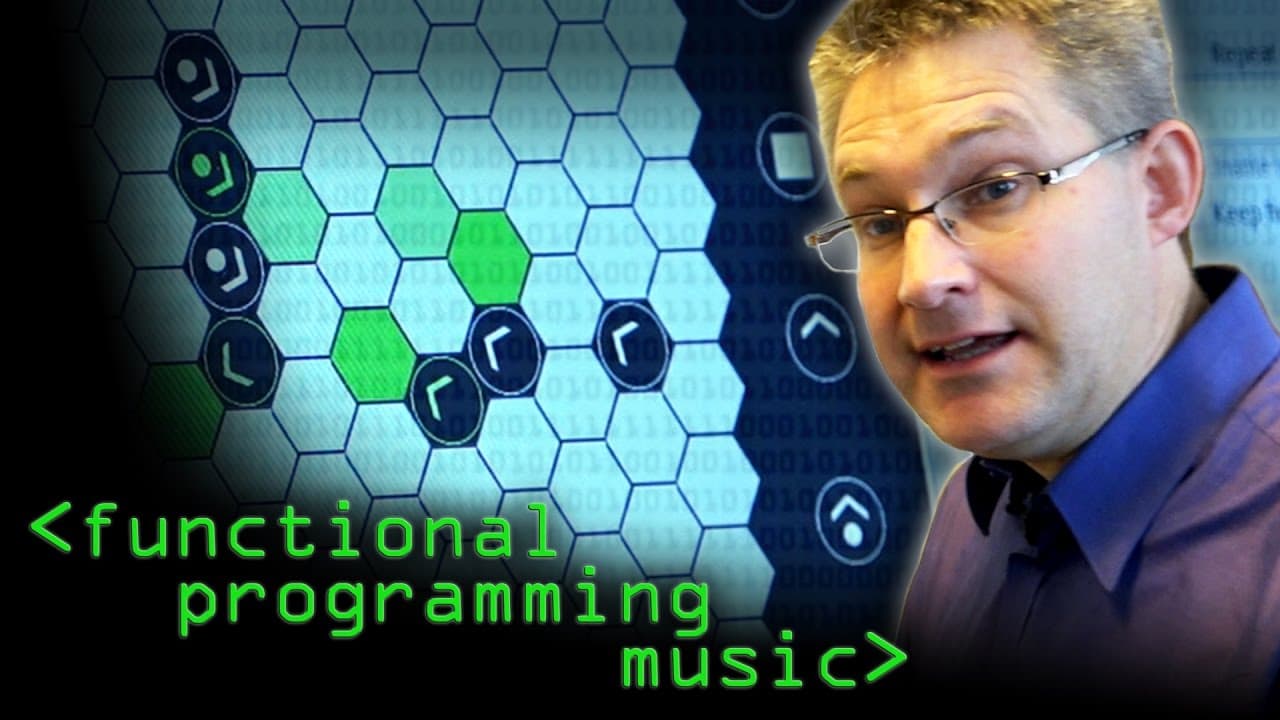
- 👻 The arpeggigon application implements reactive functional programming and allows for the creation of musical patterns using the harmonic table.
- 🎼 The layout of the arpeggigon can be dynamically modified to create different musical patterns.
- 🍉 Functional reactive programming (FRP) is not just one system but an umbrella term for related languages and implementations.
- 🈸 FRP has various applications, including games and banking applications, where communication and signal processing are crucial.
- 🕴️ Fully functional FRP systems are well-suited for complex distributed systems by handling side effects through pure functional programming.
Install to Summarize YouTube Videos and Get Transcripts
Explore YouTube Video Summarizer or Get YouTube Transcript Extractor
Questions & Answers
Q: How can functional programming be used to create interactive applications like games and music?
Functional programming allows for the creation of small, manageable functions that can be easily combined to create complex systems. Reactive functional programming, in particular, is designed for interactive applications and provides constructs for dealing with time aspects.
Q: What makes the arpeggigon application unique and how does it work?
The arpeggigon is patterned after the reactogon, a chain reactive performance arpeggiator. It uses the harmonic table, a hexagonal grid, to place musical nodes with specific intervals. Tokens placed on the grid can create musical patterns, and the layout can be dynamically modified.
Q: Is it possible to make non-musical sounds with the arpeggigon?
While the specific intervals and layout of the arpeggigon are designed to create musical patterns, the concept of what is considered "musical" is subjective. It may be possible to create cacophonous sounds with certain configurations.
Q: Is the arpeggigon software available for download?
Yes, the arpeggigon software is available for free online. It is currently being further developed to improve usability and polish.
Summary & Key Takeaways
-
Functional programming allows for the creation of large systems using small, reasonable functions that are easy to understand and put together.
-
Reactive functional programming, a variation of functional programming, is specifically tailored for interactive applications like games and music.
-
The arpeggigon, an application implemented using reactive functional programming, allows for the creation of musical patterns and even dynamic layout modifications.
Read in Other Languages (beta)
Share This Summary 📚
Summarize YouTube Videos and Get Video Transcripts with 1-Click
Try YouTube Summary with ChatGPT & Claude or YouTube Transcript Generator
Explore More Summaries from Computerphile 📚


Summarize YouTube Videos and Get Video Transcripts with 1-Click
Try YouTube Summary with ChatGPT & Claude or YouTube Transcript Generator