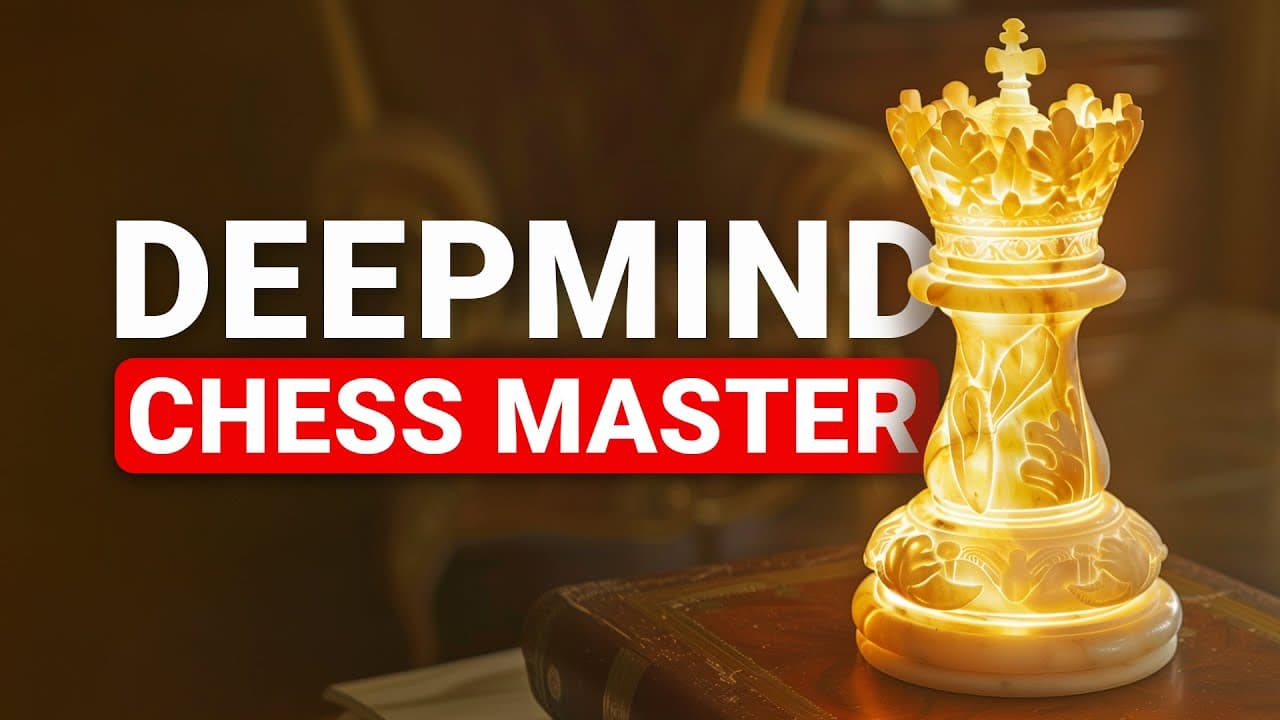
DeepMind’s New AI Saw 15,000,000,000 Chess Boards!
TL;DR
Google DeepMind has developed a Chess AI that learned from a powerful Chess engine and can play at a grandmaster level without self-play or search techniques.
Transcript
Scientists at Google DeepMind have already created an AI-based system that plays Chess on the level of a grandmaster. Actually, these are so good, no human has a reasonable chance to beat them. So why write a new paper on it, especially one that does not perform as well? How does this make any sense? Well, to accomplish all this, earlier the... Read More
Key Insights
- 🖐️ Google DeepMind developed a Chess AI without self-play or search, showcasing the power of observing and learning from a master.
- 🏂 The AI learned from a powerful Chess engine by studying moves in billions of board states.
- 🛩️ Despite its small size, the AI outperforms much larger neural network models in Chess.
- 💪 The goal of the AI technique is not just to create a strong Chess engine but to demonstrate the potential for learning expertise and approximating algorithms.
- 💨 This breakthrough has implications beyond Chess, paving the way for AI techniques that can create useful algorithms in various fields.
- 💨 Scientists are already exploring ways to extract algorithms from neural networks, further pushing the boundaries of AI understanding.
- 🥶 The achievement showcases the progress made since an older paper on the Neural Programmer Interpreter, hinting at a future where AI can generate readable programs and algorithms.
Install to Summarize YouTube Videos and Get Transcripts
Explore YouTube Video Summarizer or Get YouTube Transcript Extractor
Questions & Answers
Q: How did Google DeepMind's AI learn to play Chess at a grandmaster level without self-play or search?
Instead of self-play, the AI studied moves made by the powerful Chess engine Stockfish in 15 billion board states. It learned to make high-probability winning moves in a single move ahead.
Q: What is the significance of this achievement?
The goal of this AI technique was not solely to create a strong Chess engine but to demonstrate that a transformer-type neural network can learn expertise by observing a master at work. It learned to approximate algorithms, which has implications beyond Chess.
Q: How does the performance of the AI compare to larger neural network models?
Despite having only 270 million parameters (much smaller than models like GPT-4), the AI performs exceptionally well. It can make 20 moves per second on a graphics card costing $200, outperforming models 3,000 times bigger.
Q: How can this AI technique be applied to other fields?
This technique of learning expertise through observation can have applications in creating algorithms for self-driving cars, ray tracing, and other areas requiring complex decision-making.
Summary & Key Takeaways
-
Google DeepMind created a grandmaster-level AI in Chess without using self-play or search methods.
-
The AI learned from a strong Chess engine by studying moves in 15 billion board states.
-
The AI can play at the level of a human grandmaster, performing better than much larger neural network models.
Read in Other Languages (beta)
Share This Summary 📚
Summarize YouTube Videos and Get Video Transcripts with 1-Click
Try YouTube Summary with ChatGPT & Claude or YouTube Transcript Generator
Explore More Summaries from Two Minute Papers 📚




Summarize YouTube Videos and Get Video Transcripts with 1-Click
Try YouTube Summary with ChatGPT & Claude or YouTube Transcript Generator