How Does a Trompe Compress Air Without Moving Parts?
TL;DR
A trompe compresses air by using falling water to create a vacuum effect that draws in air, allowing for natural air compression without mechanical components. This method results in cooler, drier compressed air, which helps reduce tool corrosion, making it valuable for off-grid applications like aquaponics and mining.
Transcript
This is the Ragged Chute hydropower plant on the Montreal River in eastern Ontario, Canada. It doesn’t look like much from an aerial photo, but that’s because the most interesting parts of this facility are underground: two massive vertical shafts and large tunnel connecting the two. Before it was converted to generate electricity, Ragged Chute was... Read More
Key Insights
- The Ragged Chute hydropower plant in Ontario was originally a water-powered compressed air plant, crucial for silver mines in the early 20th century.
- Trompes harness water flow to compress air without moving parts, ideal for locations lacking electricity and complex machinery.
- Compressed air is a versatile energy source, especially in mining, due to its safety and reliability compared to electricity or diesel.
- Traditional air compressors require a separate power source, unlike trompes that utilize natural hydraulic energy.
- Trompes compress air isothermally, resulting in cooler and drier air, which is advantageous for preventing tool corrosion.
- Modern uses of trompes include off-grid systems for aeration in aquaponics and hydroponics, thanks to their simplicity and efficiency.
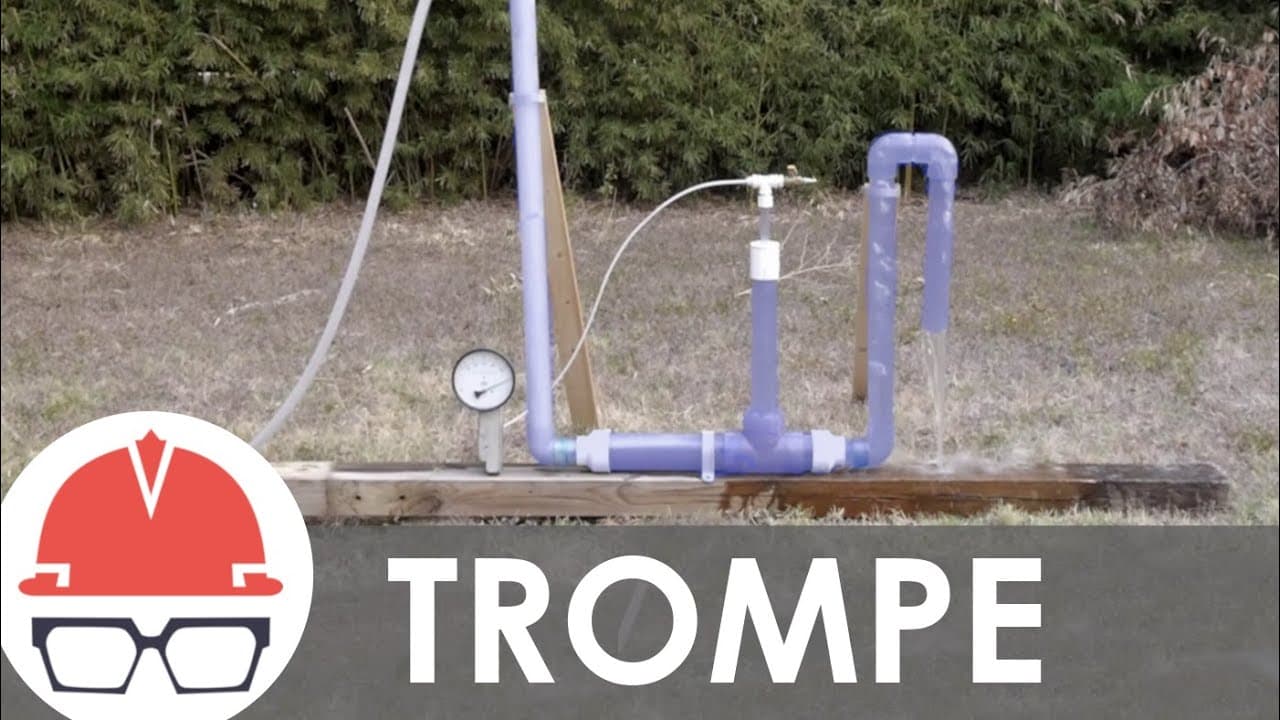
- The video demonstrates a scaled-down trompe model, illustrating the principle of air compression through water flow.
- The resurgence of trompes highlights a growing interest in renewable energy solutions and ancient technologies adapted for current needs.
Install to Summarize YouTube Videos and Get Transcripts
Explore YouTube Video Summarizer or Get YouTube Transcript Extractor
Questions & Answers
Q: How does a trompe work to compress air?
A trompe compresses air by utilizing the flow of water through vertical shafts. As water descends, it creates a vacuum that draws in air, which is then carried down with the water. At a lower chamber, the air separates from the water, becomes trapped, and gets compressed as the water exits through another shaft.
Q: Why was the Ragged Chute plant significant in the early 20th century?
The Ragged Chute plant was significant because it was one of the few water-powered compressed air plants globally. It provided a critical energy source for silver mines in Cobalt, Ontario, enabling mining operations to run tools and equipment safely and reliably without the need for electricity or diesel power.
Q: What are the advantages of using compressed air over electricity in mines?
Compressed air is advantageous in mines because it is safer, as it eliminates risks of sparks and explosions associated with electricity. It is also reliable and easy to transport, making it suitable for various mining activities, including exploration, blasting, and ventilation, where consistent power is essential.
Q: How does the temperature of compressed air in a trompe compare to traditional compressors?
In a trompe, the compressed air remains cooler because the heat generated during compression is absorbed by the water. This is in contrast to traditional compressors where air heats up during compression. Cooler air is beneficial as it holds less moisture, reducing the risk of corrosion in tools and equipment.
Q: What modern applications are there for trompes?
Modern applications for trompes include their use in off-grid aquaponics and hydroponics systems, where they provide necessary aeration without electricity. Trompes are also being revisited for their potential in remote locations for water aeration and treatment, thanks to their simplicity and reliance on natural water sources.
Q: Why are trompes considered renewable energy solutions?
Trompes are considered renewable energy solutions because they utilize the natural flow of water to generate compressed air, without the need for fossil fuels or electricity. This makes them environmentally friendly and sustainable, aligning with the growing focus on renewable energy and reducing carbon footprints.
Q: What inspired the video on trompes?
The video on trompes was inspired by the late Bruce Leavitt, a mining engineer who pioneered the use of small trompes for aeration and treatment of mining water in remote areas. His innovative applications demonstrated the potential of this ancient technology in modern contexts, sparking interest in its broader use.
Q: How does the video demonstrate the workings of a trompe?
The video demonstrates the workings of a trompe through a scaled-down model made of clear pipes, allowing viewers to see the process of air compression. It shows how water flow creates a vacuum to draw in air, which is then compressed as it separates from the water in a lower chamber, illustrating the principle effectively.
Summary & Key Takeaways
-
Trompes are ingenious devices that use water flow to compress air without moving parts, originally used in early 20th-century mining operations. They offer a simple and reliable energy source, especially in locations without electricity.
-
Modern applications of trompes include off-grid aquaponics and hydroponics systems, where they provide aeration using natural water sources. Their resurgence reflects the increasing interest in renewable and sustainable energy solutions.
-
The video demonstrates a small-scale trompe, showcasing its operation and benefits, such as cooler and drier compressed air, which is less prone to causing corrosion in tools and equipment.
Read in Other Languages (beta)
Share This Summary 📚
Summarize YouTube Videos and Get Video Transcripts with 1-Click
Try YouTube Summary with ChatGPT & Claude or YouTube Transcript Generator
Explore More Summaries from Practical Engineering 📚





Summarize YouTube Videos and Get Video Transcripts with 1-Click
Try YouTube Summary with ChatGPT & Claude or YouTube Transcript Generator