Introduction to Combustion Analysis, Empirical Formula & Molecular Formula Problems
TL;DR
In this video, the process of finding the empirical and molecular formulas of compounds in combustion analysis problems is explained.
Transcript
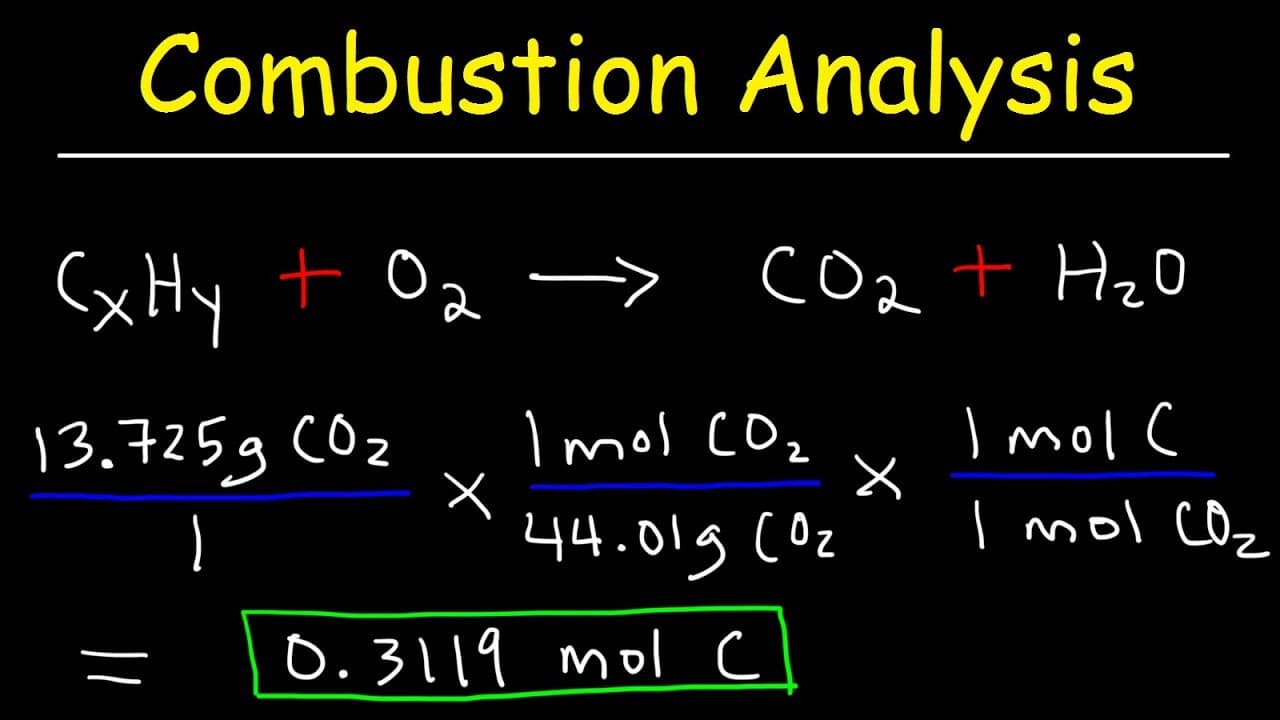
in this video we're going to focus on finding the empirical formula of a compound in a typical combustion analysis problem so let's begin let's read the problem a compound consists only of carbon and hydrogen 13.725 grams of co2 and 6.742 grams of water are formed during complete combustion of the compound what is the empirical formula of the unkno... Read More
Key Insights
- ❓ Combustion analysis is a useful method to determine the empirical and molecular formulas of compounds.
- 💁 The mass of carbon dioxide and water formed during combustion provides information about the moles of carbon and hydrogen in the compound.
- 🧑🏭 Decimal subscripts in the empirical formula can be converted to whole numbers by multiplying them by the appropriate factor.
- 🫀 The molar mass of the empirical formula can be determined by calculating the sum of the atomic masses of each element.
Install to Summarize YouTube Videos and Get Transcripts
Explore YouTube Video Summarizer or Get YouTube Transcript Extractor
Questions & Answers
Q: What is the purpose of combustion analysis in determining the empirical formula of a compound?
Combustion analysis allows us to determine the moles of carbon and hydrogen in a compound based on the mass of carbon dioxide and water formed during combustion reactions.
Q: How can we convert decimal subscripts to whole numbers in the empirical formula?
To convert decimal subscripts to whole numbers, we multiply them by the right factor. For example, if the subscript is 0.5, we multiply by 2; if it is 0.333, we multiply by 3.
Q: What is the difference between the empirical formula and the molecular formula?
The empirical formula represents the simplest ratio of elements in a compound, while the molecular formula represents the actual number of atoms of each element in a compound.
Q: How do we calculate the molar mass of the empirical formula?
The molar mass of the empirical formula is calculated by multiplying the atomic masses of each element by their respective subscripts and summing them up.
Q: What is the process of finding the molecular formula from the empirical formula?
To find the molecular formula, divide the molar mass of the compound by the molar mass of the empirical formula, and then multiply the subscripts of the empirical formula by the resulting factor.
Summary & Key Takeaways
-
The video explains the process of finding the empirical formula of a compound in combustion analysis problems by determining the moles of carbon and hydrogen based on the mass of carbon dioxide and water formed during combustion.
-
The video also discusses how to convert decimal subscripts to whole numbers by multiplying them by the appropriate factor.
-
A second problem is presented, where the mass of carbon dioxide, water, and the compound is provided, and the process of finding the empirical formula and molecular formula is demonstrated.
-
The video concludes by explaining how to find the molecular formula by comparing the molar mass of the empirical formula to the molar mass of the compound.
Read in Other Languages (beta)
Share This Summary 📚
Summarize YouTube Videos and Get Video Transcripts with 1-Click
Try YouTube Summary with ChatGPT & Claude or YouTube Transcript Generator
Explore More Summaries from The Organic Chemistry Tutor 📚




Summarize YouTube Videos and Get Video Transcripts with 1-Click
Try YouTube Summary with ChatGPT & Claude or YouTube Transcript Generator