Constructing a unit normal vector to a surface | Multivariable Calculus | Khan Academy
TL;DR
Learn how to construct a unit normal vector for a surface integral using the cross product of partial derivatives.
Transcript
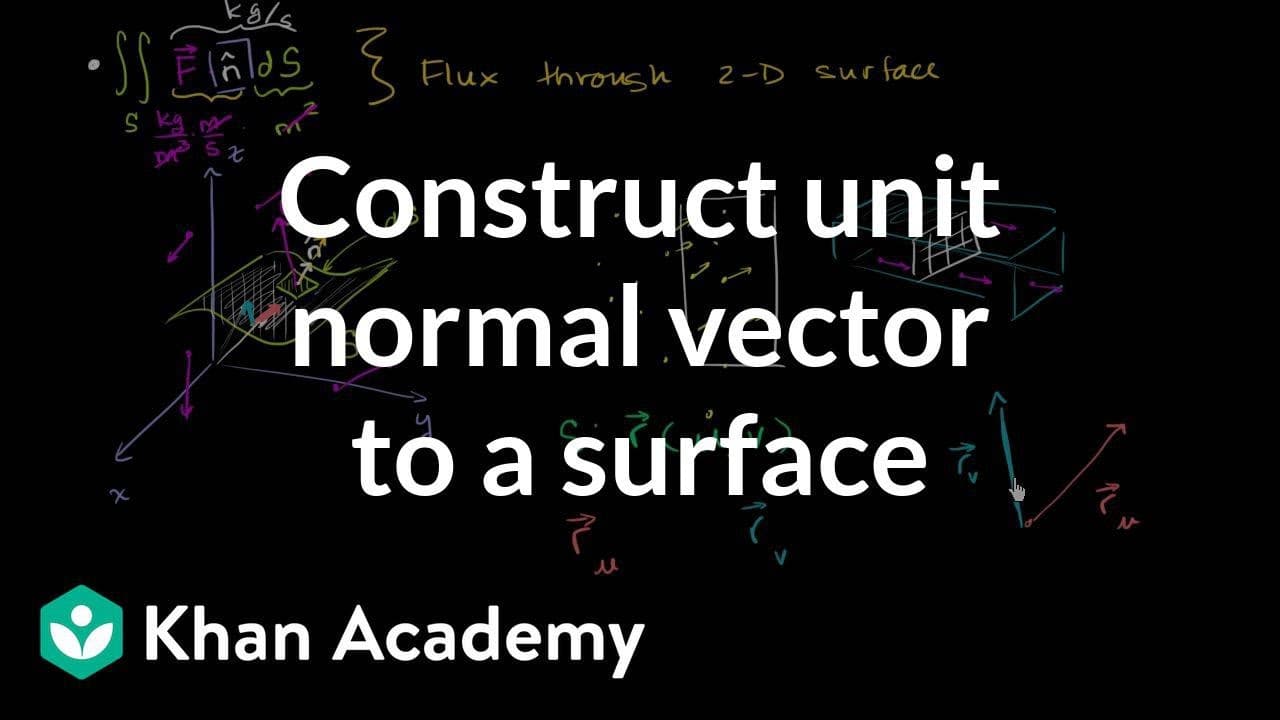
Now that we hopefully have a conceptual understanding... ...of what a surface integral like this COULD represent, ...I want to think about how we can actually construct... ...a unit vector... ...a unit normal vector, at any point on the surface. And to do that, I will assume... ...that our surface can be parametrized... ...by the position vector fu... Read More
Key Insights
- 😥 A surface can be parametrized using the position vector function, making it possible to specify points on the surface.
- 😍 Tangent vectors, r_u and r_v, are tangent to the surface and give us information about the surface's slope in the u and v directions.
- 😵 Taking the cross product of r_u and r_v gives us a normal vector that is perpendicular to the tangent plane and the surface itself.
- 🇦🇪 Normalizing the normal vector gives us the unit normal vector, which is often used in surface integrals.
Install to Summarize YouTube Videos and Get Transcripts
Explore YouTube Video Summarizer or Get YouTube Transcript Extractor
Questions & Answers
Q: How do you parametrize a surface using the position vector function?
To parametrize a surface, we use the position vector function, r, which is a function of two parameters, u and v. Choosing specific values for u and v allows us to specify a point on the surface.
Q: What do the partial derivatives of r with respect to u and v represent?
The partial derivative of r with respect to u, denoted as r_u, represents the direction and magnitude of how r changes as u increases. Similarly, r_v represents the direction and magnitude of how r changes as v increases.
Q: What is the significance of the cross product of r_u and r_v?
The cross product of r_u and r_v gives us a vector that is perpendicular to both vectors, resulting in a vector that is normal to the surface. It represents the direction in which the surface is pointing.
Q: How do you find the unit normal vector from the normal vector?
To find the unit normal vector, we divide the normal vector by its magnitude. This normalizes the vector and gives us a vector of unit length, representing the direction of the surface.
Summary & Key Takeaways
-
A surface can be parametrized by the position vector function, r, which is a function of u and v.
-
The partial derivatives of r with respect to u and v give us the tangent vectors r_u and r_v, which are tangent to the surface at a given point.
-
Taking the cross product of r_u and r_v gives us a vector perpendicular to the tangent plane and a normal vector to the surface.
-
Normalizing this vector gives us the unit normal vector, which can be used in surface integrals.
Read in Other Languages (beta)
Share This Summary 📚
Summarize YouTube Videos and Get Video Transcripts with 1-Click
Try YouTube Summary with ChatGPT & Claude or YouTube Transcript Generator
Explore More Summaries from Khan Academy 📚



Summarize YouTube Videos and Get Video Transcripts with 1-Click
Try YouTube Summary with ChatGPT & Claude or YouTube Transcript Generator