Linear Queue using Link List Part 2 | Stack and Queue | Data Structure Using C
TL;DR
Learn how to implement a queue in C using linked lists with nodes containing data and pointers.
Transcript
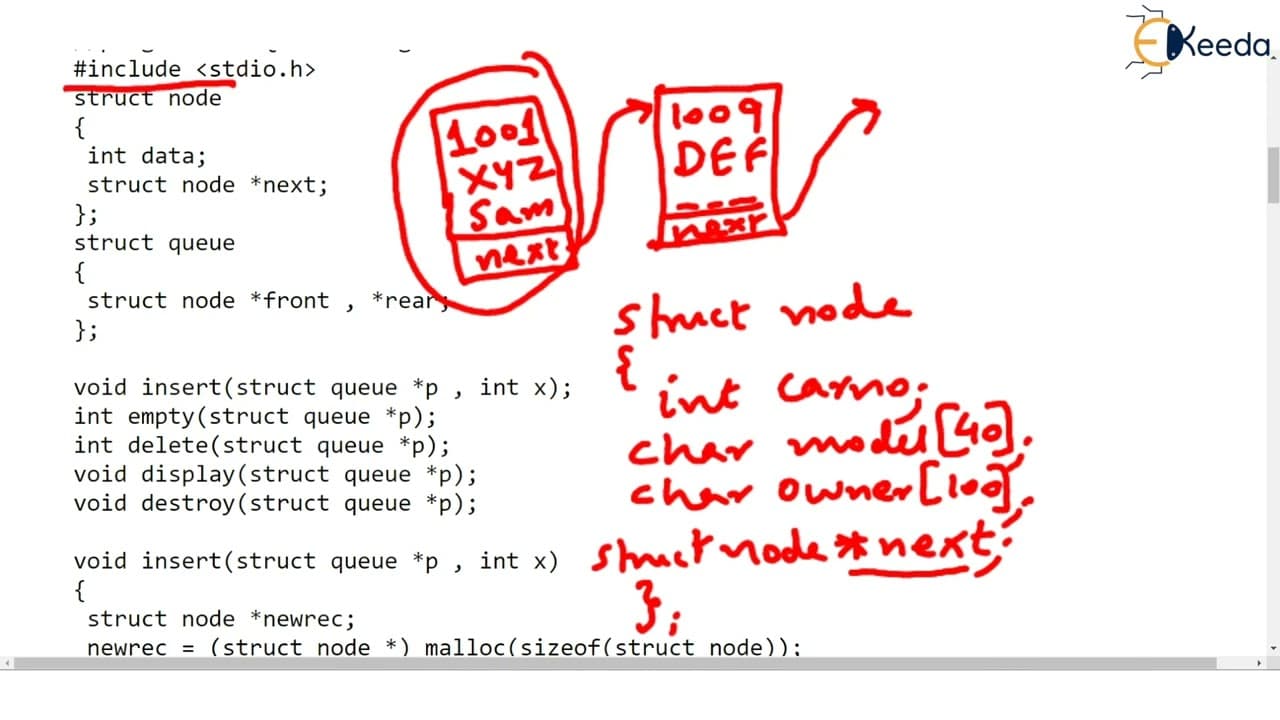
hello dear students from this video we will see implementation of queue in c language in the previous video we saw fundamentals of queue data structure and how exactly queue is constructed or seen in the form of singly linked list and why we require two pointers namely front and rear to maintain the queue from this video we will see implementation ... Read More
Key Insights
- 🎅 Queue implementation in C involves using a node structure with data and a pointer to the next node.
- 🏪 Nodes in a queue can store any type of data, making them versatile for different applications.
- 🪈 Front and rear pointers are essential for maintaining the order of elements in a queue.
- 🎅 Declaring a queue structure in C involves defining front and rear pointers of node type.
- ❓ Queues differ from stacks as they require two pointers to manage insertion and deletion operations efficiently.
- 👻 Implementation of a queue with linked lists allows for dynamic data storage and retrieval.
- 🫥 Each node in a queue represents an item waiting in line for processing or removal.
Install to Summarize YouTube Videos and Get Transcripts
Explore YouTube Video Summarizer or Get YouTube Transcript Extractor
Questions & Answers
Q: How do you declare a node structure for a queue in C?
In C language, you declare a node structure for a queue with data and a pointer to the next node, ensuring the next pointer is of node type. This structure will hold the data for each element in the queue.
Q: Why do queues require two pointers, front and rear?
Front and rear pointers are necessary for queues to maintain the order of elements. Front points to the first element, while rear points to the last, crucial for insertion and deletion operations.
Q: Can queues store different types of data, not just integers?
Yes, queues can store various data types, such as cars with details like car number, model, and owner. Each node can represent a different item in the queue, allowing flexibility in data storage.
Q: How does queue implementation differ from stack implementation?
In stack implementation, only one pointer is needed (top) since operations occur at one end. However, queues require front and rear pointers for insertion and deletion at different ends.
Summary & Key Takeaways
-
Explanation of how to build a queue with linked lists using a node structure.
-
Nodes contain data and a pointer to the next node.
-
Queues can store any type of data, like cars, with each node representing an item in the queue.
Read in Other Languages (beta)
Share This Summary 📚
Summarize YouTube Videos and Get Video Transcripts with 1-Click
Try YouTube Summary with ChatGPT & Claude or YouTube Transcript Generator
Explore More Summaries from Ekeeda 📚




Summarize YouTube Videos and Get Video Transcripts with 1-Click
Try YouTube Summary with ChatGPT & Claude or YouTube Transcript Generator