Buoyancy and Archimedes’ Principle: An Explanation
TL;DR
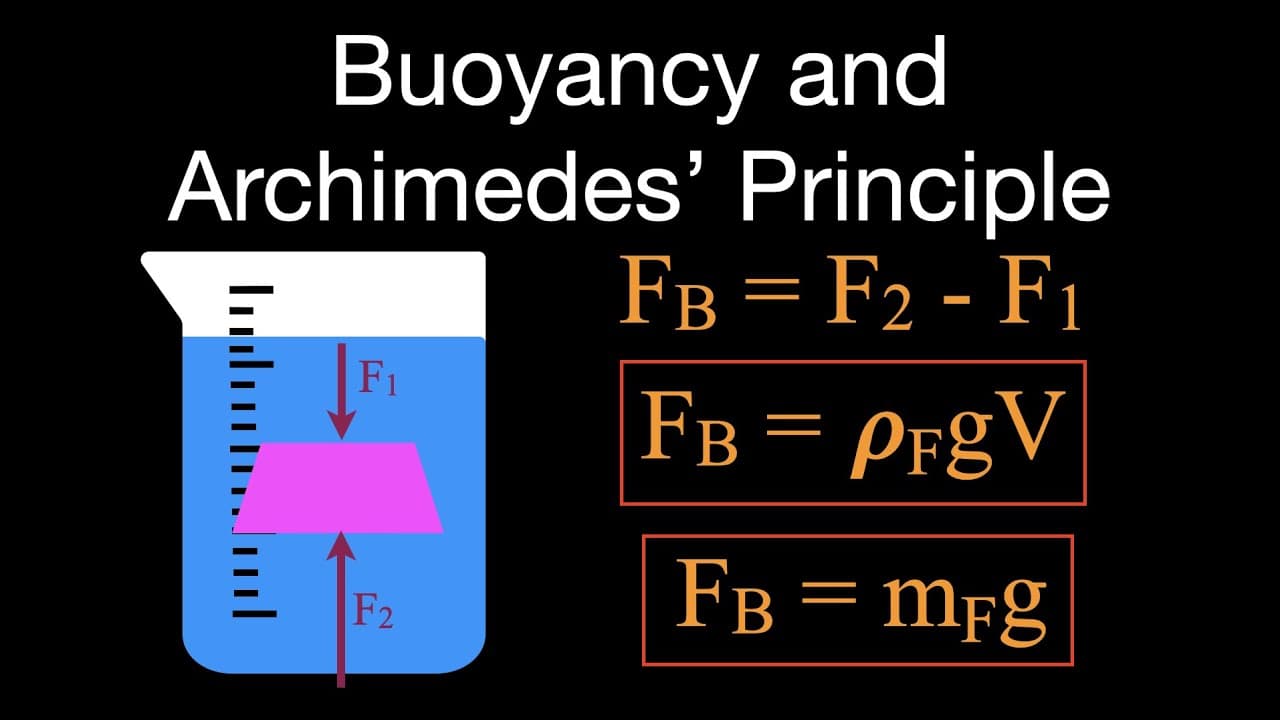
Buoyancy is an upward force in fluids opposing weight; Archimedes principle states buoyant force equals weight of displaced fluid.
Transcript
in today's video we're going to go over two very interesting topics that's buoyancy and Archimedes principle before you started please don't forget to subscribe to our Channel please support our Channel step-by-step science Please Subscribe click the notification Bell leave us a nice positive comment and don't forget to share this video and in addi... Read More
Key Insights
- ❓ Buoyancy is caused by the pressure difference at different depths in a fluid.
- 🏋️ Archimedes principle states that the buoyant force equals the weight of the fluid displaced.
- 🔇 The buoyant force can be calculated using the density of the fluid, gravitational acceleration, and volume of the object.
- 🏋️ Objects weigh less when submerged in fluid due to the opposing buoyant force.
- 🔇 The shape and volume of an object determine the magnitude of the buoyant force.
- 🧘 Buoyant force remains constant regardless of the object's position in the fluid.
- 🆘 Understanding buoyancy helps in explaining the behavior of objects submerged in fluids.
Install to Summarize YouTube Videos and Get Transcripts
Explore YouTube Video Summarizer or Get YouTube Transcript Extractor
Questions & Answers
Q: What is buoyancy and how does it relate to Archimedes principle?
Buoyancy is the upward force in fluids that opposes weight. Archimedes principle states that the buoyant force on an object is equal to the weight of the fluid it displaces.
Q: How can we calculate the buoyant force on an object submerged in a fluid?
The buoyant force can be calculated by multiplying the density of the fluid, gravitational acceleration, and volume of the object or fluid displaced.
Q: Why do objects weigh less when submerged in fluid?
Objects weigh less when submerged in fluid because the buoyant force opposes gravity, resulting in a net upward force that reduces the effective weight of the object.
Q: How does the shape of an object affect the buoyant force acting on it?
The shape of an object determines its volume, which in turn affects the buoyant force. Objects with larger volumes displace more fluid, experiencing greater buoyant forces.
Summary & Key Takeaways
-
Buoyancy is the upward force in fluids that opposes weight.
-
Archimedes principle states buoyant force equals weight of displaced fluid.
-
Understanding buoyancy helps in calculating forces in objects submerged in fluids.
Read in Other Languages (beta)
Share This Summary 📚
Summarize YouTube Videos and Get Video Transcripts with 1-Click
Try YouTube Summary with ChatGPT & Claude or YouTube Transcript Generator
Explore More Summaries from Step by Step Science 📚


Summarize YouTube Videos and Get Video Transcripts with 1-Click
Try YouTube Summary with ChatGPT & Claude or YouTube Transcript Generator