Introduction to graphing inequalities | Two-variable linear inequalities | Algebra I | Khan Academy
TL;DR
Learn how to graph linear inequalities by breaking them into equations and understanding their meaning.
Transcript
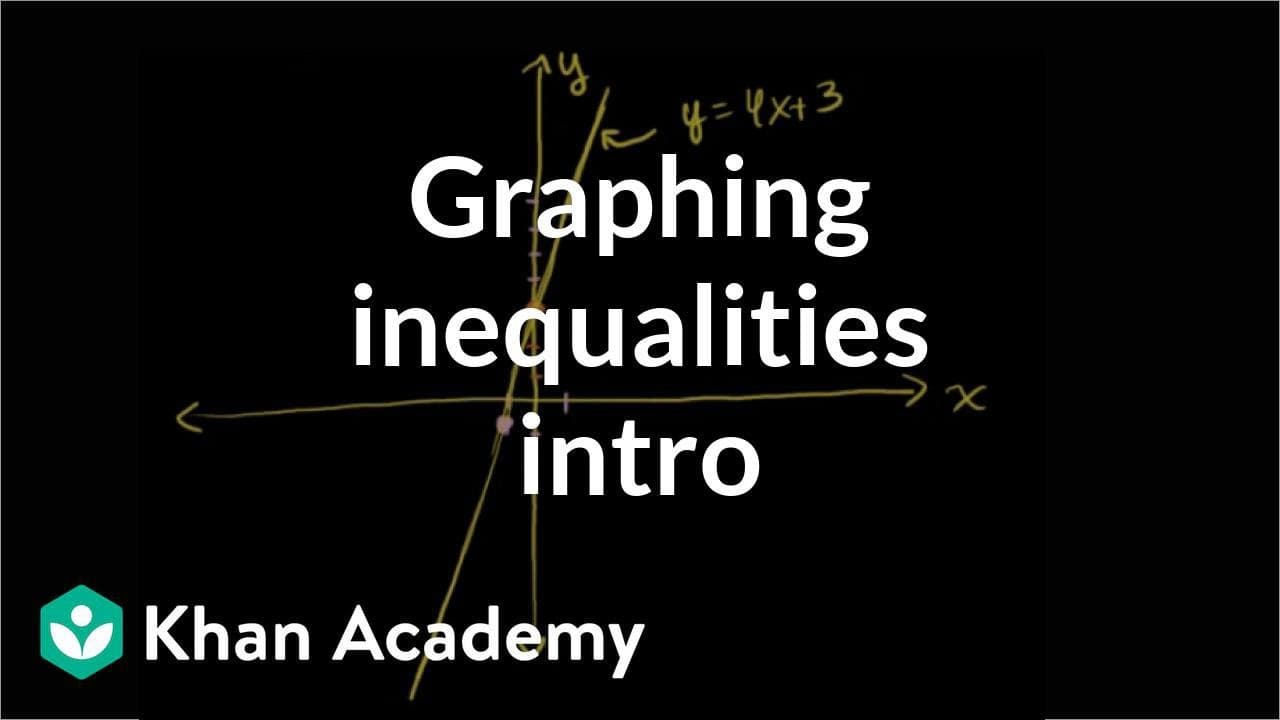
Let's graph ourselves some inequalities. So let's say I had the inequality y is less than or equal to 4x plus 3. On our xy coordinate plane, we want to show all the x and y points that satisfy this condition right here. So a good starting point might be to break up this less than or equal to, because we know how to graph y is equal to 4x plus 3. So... Read More
Key Insights
- 🍳 Graphing linear inequalities involves breaking them into equations.
- 🫥 The inequality condition determines whether to shade above or below the line on the coordinate plane.
- 🫥 The line in an inequality graph may or may not be included depending on whether the inequality is strict or inclusive.
- 😥 Graphs of linear inequalities represent regions of possible solutions rather than a specific point.
- 🫥 Linear inequalities can be represented as dashed lines to indicate that the line itself is not included in the solutions.
- 👻 The process of graphing linear inequalities allows for visualizing and analyzing multiple possible solutions.
- 🎮 The video provides step-by-step examples to demonstrate graphing linear inequalities.
Install to Summarize YouTube Videos and Get Transcripts
Explore YouTube Video Summarizer or Get YouTube Transcript Extractor
Questions & Answers
Q: How can we graph a linear inequality?
To graph a linear inequality, start by graphing the corresponding linear equation. Then, shade the region that satisfies the inequality condition (e.g., below the line for "less than" inequalities), excluding the actual line for strict inequalities.
Q: What does it mean when y ≤ 4x + 3?
The inequality y ≤ 4x + 3 represents all the points below or on the line y = 4x + 3 on a coordinate plane. It includes the line itself, as well as all points below it.
Q: How do we graph y > -x/2 - 6?
Firstly, graph y = -x/2 - 6 as a solid line. Then, shade the region above the line, excluding the line itself, to represent the "greater than" inequality.
Q: How can we differentiate between inequalities that include the line and those that don't?
Inequalities that include the line (e.g., "less than or equal to") are graphed with a solid line, while strict inequalities (e.g., "less than") are represented with a dashed line to indicate that the line itself does not satisfy the inequality.
Summary & Key Takeaways
-
The video explains how to graph linear inequalities on a coordinate plane using the example y ≤ 4x + 3.
-
By breaking the inequality into equations, the video shows how to graph y = 4x + 3, and then demonstrates how to shade the region that satisfies y < 4x + 3.
-
The process is further exemplified with another inequality, y > -x/2 - 6, showing how to graph y = -x/2 - 6 and shade the region above the line.
Read in Other Languages (beta)
Share This Summary 📚
Summarize YouTube Videos and Get Video Transcripts with 1-Click
Try YouTube Summary with ChatGPT & Claude or YouTube Transcript Generator
Explore More Summaries from Khan Academy 📚



Summarize YouTube Videos and Get Video Transcripts with 1-Click
Try YouTube Summary with ChatGPT & Claude or YouTube Transcript Generator