Graph from slope-intercept equation example | Algebra I | Khan Academy
TL;DR
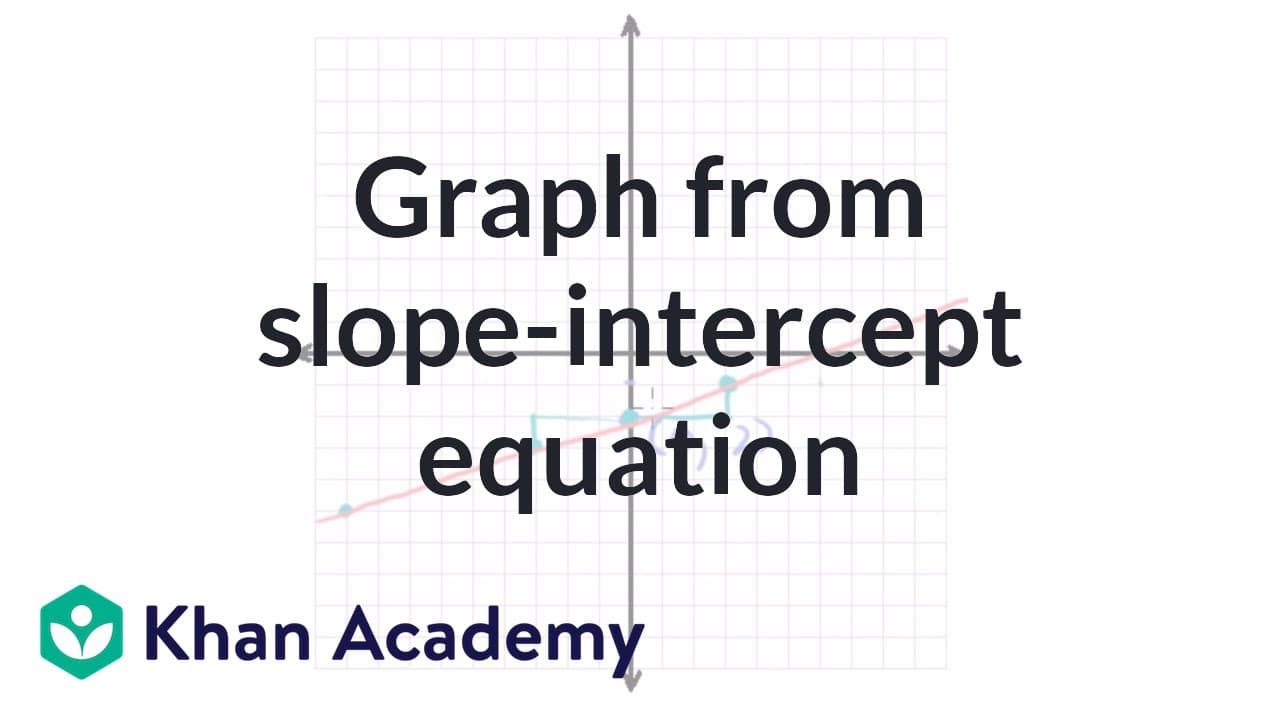
This video explains how to graph linear equations in slope-intercept form, which includes information on the slope, y-intercept, and how to find points on the line.
Transcript
We are asked to graph y is equal to 1/3x minus 2. Now, whenever you see an equation in this form, this is called slope-intercept form. And the general way of writing it is y is equal to mx plus b, where m is the slope. And here in this case, m is equal to 1/3-- so let me write that down-- m is equal to 1/3, and b is the y-intercept. So in this case... Read More
Key Insights
- 💁♂️ Linear equations in slope-intercept form can be easily graphed by identifying the y-intercept and using the slope to find other points.
- 😵 The y-intercept serves as the starting point where the line crosses the y-axis.
- 💱 The slope determines the steepness and direction of the line, and the ratio of the change in y to the change in x.
- ❣️ By evaluating the equation for x = 0, the y-intercept can be verified.
Install to Summarize YouTube Videos and Get Transcripts
Explore YouTube Video Summarizer or Get YouTube Transcript Extractor
Questions & Answers
Q: What is the slope-intercept form of a linear equation?
The slope-intercept form of a linear equation is y = mx + b, where m represents the slope and b represents the y-intercept. It is a common form used to graph linear equations.
Q: How do you determine the y-intercept of a line?
The y-intercept is the value of y when x is equal to 0. In this equation, the y-intercept is -2, which means the line intersects the y-axis at the point (0, -2).
Q: How does the slope affect the line?
The slope represents the change in y for every change in x. In this case, a slope of 1/3 means that for every increase of 3 units in x, y will increase by 1 unit. Similarly, for every decrease of 3 units in x, y will decrease by 1 unit.
Q: How do you graph a linear equation given in slope-intercept form?
To graph the equation y = (1/3)x - 2, start by marking the y-intercept at (0, -2). Then, use the slope to find additional points by moving up 1 and to the right 3 units, or down 1 and to the left 3 units. Connect these points to form the line.
Summary & Key Takeaways
-
The slope-intercept form of an equation is y = mx + b, where m is the slope and b is the y-intercept.
-
The y-intercept is the point where the line intersects the y-axis. In this case, the y-intercept is -2.
-
The slope indicates how much y changes for every change in x. In this equation, the slope is 1/3.
Read in Other Languages (beta)
Share This Summary 📚
Summarize YouTube Videos and Get Video Transcripts with 1-Click
Try YouTube Summary with ChatGPT & Claude or YouTube Transcript Generator
Explore More Summaries from Khan Academy 📚



Summarize YouTube Videos and Get Video Transcripts with 1-Click
Try YouTube Summary with ChatGPT & Claude or YouTube Transcript Generator