The Seventh Amendment | US government and civics | Khan Academy
TL;DR
The Seventh Amendment guarantees the right to juries in civil cases, but less than 1% of civil cases go to trial today.
Transcript
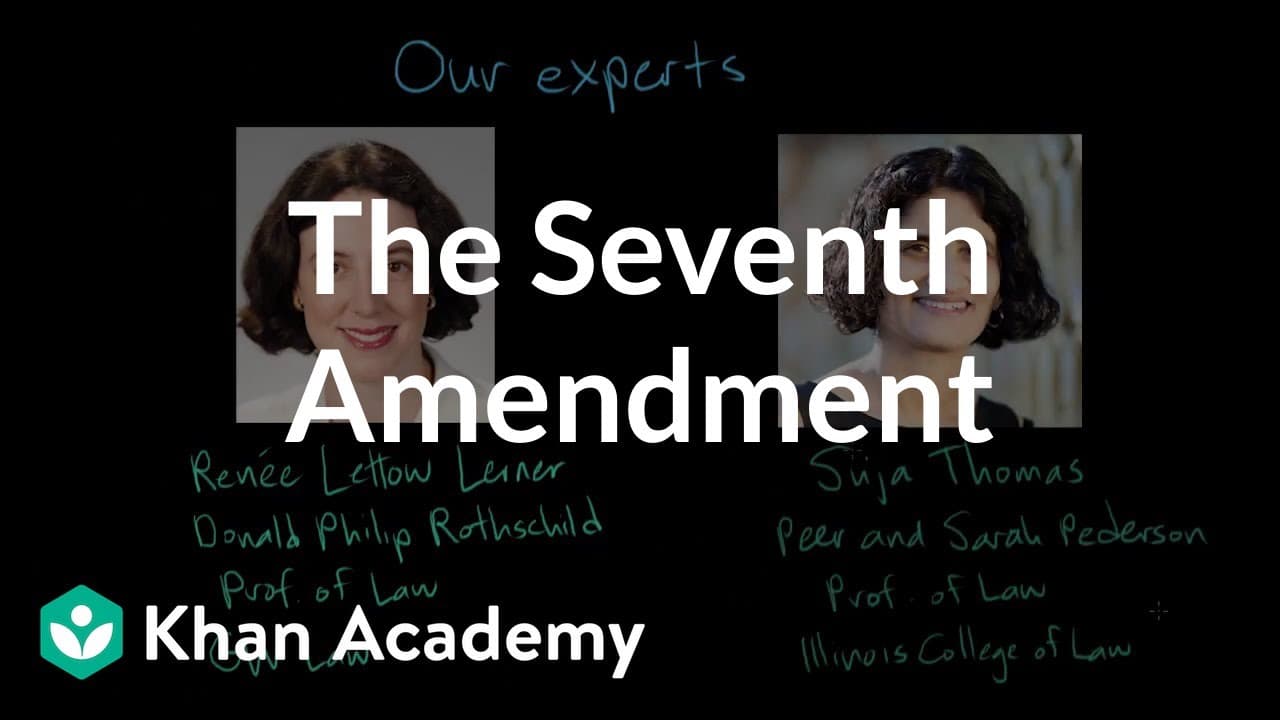
- [Kim] Hi, this is Kim from Khan Academy. Today we're learning more about the Seventh Amendment to the U.S. Constitution. The Seventh Amendment guarantees the right to juries in civil cases, when the value in controversy is greater than $20. To learn more about the Seventh Amendment, I talked with two experts. Renee Lerner is the Donald Philip Rot... Read More
Key Insights
- 😌 The Seventh Amendment's origins lie in the Revolutionary War, where juries served as a means for Americans to have popular representation in government.
- 🧑⚖️ The Framers valued juries for their ability to protect against bad laws, biased judges, and executive actions.
- 😮 Today, less than 1% of civil cases go to trial, primarily due to increased judicial power, rising costs, and the preference for settlement.
- 💾 Settlements have become more common because they save expenses and provide predictability in outcomes.
Install to Summarize YouTube Videos and Get Transcripts
Explore YouTube Video Summarizer or Get YouTube Transcript Extractor
Questions & Answers
Q: Why were the Framers so interested in protecting the right to juries in civil cases?
The colonists were familiar with juries from English legal history, and they saw juries as a means to restrain the government, preserve liberty, and protect against unfavored laws and actions by the executive.
Q: What is the difference between a civil trial and a criminal trial?
Civil trials involve disputes between parties seeking damages, while criminal trials involve accusations of crimes. The burden of proof is higher in criminal cases, requiring proof beyond a reasonable doubt, compared to civil cases, which require proof by a preponderance of the evidence.
Q: Why did the number of civil cases going to juries decrease over time?
Several factors contributed to the decline, including judges having more power to dismiss cases early on, the rise of summary judgments, the increasing cost of trials and pretrial discovery, and the prevalence of settlement agreements between parties.
Q: What contributed to the decrease in jury trials in the 1930s?
Factors such as a shift in judicial attitudes favoring judges over juries, concerns about diverse juries, and the emergence of summary judgment procedures likely contributed to the decline in jury trials during that time.
Summary & Key Takeaways
-
The Seventh Amendment ensures the right to juries in civil cases when the value is greater than $20.
-
Juries were highly valued by the Framers because they restrained the government, preserved liberty, and protected against bad laws, executive actions, and biased judges.
-
Civil trials differ from criminal trials in that they involve disputes over damages, require a lower burden of proof, and have a lower rate of jury trials today.
Read in Other Languages (beta)
Share This Summary 📚
Summarize YouTube Videos and Get Video Transcripts with 1-Click
Try YouTube Summary with ChatGPT & Claude or YouTube Transcript Generator
Explore More Summaries from Khan Academy 📚



Summarize YouTube Videos and Get Video Transcripts with 1-Click
Try YouTube Summary with ChatGPT & Claude or YouTube Transcript Generator