Products
Features
YouTube Video Summarizer
Summarize YouTube videos
Web & PDF Highlighter
Highlight web pages & PDFs
Chat with PDF
Ask any PDF questions with AI
Ask AI Clone
Chat with your highlights & memories
Audio Transcriber
Transcribe audio files to text
Glasp Reader
Read and highlight articles
Kindle Highlight Export
Export your Kindle highlights
Idea Hatch
Hatch ideas from your highlights
Integrations
Obsidian Plugin
Notion Integration
Pocket Integration
Instapaper Integration
Medium Integration
Readwise Integration
Snipd Integration
Hypothesis Integration
Apps & Extensions
Chrome Extension
Safari Extension
Edge Add-ons
Firefox Add-ons
iOS App
Android App
Discover
Discover
Ideas
Discover new ideas and insights
Articles
Curated articles and insights
Books
Book recommendations by great minds
Posts
Essays and notes from readers
Quotes
Inspiring quotes collection
Videos
Curated videos and summaries
Explore Glasp
Glasp Newsletter
Weekly insights and updates
Glasp Talk
Interview series with great minds
Glasp Blog
Latest news and articles
Glasp Use Cases
Learn how others use Glasp
Build & Support
Glasp API
Access Glasp's API for developers
MCP Connector
Connect Glasp to Claude & ChatGPT
Community
Glasp Reddit Community
Students
Student discount and benefits
FAQs
Frequently Asked Questions
AboutPricing
DashboardLog inSign up

What Is Covariance and How Is It Related to Regression?
November 8, 2010
by
Khan Academy
YouTube video player
What Is Covariance and How Is It Related to Regression?

TL;DR

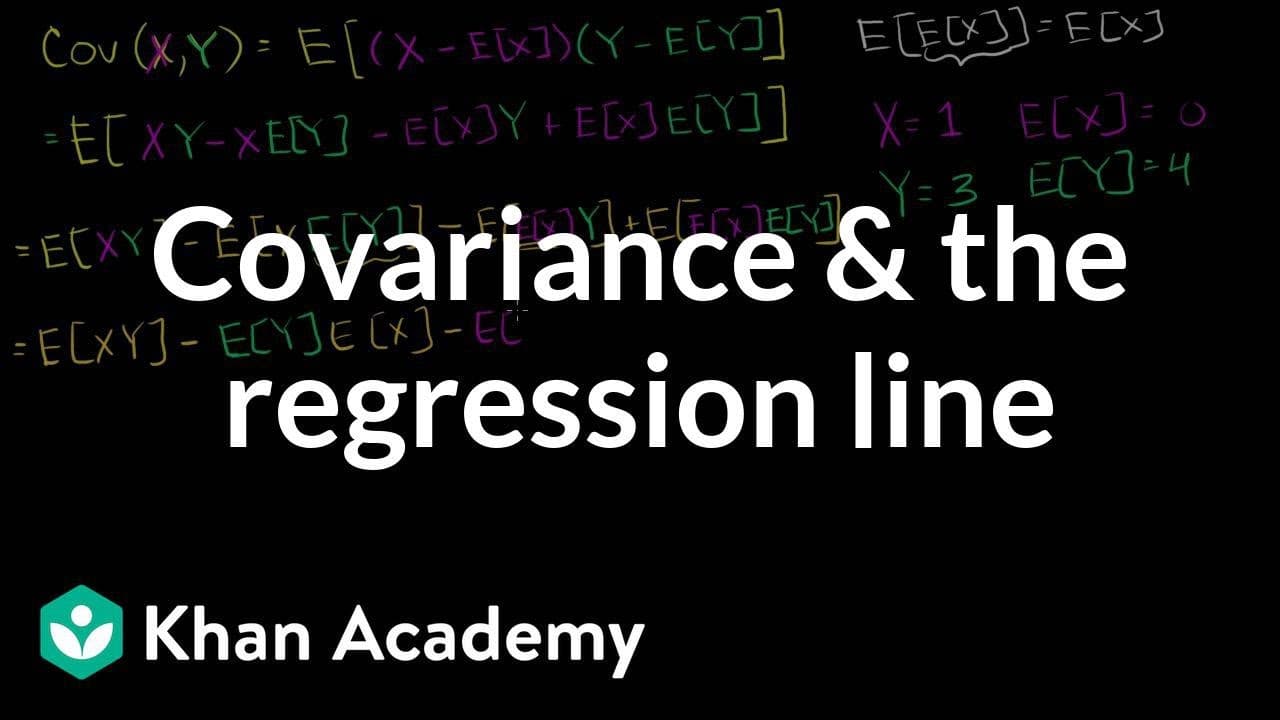
Covariance quantifies how two random variables change together, calculated as the expected value of their paired deviations from their means. It can be approximated using sample means and is directly linked to the slope of a regression line, as the slope equals the covariance of the two variables divided by the variance of the independent variable.

Transcript

What I want to do in this video is introduce you to the idea of the covariance between two random variables. And it's defined as the expected value of the distance-- or I guess the product of the distances of each random variable from their mean, or from their expected value. So let me just write that down. So I'll have X first, I'll do this in ano... Read More

Key Insights

  • 🎚️ Covariance measures the level of variation between two random variables.
  • ❓ It can be approximated using sample means.
  • ❎ Covariance can be positive or negative, depending on how the variables vary together.

Install to Summarize YouTube Videos and Get Transcripts

Explore YouTube Video Summarizer or Get YouTube Transcript Extractor

Questions & Answers

Q: What is the definition of covariance between two random variables?

Covariance is the expected value of the product of the distances of each random variable from their mean. It measures the level of variation between the two variables.

Q: How can covariance be interpreted intuitively?

Covariance shows how two variables vary together. If they both increase or decrease together, the covariance will be positive. If one increases while the other decreases, the covariance will be negative.

Q: How can covariance be estimated using sample data?

To estimate covariance, you can calculate the mean of the products of the two variables, the mean of one variable multiplied by the mean of the other, and then subtract the two means.

Q: What is the relationship between covariance and regression?

The slope of a regression line can be viewed as the covariance between the dependent variable and the independent variable divided by the variance of the independent variable. This shows how the variables are related.

Summary & Key Takeaways

  • Covariance measures how much two random variables vary together.

  • It is calculated as the product of the distances of each variable from their mean.

  • Covariance can be approximated using sample means and is closely related to the slope of a regression line.


Read in Other Languages (beta)

English

Share This Summary 📚

Summarize YouTube Videos and Get Video Transcripts with 1-Click

Download browser extensions on:

Try YouTube Summary with ChatGPT & Claude or YouTube Transcript Generator

Explore More Summaries from Khan Academy 📚

Interview with Karina Murtagh thumbnail
Interview with Karina Murtagh
Khan Academy
Breakthrough Junior Challenge Winner Reveal! Homeroom with Sal - Thursday, December 3 thumbnail
Breakthrough Junior Challenge Winner Reveal! Homeroom with Sal - Thursday, December 3
Khan Academy
Classical Japan during the Heian Period | World History | Khan Academy thumbnail
Classical Japan during the Heian Period | World History | Khan Academy
Khan Academy

Summarize YouTube Videos and Get Video Transcripts with 1-Click

Download browser extensions on:

Try YouTube Summary with ChatGPT & Claude or YouTube Transcript Generator

Apps & Extensions

  • Chrome Extension
  • Safari Extension
  • Edge Add-ons
  • Firefox Add-ons
  • iOS App
  • Android App

Key Features

  • YouTube Video Summarizer
  • Web & PDF Summarizer
  • Web & PDF Highlighter
  • Chat with PDF
  • Ask AI Clone
  • Audio Transcriber
  • Glasp Reader
  • Kindle Highlight Export
  • Idea Hatch

Integrations

  • Obsidian Plugin
  • Notion Integration
  • Pocket Integration
  • Instapaper Integration
  • Medium Integration
  • Readwise Integration
  • Snipd Integration
  • Hypothesis Integration

More Features

  • APIs
  • MCP Connector
  • Blog & Post
  • Embed Links
  • Image Highlight
  • Personality Test
  • Quote Shots

Company

  • About us
  • Blog
  • Community
  • FAQs
  • Job Board
  • Newsletter
  • Pricing
Terms

•

Privacy

•

Guidelines

© 2026 Glasp Inc. All rights reserved.

