The Gilded Age part 2 | The Gilded Age (1865-1898) | US History | Khan Academy
TL;DR
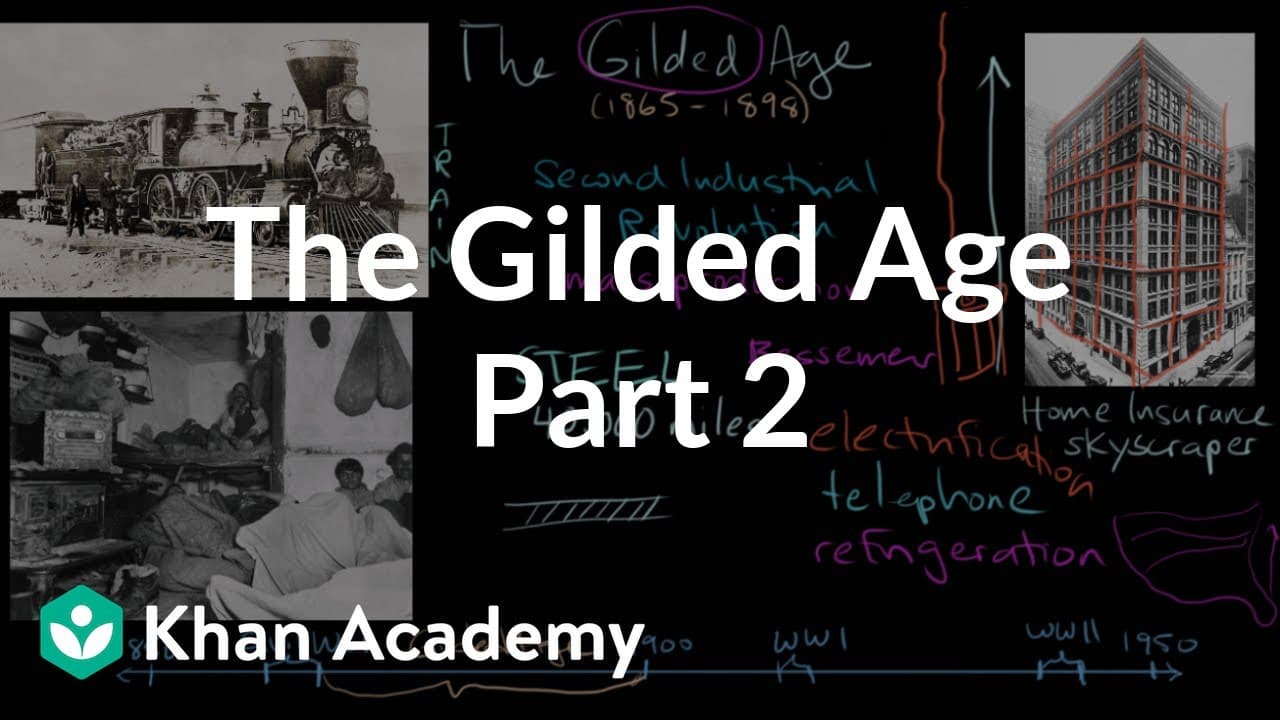
The Second Industrial Revolution in the Gilded Age brought about disruptive technologies such as trains, steel, elevators, and electricity, transforming industries and cities.
Transcript
- [Voiceover] So, we were talking about the wealth inequality that characterized the Gilded Age, but you were telling me that that's not the only thing, Kim, that characterizes this period. - [Voiceover] Right, what really makes the Gilded Age happen is what we call the Second Industrial Revolution. Are you familiar with the First Industrial Revolu... Read More
Key Insights
- ❓ The Second Industrial Revolution brought about disruptive technologies that transformed the Gilded Age.
- 🖐️ Steel, trains, elevators, electricity, refrigeration, and the telephone played crucial roles in shaping industries, markets, and cities.
- 👳 These technologies increased the efficiency of production, connected markets, and facilitated the growth of urban areas.
- 🚈 The expansion of rail networks and the invention of the light bulb also led to the standardization of time.
- 💨 The goal of these innovations was to produce goods faster and at lower costs, with less reliance on skilled workers.
Install to Summarize YouTube Videos and Get Transcripts
Explore YouTube Video Summarizer or Get YouTube Transcript Extractor
Questions & Answers
Q: What significant role did steel play in the Gilded Age?
Steel, produced faster and cheaper through the Bessemer process, facilitated the construction of railroads, buildings, and other industries. It led to the growth of major steel barons like Andrew Carnegie and the expansion of rail networks in the United States.
Q: How did the invention of elevators contribute to the Gilded Age?
Elevators revolutionized the construction of tall buildings, making it easier for people to access the upper floors and enabling the construction of skyscrapers. It increased efficiency and reduced the need for climbing numerous flights of stairs.
Q: What impact did the telephone have on business transactions?
The telephone transformed business speed by allowing instantaneous communication across distances. It facilitated on-the-spot business transactions, similar to the way the internet revolutionized business in the 1990s.
Q: How did refrigeration impact the meat industry?
Refrigeration allowed for the transportation of perishable goods, most notably meat, over long distances. This development was significant in enabling cattle drives in Chicago, where cattle could be slaughtered and meat transported to various markets in the United States.
Summary & Key Takeaways
-
The Second Industrial Revolution, characterized by mass production and new ways of communication, was instrumental in fueling the wealth inequality of the Gilded Age.
-
Steel, created using the Bessemer process, enabled the construction of extensive rail networks, revolutionizing transportation and connecting markets.
-
Tall buildings became possible with steel-frame structures and elevators, while telephone and refrigeration facilitated business transactions and expanded markets.
Read in Other Languages (beta)
Share This Summary 📚
Summarize YouTube Videos and Get Video Transcripts with 1-Click
Try YouTube Summary with ChatGPT & Claude or YouTube Transcript Generator
Explore More Summaries from Khan Academy 📚



Summarize YouTube Videos and Get Video Transcripts with 1-Click
Try YouTube Summary with ChatGPT & Claude or YouTube Transcript Generator