How saber-toothed cats grew their mouth swords
TL;DR
Saber-toothed cats used their teeth as deadly weapons.
Transcript
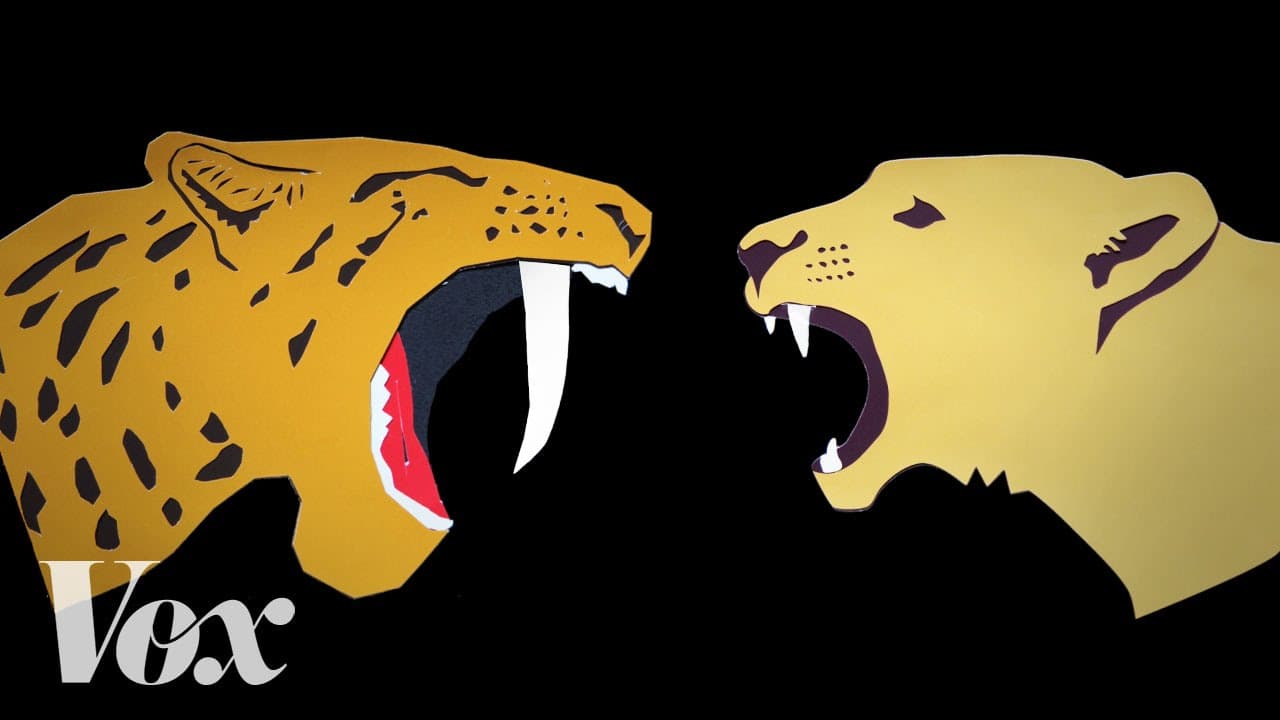
This is a story about a deadly tooth, and a paleontologist named Jack Sang. JT: I like to study animals that look weird or awesome. And few animals look as weird and awesome as the saber tooth cat, Smilodon fatalis [SMILE-oh-don fat-TALL-is] JT: Their mouths are their weapons. And that's part of the draw to study them. What were these animals doing... Read More
Key Insights
- Smilodon fatalis, known as saber-toothed cats, had large, visible teeth resembling a mountain lion on steroids, which were used as weapons.
- The saber teeth could grow nearly a foot long and were often serrated, similar to steak knives, making them effective for hunting.
- The evolution of saber teeth occurred six times in different lineages, suggesting their effectiveness as a carnivorous tool.
- Debate exists around their hunting capabilities, but most agree the teeth were used for killing, stabbing, or cutting prey.
- Saber-toothed cats employed stealth and powerful neck muscles to drive their canines into prey's throats, severing vital arteries or windpipes.
- Research using CT scans and chemical analysis of fossils revealed that Smilodon sabers grew about 6 millimeters per month.
- Compared to modern big cats, Smilodon's teeth took longer to grow, with a seven-inch saber taking up to three years to develop.
- The extended growth period of their teeth indicates that saber-toothed cubs likely required prolonged parental care.
Install to Summarize YouTube Videos and Get Transcripts
Explore YouTube Video Summarizer or Get YouTube Transcript Extractor
Questions & Answers
Q: What is unique about the saber-toothed cat's teeth?
Saber-toothed cats, particularly Smilodon fatalis, had large, visible teeth that could grow nearly a foot long. These teeth were often serrated like steak knives, making them effective tools for hunting. Their unique structure and size set them apart from other predators, emphasizing their role as deadly weapons in hunting and killing prey.
Q: How often did the evolution of saber teeth occur?
The evolution of saber teeth occurred six times in different lineages, indicating their effectiveness as a carnivorous tool. This repeated evolution suggests that the saber tooth design provided a significant advantage for hunting, making it a successful adaptation for various species over time.
Q: What methods were used to study the growth of Smilodon's teeth?
Researchers used a combination of CT scans and chemical analysis to study the growth of Smilodon's teeth. CT scans provided detailed 3-D images of the teeth, while chemical analysis revealed the growth rate by examining the nutrient absorption patterns and seasonal cycles within the teeth's composition.
Q: How long did it take for Smilodon's teeth to grow?
Smilodon's teeth grew at a rate of approximately 6 millimeters per month. Given this growth rate, it took up to three years for a saber-toothed cat's teeth to reach their full length of about seven inches. This extended growth period is longer than that of modern big cats, which highlights the unique nature of Smilodon's development.
Q: What does the extended growth period of Smilodon's teeth suggest about their cubs?
The extended growth period of Smilodon's teeth suggests that their cubs required prolonged parental care. Since it took several years for their teeth to fully develop, young saber-toothed cats likely depended on their parents for protection and learning hunting skills, indicating a complex social structure and extended family bonds.
Q: What role did the saber teeth play in Smilodon's hunting strategy?
The saber teeth played a crucial role in Smilodon's hunting strategy by allowing them to deliver precise, lethal bites to their prey. They used their powerful neck muscles to drive the canines into the throat of their prey, severing vital arteries or the windpipe, which quickly incapacitated the animal and ensured a successful hunt.
Q: How does modern paleontology help us understand extinct creatures like Smilodon?
Modern paleontology, through techniques like CT scanning and chemical analysis, allows scientists to reconstruct the lives and behaviors of extinct creatures like Smilodon. By studying fossilized remains, researchers can infer growth patterns, social structures, and hunting strategies, providing a window into the past and helping us understand the evolution and adaptation of these ancient animals.
Q: What is the significance of the La Brea tar pits in the study of Smilodon?
The La Brea tar pits are significant in the study of Smilodon because they have preserved a wealth of fossilized remains, providing researchers with valuable specimens to analyze. The tar pits' unique preservation conditions have allowed scientists to study the physical characteristics and growth patterns of Smilodon teeth, offering insights into the life and behavior of these extinct predators.
Summary & Key Takeaways
-
Saber-toothed cats, specifically Smilodon fatalis, are known for their large, intimidating teeth, which were used as weapons. These teeth could grow up to a foot long and were often serrated. The evolution of such teeth occurred multiple times, highlighting their effectiveness as tools for hunting and killing prey.
-
Research into these extinct creatures involves analyzing fossils from the La Brea tar pits using CT scans and chemical composition studies. These methods have revealed that Smilodon's teeth grew at a rate of 6 millimeters per month, taking up to three years to reach full length, longer than modern big cats.
-
The slow growth rate of saber-toothed cats' teeth suggests that their young required extended parental care. This research allows paleontologists to imagine the life of these ancient creatures, providing insights into their behavior and development through the study of fossilized remains.
Read in Other Languages (beta)
Share This Summary 📚
Summarize YouTube Videos and Get Video Transcripts with 1-Click
Try YouTube Summary with ChatGPT & Claude or YouTube Transcript Generator
Explore More Summaries from Vox 📚




Summarize YouTube Videos and Get Video Transcripts with 1-Click
Try YouTube Summary with ChatGPT & Claude or YouTube Transcript Generator