How to Derive the Inertia Formula for a Hollow Cylinder
TL;DR
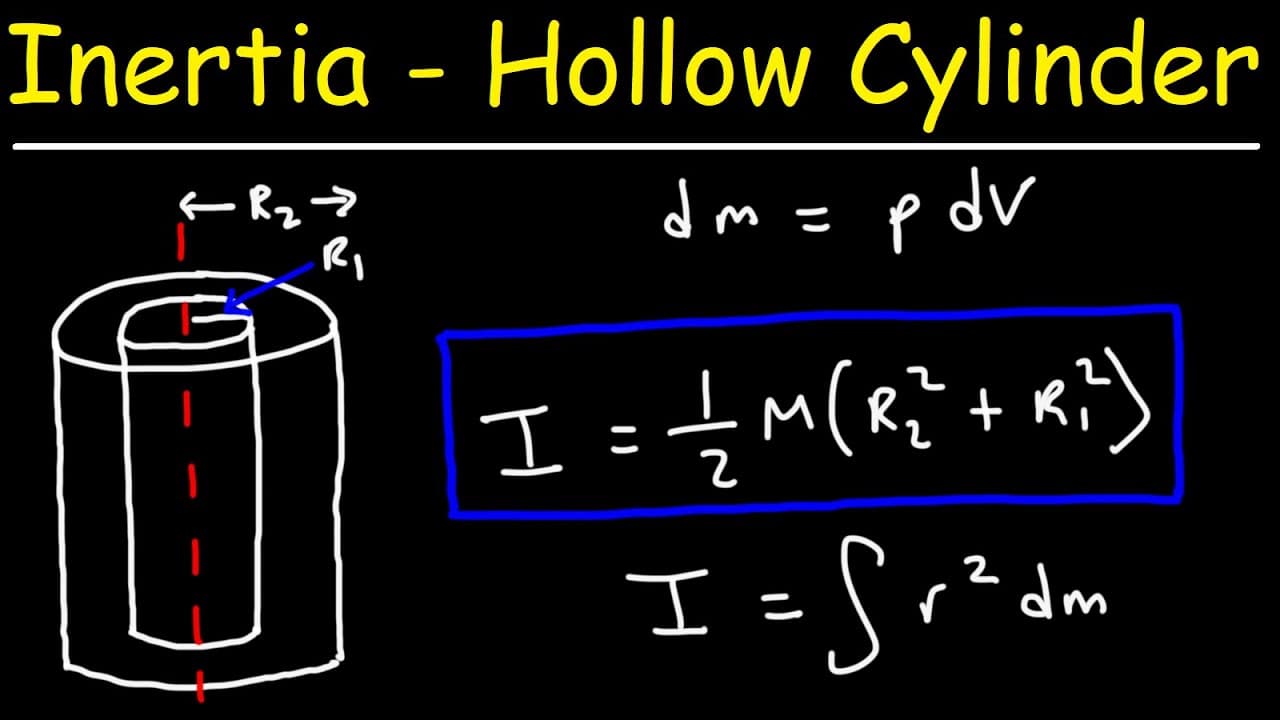
To derive the inertia formula for a hollow cylinder, start by calculating the mass using density and volume, and then integrate using the mass distribution from the inner radius to the outer radius. The final formula is I = 1/2 * M * (R2² + R1²), where M is mass and R2 and R1 are the outer and inner radii, respectively.
Transcript
in this video we're going to derive the formula for the inertia of a hollow cylinder so let's begin with a picture so let's say this is our cylinder and let's say this is the inside part of that cylinder and then this is going to be the axis of rotation R1 is going to be the radius of the inside part of the hollow cylinder R2 is the outer radius so... Read More
Key Insights
- 🔇 The volume of a hollow cylinder is obtained by subtracting the volume of the inner cylinder from the volume of the outer cylinder.
- 💆 The formula for the inertia of a hollow cylinder includes the mass, outer radius, and inner radius.
- ⭕ The formula for the inertia of a solid cylinder simplifies the formula for a hollow cylinder by considering only the outer radius.
- 💆 Inertia is a property that depends on the object's mass and its distribution.
- ❓ The derivation process involves differentiating equations and integrating to obtain the final formula.
- 🥋 The density of the cylinder is assumed to be uniform throughout.
- 💯 The difference of perfect squares formula is used to factor R2^4 - R1^4.
Install to Summarize YouTube Videos and Get Transcripts
Explore YouTube Video Summarizer or Get YouTube Transcript Extractor
Questions & Answers
Q: How is the volume of a hollow cylinder calculated?
The volume of a hollow cylinder is obtained by subtracting the volume of the inner cylinder from the volume of the outer cylinder. The formula is V = pi * (R2^2 - R1^2) * L, where R2 and R1 are the outer and inner radii, and L is the length.
Q: What is the formula for the inertia of a hollow cylinder?
The formula for the inertia of a hollow cylinder is derived as 12 * M * (R2^2 + R1^2), where M is the mass and R2 and R1 are the outer and inner radii, respectively.
Q: How does the formula for the inertia of a solid cylinder differ from that of a hollow cylinder?
The formula for the inertia of a solid cylinder is simpler as there is no inner radius. It is given by 12 * M * R2^2, where M is the mass and R2 is the outer radius.
Q: What is the difference between inertia and mass?
Inertia is a property that quantifies an object's resistance to changes in its motion, while mass is a measure of the amount of matter in an object. Inertia depends on both the mass and the distribution of mass within the object.
Summary & Key Takeaways
-
The video demonstrates the derivation of the formula for the inertia of a hollow cylinder using a picture and equations.
-
It explains how to calculate the volume of a hollow cylinder by subtracting the volumes of the outer and inner cylinders.
-
The final formula for the inertia of a hollow cylinder is derived as 12 * M * (R2^2 + R1^2), where M is the mass and R2 and R1 are the outer and inner radii, respectively.
Read in Other Languages (beta)
Share This Summary 📚
Summarize YouTube Videos and Get Video Transcripts with 1-Click
Try YouTube Summary with ChatGPT & Claude or YouTube Transcript Generator
Explore More Summaries from The Organic Chemistry Tutor 📚



Summarize YouTube Videos and Get Video Transcripts with 1-Click
Try YouTube Summary with ChatGPT & Claude or YouTube Transcript Generator