Divergence formula, part 1
TL;DR
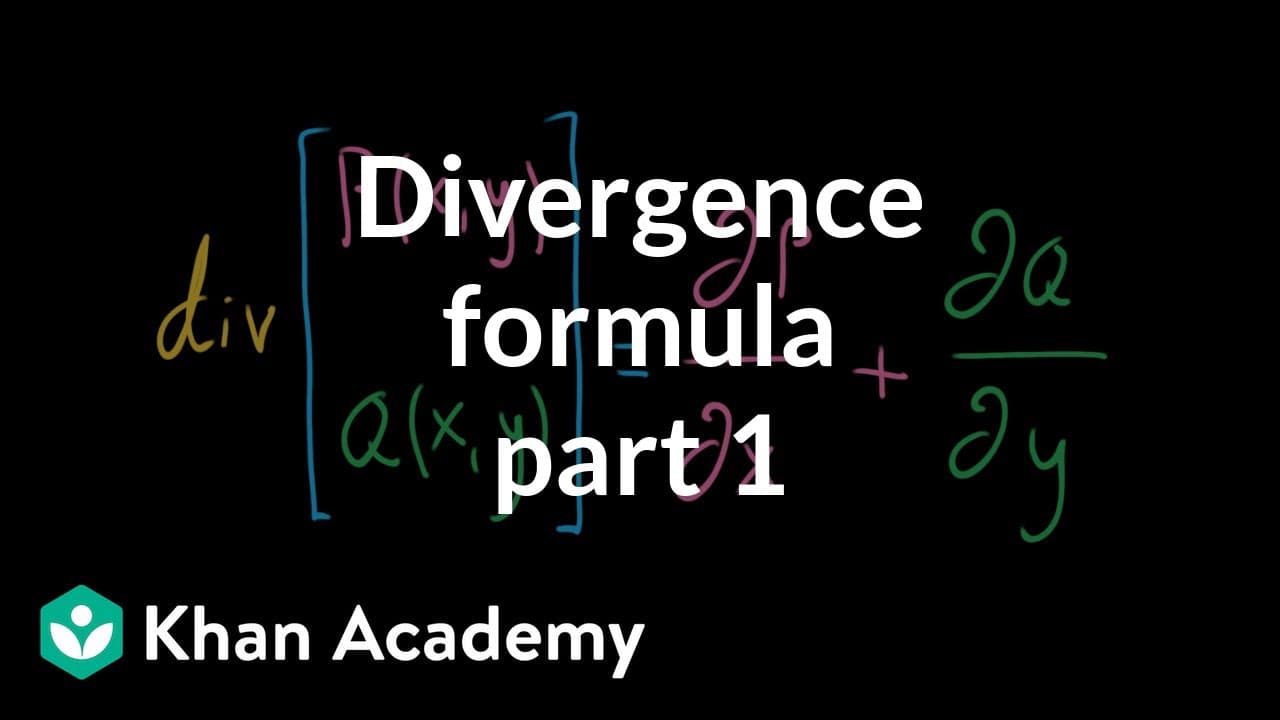
Divergence measures the rate of flow of a vector field, specifically focusing on the X component, and is related to the positive partial derivative of the X component with respect to X.
Transcript
- [Voiceover] Hello everyone. So now that we have an intuition for what divergence is trying to represent, let's start actually drilling in on a formula. The first thing I want to do is just limit our perspective to functions that only have an X component, or rather, where the Y component of the output is just zero. So this is some kind of vector f... Read More
Key Insights
- ☺️ Divergence measures the flow of a vector field, specifically focusing on the X component.
- 👈 Positive divergence can occur when the vectors only go left or right, either with the X component changing from negative to positive or with vectors going away from the point being larger than those coming in.
- ☺️ In positive divergence situations, there is an increase in the value of the X component as X increases, indicating a positive partial derivative of the X component with respect to X.
- 🇾🇪 The Y component is not considered in this specific analysis of divergence.
- 💱 Understanding partial derivatives of vector field components is crucial to comprehending the relationship between divergence and changes in the X component.
- 👻 Divergence allows for the quantification and analysis of the flow patterns within a vector field.
- 💱 Positive divergence can have different manifestations depending on the behavior of the X component in relation to changes in X.
Install to Summarize YouTube Videos and Get Transcripts
Explore YouTube Video Summarizer or Get YouTube Transcript Extractor
Questions & Answers
Q: What is divergence?
Divergence refers to the rate of flow of a vector field and is a measure of how the vectors in the field are spreading out or coming together at a specific point.
Q: How does divergence relate to the X component of a vector field?
Divergence primarily focuses on the X component of a vector field, specifically in cases where the Y component is zero. This allows for a clearer understanding of how the vectors are moving horizontally.
Q: What are the two scenarios in which positive divergence can occur?
Positive divergence can occur when the X component is negative to the left of a point and positive to the right, or when the X component is positive at the point but the vectors going away from the point are larger in magnitude than the ones coming in.
Q: What does a positive partial derivative of the X component with respect to X indicate?
A positive partial derivative of the X component with respect to X corresponds to an increase in the value of the X component as X increases, which aligns with the concept of positive divergence.
Summary & Key Takeaways
-
Divergence is a concept that describes the flow of a vector field, with a focus on the X component.
-
Positive divergence can occur in two scenarios: either the X component is negative to the left of a point and positive to the right, or the X component is positive at the point but the vectors going away are larger in magnitude than the ones coming in.
-
The positive divergence is correlated with an increase in the value of the X component as X increases, indicating a positive partial derivative of the X component with respect to X.
Read in Other Languages (beta)
Share This Summary 📚
Summarize YouTube Videos and Get Video Transcripts with 1-Click
Try YouTube Summary with ChatGPT & Claude or YouTube Transcript Generator
Explore More Summaries from Khan Academy 📚



Summarize YouTube Videos and Get Video Transcripts with 1-Click
Try YouTube Summary with ChatGPT & Claude or YouTube Transcript Generator