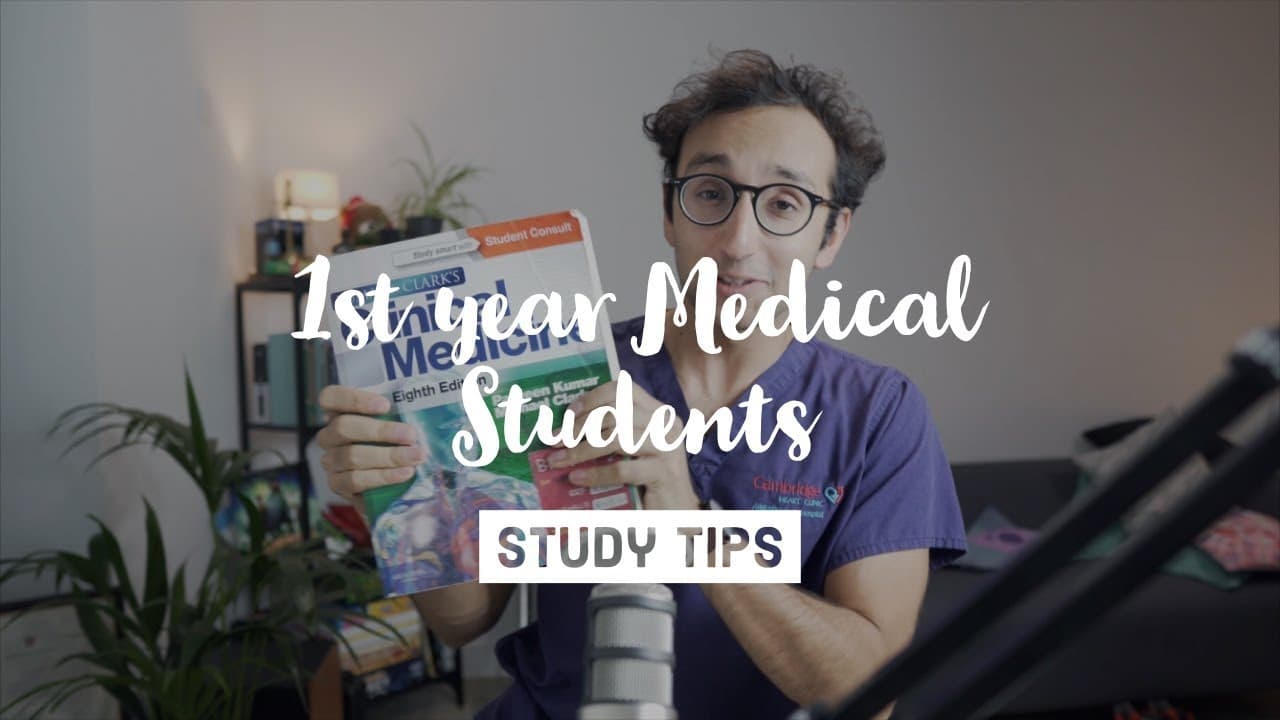
Study Tips for First Year Medical Students
TL;DR
First-year medical student survival tips focusing on study strategies, workload management, and collaborative learning.
Transcript
hey guys welcome back to the channel if you new here my name is Ollie I'm a junior doctor working in Cambridge and today we're kicking off a brand new series on this channel called how to survive medical school and this is going to end up being a series of at least 20 videos and in each video me and various of my friends who have interviewed for th... Read More
Key Insights
- 😷 Medical school curriculums vary, requiring personalized study strategies and resource selection.
- ❓ Focus on understanding concepts rather than memorizing details for effective learning.
- 👾 Incorporate active recall and spaced repetition techniques for efficient retention of information.
- 🫠 Establish consistent study habits, including pre-reading for lectures and collaborating with peers.
- 🤩 Avoid excessive use of textbooks and flashcards, prioritize understanding key concepts.
- ❓ Utilize online resources like Wikipedia, Anki, and Instant Anatomy for subject-specific learning.
- 💦 Work together with peers, share resources, and maintain a supportive academic environment.
Install to Summarize YouTube Videos and Get Transcripts
Explore YouTube Video Summarizer or Get YouTube Transcript Extractor
Questions & Answers
Q: How can making friends with seniors benefit first-year medical students?
Making friends with seniors helps in obtaining valuable advice, sharing resources, and gaining insights specific to the medical school curriculum, creating a supportive network for academic success.
Q: Why is pre-reading for lectures considered a useful practice for medical students?
Pre-reading allows students to familiarize themselves with upcoming lecture topics, aiding in comprehension, engagement, and note-taking during lectures, enhancing overall learning effectiveness.
Q: How can active recall and spaced repetition techniques improve study habits for medical students?
Active recall involves actively testing oneself, enhancing memory retention, while spaced repetition involves revisiting topics at strategic intervals, reinforcing learning and improving long-term retention, resulting in efficient study habits.
Q: Why is collaborative learning encouraged among medical students?
Collaborative learning fosters a positive academic environment, promotes knowledge sharing, reduces individual workload, enhances understanding through different perspectives, and cultivates long-lasting friendships among peers.
Summary & Key Takeaways
-
Tips for first-year medical students include making friends with seniors, focusing on exams, and understanding the bigger picture of subjects.
-
Utilize active recall and spaced repetition for efficient studying, avoiding excessive flashcard creation.
-
Pre-reading lectures, working consistently, and collaborating with peers enhance learning outcomes and reduce stress.
Read in Other Languages (beta)
Share This Summary 📚
Summarize YouTube Videos and Get Video Transcripts with 1-Click
Try YouTube Summary with ChatGPT & Claude or YouTube Transcript Generator
Explore More Summaries from Ali Abdaal 📚



Summarize YouTube Videos and Get Video Transcripts with 1-Click
Try YouTube Summary with ChatGPT & Claude or YouTube Transcript Generator