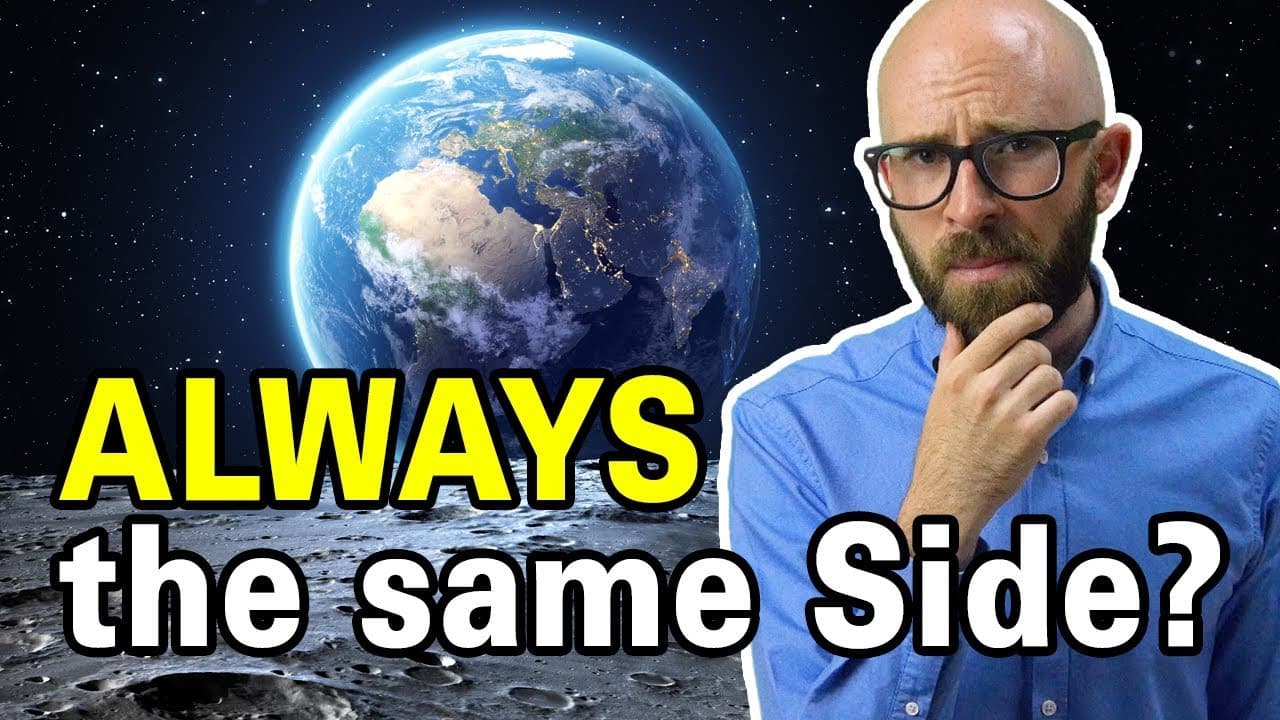
Why Does One Side of the Moon Always Face Earth?
TL;DR
One side of the Moon always faces Earth due to tidal locking caused by Earth's gravitational pull, which gradually slowed the Moon's rotation to match its orbit. This interaction creates tidal bulges on both bodies, allowing us to see about 59% of the Moon's surface from Earth. The Moon's orbit is not perfectly circular, influencing the visible portion of its surface.
Transcript
One Moon “day” is approximately 29 1/2 Earth days. This rotation coincides with its orbit around the Earth so that we only see about 59% of the surface of the Moon from Earth. When the Moon first formed, its rotational speed and orbit were very different than they are now. Over time, the Earth’s gravitational field gradually slowed the Moon’s rotat... Read More
Key Insights
- 🐢 Tidal friction caused by the Earth's gravitational field gradually slowed the Moon's rotation until it became tidally locked with the Earth.
- 🥺 The Earth's gravitational field creates tidal bulges on both the Earth and the Moon, leading to the Moon's rotation becoming tidally locked.
- 👻 The Moon's non-circular orbit allows us to see more than 50% of its surface from Earth.
- ❓ The Moon's tidal friction affects the Earth's rotation and causes a gradual increase in the distance between the Moon and the Earth.
- ☠️ Geological events and other factors can affect the rate of change in the Moon's distance from the Earth.
- 💱 The Moon's distance from the Earth is more or less in step with the Earth's rotational period change.
- ⏰ The process of the Moon becoming tidally locked with the Earth is unlikely to occur due to the increasing brightness of the Sun and its eventual expansion.
Install to Summarize YouTube Videos and Get Transcripts
Explore YouTube Video Summarizer or Get YouTube Transcript Extractor
Questions & Answers
Q: How does the Earth's gravitational field affect the Moon's rotation?
The Earth's gravitational field pulls the Moon in a different direction, creating tidal bulges and gradually slowing its rotation until it became tidally locked with the Earth.
Q: Why do we see 59% of the Moon's surface from Earth?
The Moon's non-circular orbit causes its angular speed to change, allowing us to see an extra 9% of its surface compared to a perfectly circular orbit.
Q: Will the Moon's distance from the Earth always keep increasing?
The Moon's distance from the Earth changes gradually due to the transfer of rotational momentum, geological events, and other factors. It will continue to increase over time.
Q: Will the Earth ever become tidally locked with the Moon?
In theory, billions of years from now, the same side of the Earth will always face the Moon, but the increasing brightness of the Sun and its eventual expansion will likely prevent this from happening.
Summary & Key Takeaways
-
The Moon's rotation and orbit were different when it first formed, but tidal friction caused by the Earth's gravitational field gradually slowed its rotation.
-
The Earth's gravitational field creates tidal bulges on both the Earth and the Moon, which ultimately led to the Moon becoming tidally locked.
-
The Moon's orbit is not perfectly circular, causing its distance from the Earth to change and allowing us to see about 59% of its surface.
Read in Other Languages (beta)
Share This Summary 📚
Summarize YouTube Videos and Get Video Transcripts with 1-Click
Try YouTube Summary with ChatGPT & Claude or YouTube Transcript Generator
Explore More Summaries from Today I Found Out 📚






Summarize YouTube Videos and Get Video Transcripts with 1-Click
Try YouTube Summary with ChatGPT & Claude or YouTube Transcript Generator