How a dictionary writer defines English
TL;DR
Dictionary writing captures language evolution without imposing rules.
Transcript
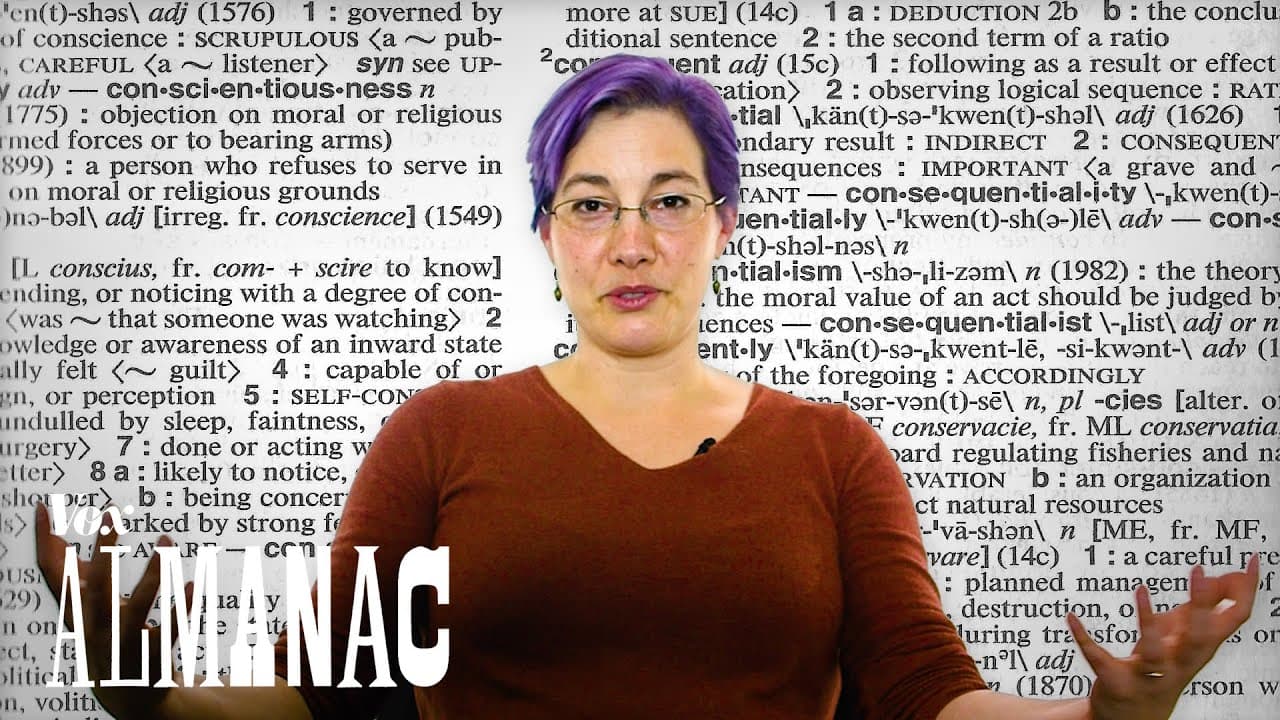
When you spend all day in English and everything around you is words, you know, I imagine it's like being a podiatrist where like the whole world is feet. My name is Kory Stamper. I'm an associate editor at Merriam Webster, where I write dictionary definitions, and my new book is called “Word by Word: The Secret Life of Dictionaries.” For a while, ... Read More
Key Insights
- Kory Stamper is an associate editor at Merriam-Webster, responsible for writing dictionary definitions and advocating a descriptivist approach to language.
- Dictionary writing involves two key processes: reading and marking to find new vocabulary and defining words by matching them with their contextual use.
- A word's inclusion in the dictionary requires widespread use, a shelf life, and meaningful use, ensuring it is not just a random collection of letters.
- The debate between prescriptivism and descriptivism highlights the tension between promoting 'best' language practices and recording language as it is used.
- English is likened to a river with various dialects and currents, all contributing to the language's evolution and survival.
- Words such as 'irregardless' and 'decimate' exemplify the dynamic nature of English, where meanings and usages evolve over time.
- Lexicographers like Stamper aim to record language without imposing judgments, acknowledging the organic and living nature of English.
- Understanding the role of dictionaries in capturing language evolution helps appreciate the complex task of lexicography and the importance of all language forms.
Install to Summarize YouTube Videos and Get Transcripts
Explore YouTube Video Summarizer or Get YouTube Transcript Extractor
Questions & Answers
Q: What is Kory Stamper's role at Merriam-Webster?
Kory Stamper is an associate editor at Merriam-Webster, where she is responsible for writing dictionary definitions. Her work involves capturing the evolution of language by recording how words are used, rather than imposing strict linguistic rules. Stamper's approach is aligned with descriptivism, which observes language in its natural, evolving state.
Q: What are the key processes involved in dictionary writing?
Dictionary writing involves two main processes: reading and marking, and defining. In reading and marking, editors search for new or interesting vocabulary in various sources. The defining process involves revising the dictionary by matching words with their contextual use, ensuring that definitions accurately reflect how language is used in practice.
Q: What criteria must a word meet to be included in the dictionary?
For a word to be included in the dictionary, it must meet three criteria: widespread use, a shelf life, and meaningful use. Widespread use means the word appears across diverse sources, a shelf life ensures the word's continued relevance, and meaningful use confirms that the word has a clear, understandable meaning.
Q: How does Kory Stamper describe the nature of English?
Kory Stamper describes English as an organic, living entity, similar to a river with various dialects and currents. Each dialect contributes to the language's evolution, making English dynamic and ever-changing. Stamper emphasizes that every part of the language is essential for its survival, challenging the notion of English as a static, monolithic entity.
Q: What is the debate between prescriptivism and descriptivism in linguistics?
The debate between prescriptivism and descriptivism centers on whether language should be governed by strict rules (prescriptivism) or observed as it naturally evolves (descriptivism). Prescriptivism promotes 'best' practices, often excluding non-standard forms, while descriptivism records language as it is used, embracing its dynamic and changing nature.
Q: Why do some words, like 'irregardless', spark controversy?
Words like 'irregardless' spark controversy because they challenge traditional linguistic norms and are often seen as incorrect or informal. Despite this, such words gain usage and enter dictionaries, reflecting language's evolving nature. Lexicographers record these words to capture how language is used, even if it deviates from prescriptive norms.
Q: How does the video illustrate the dynamic nature of English?
The video illustrates English's dynamic nature by comparing it to a river with various dialects and currents, each contributing to the language's evolution. Examples like 'decimate' and 'stew' show how meanings change over time. This analogy emphasizes that English is not static but constantly shaped by cultural and social influences.
Q: What is the significance of understanding the role of dictionaries in language evolution?
Understanding the role of dictionaries in language evolution highlights the complex task of lexicography, which involves capturing how language is used without imposing judgments. This approach respects the organic, living nature of English, acknowledging that every form and usage contributes to the language's richness and adaptability over time.
Summary & Key Takeaways
-
Kory Stamper, a Merriam-Webster editor, describes her role in writing dictionary definitions, emphasizing a descriptivist approach that records language as it is used. She highlights the processes of reading and marking to discover new vocabulary and defining words by contextual use. Stamper's work reflects the dynamic and evolving nature of English.
-
Stamper explains the criteria for a word's inclusion in the dictionary: widespread use, shelf life, and meaningful use. She discusses the debate between prescriptivism and descriptivism, with dictionaries leaning toward the latter, capturing language evolution without imposing strict rules. This approach respects English's organic, living nature.
-
The video illustrates English as a river with various dialects and currents, each contributing to the language's evolution. Stamper uses examples like 'irregardless' and 'decimate' to show how meanings change over time. Lexicographers aim to record language without judgment, acknowledging every form's importance for English's survival.
Read in Other Languages (beta)
Share This Summary 📚
Summarize YouTube Videos and Get Video Transcripts with 1-Click
Try YouTube Summary with ChatGPT & Claude or YouTube Transcript Generator
Explore More Summaries from Vox 📚



Summarize YouTube Videos and Get Video Transcripts with 1-Click
Try YouTube Summary with ChatGPT & Claude or YouTube Transcript Generator