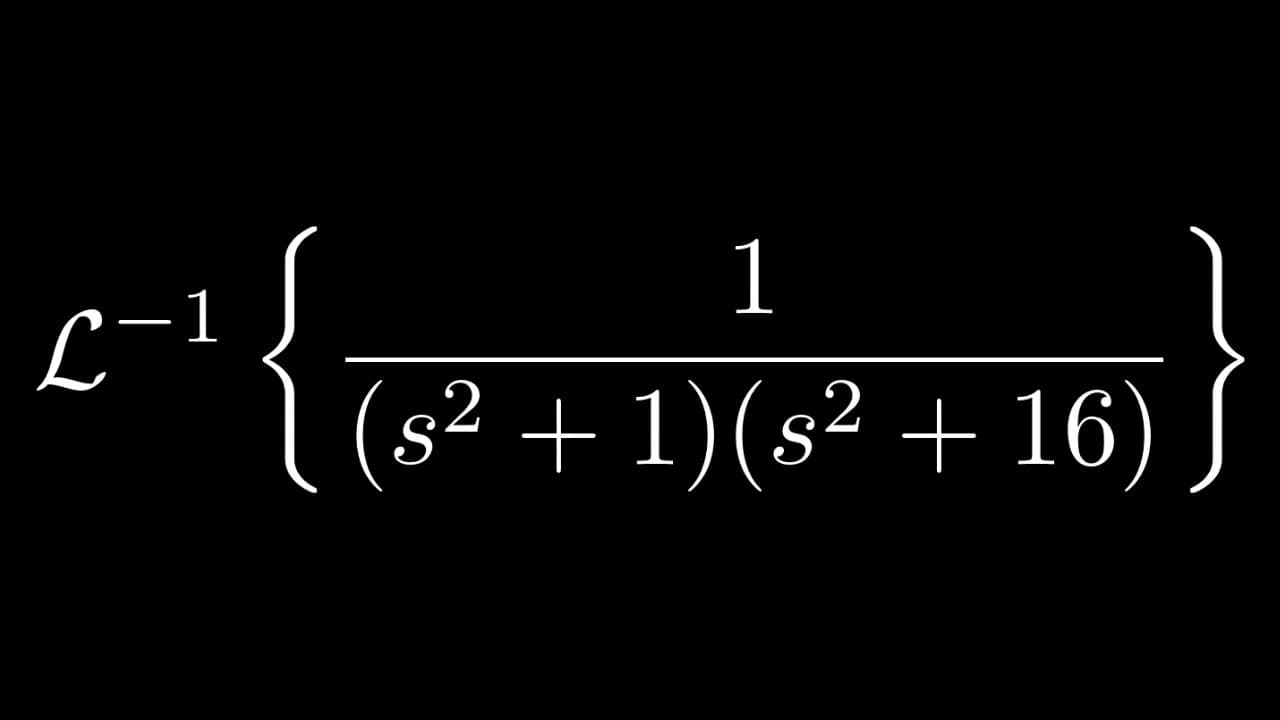
Inverse Laplace Transform of 1/((s^2 + 1)(s^2 + 16))
TL;DR
Learn how to find inverse Laplace transforms using partial fraction decomposition in a step-by-step tutorial.
Transcript
in this video we're going to find the inverse Laplace transform of this expression so as to do this we're going to use partial fraction decomposition so we'll start by writing down what's inside the inverse Laplace so we have 1 over s squared plus 1 then times s squared plus 16 so s squared plus 16 so whenever you have quadratics you have to have a... Read More
Key Insights
- ❓ Partial fraction decomposition is a crucial step in finding the inverse Laplace transform efficiently.
- 🙃 Multiplying both sides by denominators helps in simplifying expressions and preparing for coefficient equating.
- ❓ Equating coefficients systematically solves for unknown variables in the inverse Laplace transform process.
- 😑 Understanding trigonometric functions aids in transforming the final expression into a simplified form.
- ❓ Manipulating coefficients assists in deriving accurate values for variables in the inverse Laplace transform.
- ❓ The importance of following a structured approach to calculate the inverse Laplace transform accurately.
- 🈸 Application of mathematical principles like clearing fractions and equating coefficients in finding inverse Laplace transforms.
Install to Summarize YouTube Videos and Get Transcripts
Explore YouTube Video Summarizer or Get YouTube Transcript Extractor
Questions & Answers
Q: How do you clear fractions in the process of finding the inverse Laplace transform?
To clear fractions, multiply both sides by the denominators involved in the expression to simplify the equations and proceed with solving.
Q: Why is equating coefficients a necessary step in finding unknown variables in the inverse Laplace transform?
Equating coefficients allows for the systematic approach of deriving equations from terms with matching powers of 's' to solve for the unknown variables a, b, c, and d.
Q: What is the significance of manipulating the coefficients to find the inverse Laplace transform?
Manipulating coefficients helps in deriving the values of unknown variables, enabling the final expression to be simplified and transformed using known Laplace transform formulas.
Q: How does the process of finding the inverse Laplace transform relate to trigonometric functions like sine and cosine?
The inverse Laplace transform process often involves matching terms to trigonometric functions such as sine and cosine, allowing for the expression to be transformed into a more manageable form.
Summary & Key Takeaways
-
Tutorial on finding the inverse Laplace transform using partial fraction decomposition.
-
Clearing fractions by multiplying both sides with denominator terms.
-
Equating coefficients to solve for the unknown variables a, b, c, and d.
Read in Other Languages (beta)
Share This Summary 📚
Summarize YouTube Videos and Get Video Transcripts with 1-Click
Try YouTube Summary with ChatGPT & Claude or YouTube Transcript Generator
Explore More Summaries from The Math Sorcerer 📚


Summarize YouTube Videos and Get Video Transcripts with 1-Click
Try YouTube Summary with ChatGPT & Claude or YouTube Transcript Generator