Describing numerical relationships with polynomial identities | Algebra 2 | Khan Academy
TL;DR
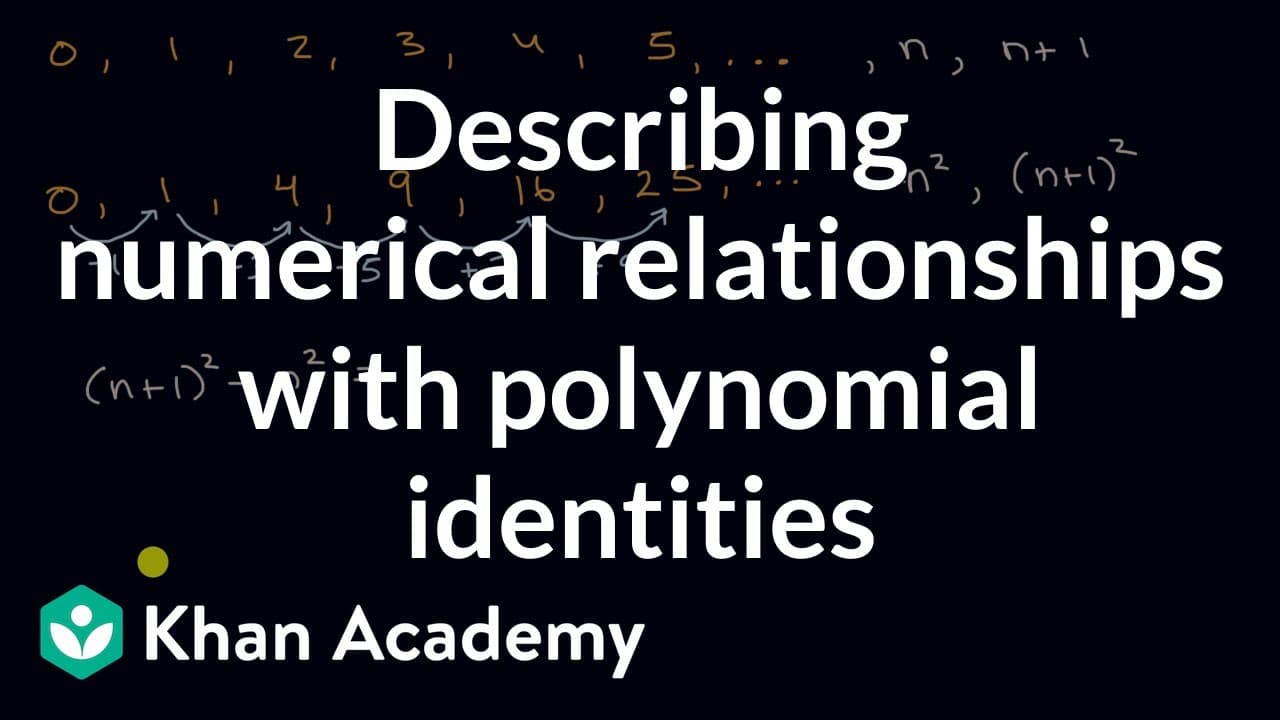
Using polynomial identities, we can prove that the difference between successive terms in a sequence of integers squares is always increasing odd numbers.
Transcript
- [Instructor] What we're going to do in this video is use what we know about polynomials and how to manipulate them and what we've talked about of whether two polynomials are equal to each other for all values of the variable that they're written in, so whether we're dealing with a polynomial identity. And we're going to use those skills in order ... Read More
Key Insights
- 👍 Polynomial identities can be used to prove properties of relationships between numbers.
- 🦕 The difference between successive terms in a sequence of integer squares follows a pattern of increasing odd numbers.
- ❓ By generalizing the pattern using algebraic manipulation, we can establish a polynomial identity that describes the relationship.
- 😑 The polynomial expression for the difference between consecutive terms is equal to two times the variable plus one.
- 😑 This polynomial expression holds true for all integer values of the variable.
- 😑 The expression yields odd numbers and increases by two as the variable increases.
- 👍 Using algebraic manipulation, we can prove that the pattern in the sequence of integer squares always follows this polynomial identity.
Install to Summarize YouTube Videos and Get Transcripts
Explore YouTube Video Summarizer or Get YouTube Transcript Extractor
Questions & Answers
Q: How can we prove properties of relationships between numbers using polynomial identities?
We can use polynomial identities to manipulate expressions and find patterns or relationships between numbers. This allows us to prove various properties and make general statements about number sequences or patterns.
Q: What is the pattern in the difference between successive terms in the sequence of integer squares?
The pattern is that the difference between successive terms is always an increasing sequence of odd numbers. This can be observed by adding increasing odd numbers to each square, resulting in the next square in the sequence.
Q: How can we prove that the pattern in the integer square sequence will always hold true?
By generalizing the pattern using algebra, we can prove that the difference between successive terms can be represented as a polynomial expression. By expanding and simplifying the expression, we can show that it is always equal to two times the variable plus one.
Q: Why does the polynomial expression equal to two times the variable plus one?
The polynomial expression equals two times the variable plus one because it represents the difference between two consecutive squares. By subtracting the variable squared terms and simplifying, we are left with the expression two times the variable plus one.
Summary & Key Takeaways
-
The video discusses using polynomial identities to prove properties of relationships between numbers.
-
It uses the example of a sequence of integer squares to demonstrate the pattern in the difference between successive terms.
-
By using algebra to manipulate the polynomial expression, it is shown that the difference is equal to two times the variable plus one, resulting in increasing odd numbers.
Read in Other Languages (beta)
Share This Summary 📚
Summarize YouTube Videos and Get Video Transcripts with 1-Click
Try YouTube Summary with ChatGPT & Claude or YouTube Transcript Generator
Explore More Summaries from Khan Academy 📚



Summarize YouTube Videos and Get Video Transcripts with 1-Click
Try YouTube Summary with ChatGPT & Claude or YouTube Transcript Generator