Converting within the metric system | Pre-Algebra | Khan Academy
TL;DR
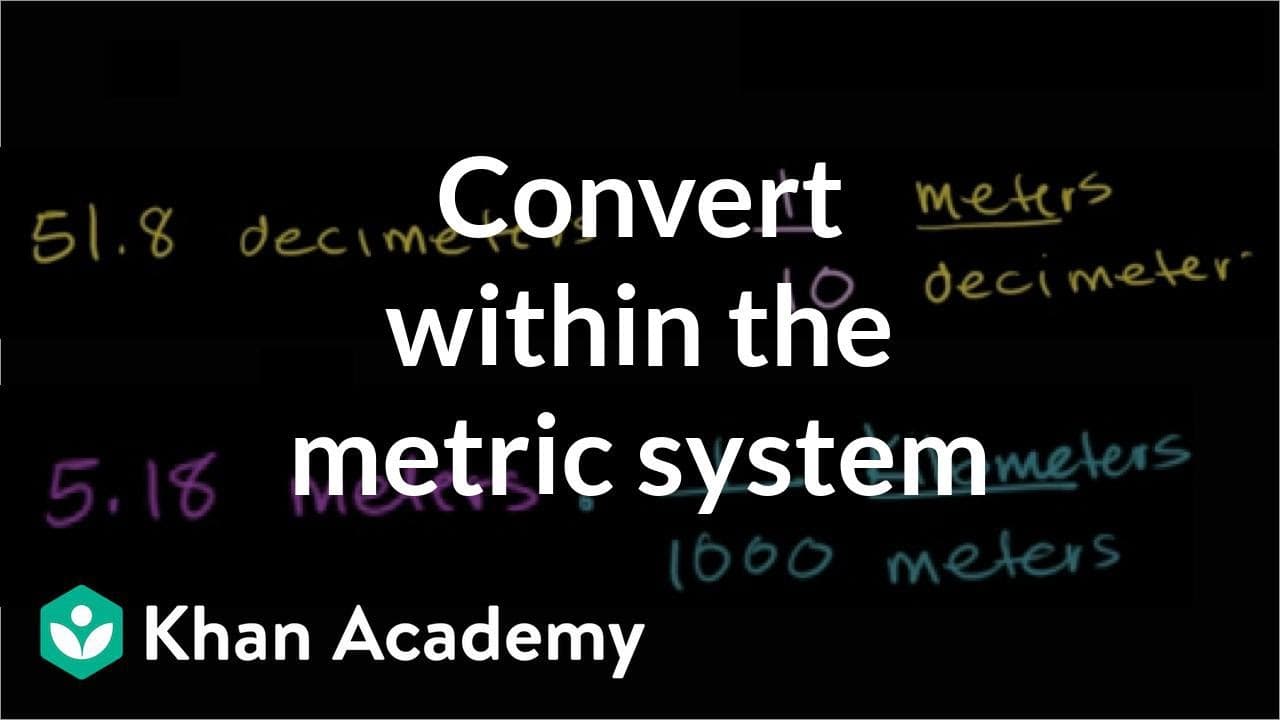
Convert 51.8 decimeters to kilometers by first converting to meters and then to kilometers.
Transcript
Convert 51.8 decimeters to kilometers. So let's just think about what decimeters means in terms of meters, and then we can think about what kilometers mean in terms of meters, and then convert them. So we're going to start with 51.8 decimeters. Now, as a starting point, just to keep things simple, we're going to convert them into meters, because th... Read More
Key Insights
- 🤒 The prefix "deci" in decimeter indicates 1/10, meaning there are 10 decimeters in one meter.
- 🇦🇪 When converting units, you can use conversion factors to cancel out unwanted units.
- 🛩️ Going from a smaller unit to a larger unit results in a smaller quantity.
- 🤒 The prefix "kilo" in kilometer indicates 1,000, meaning there are 1,000 meters in one kilometer.
- 🎭 Performing a reality check helps ensure the accuracy and sensibility of the conversion.
- 🧑🏭 Converting between units involves multiplication or division by specific factors.
- 👈 The decimal point shifts to the left when converting from smaller units to larger units.
Install to Summarize YouTube Videos and Get Transcripts
Explore YouTube Video Summarizer or Get YouTube Transcript Extractor
Questions & Answers
Q: How do you convert decimeters to meters?
To convert decimeters to meters, you multiply the given value by 1/10 or divide it by 10. This is because there are 10 decimeters in one meter.
Q: What is the conversion factor between meters and kilometers?
One kilometer is equal to 1,000 meters. Therefore, to convert meters to kilometers, you divide the value by 1,000.
Q: Why is the quantity of decimeters larger than the equivalent in kilometers?
Decimeters are a smaller unit of length than kilometers. When converting from smaller units to larger units, the quantity of the larger unit will be smaller.
Q: How can you perform a reality check when converting units?
To perform a reality check, you can consider the logic of the conversion. In this case, it makes sense for the quantity to decrease when going from decimeters to meters or from meters to kilometers.
Summary & Key Takeaways
-
To convert 51.8 decimeters to meters, multiply it by 1/10. The result is 5.18 meters.
-
To convert 5.18 meters to kilometers, divide it by 1,000. The result is 0.00518 kilometers.
-
Going from a smaller unit (decimeters) to a larger unit (kilometers) results in a smaller quantity.
Read in Other Languages (beta)
Share This Summary 📚
Summarize YouTube Videos and Get Video Transcripts with 1-Click
Try YouTube Summary with ChatGPT & Claude or YouTube Transcript Generator
Explore More Summaries from Khan Academy 📚



Summarize YouTube Videos and Get Video Transcripts with 1-Click
Try YouTube Summary with ChatGPT & Claude or YouTube Transcript Generator