How to Calculate the Area of a Quadrilateral
TL;DR
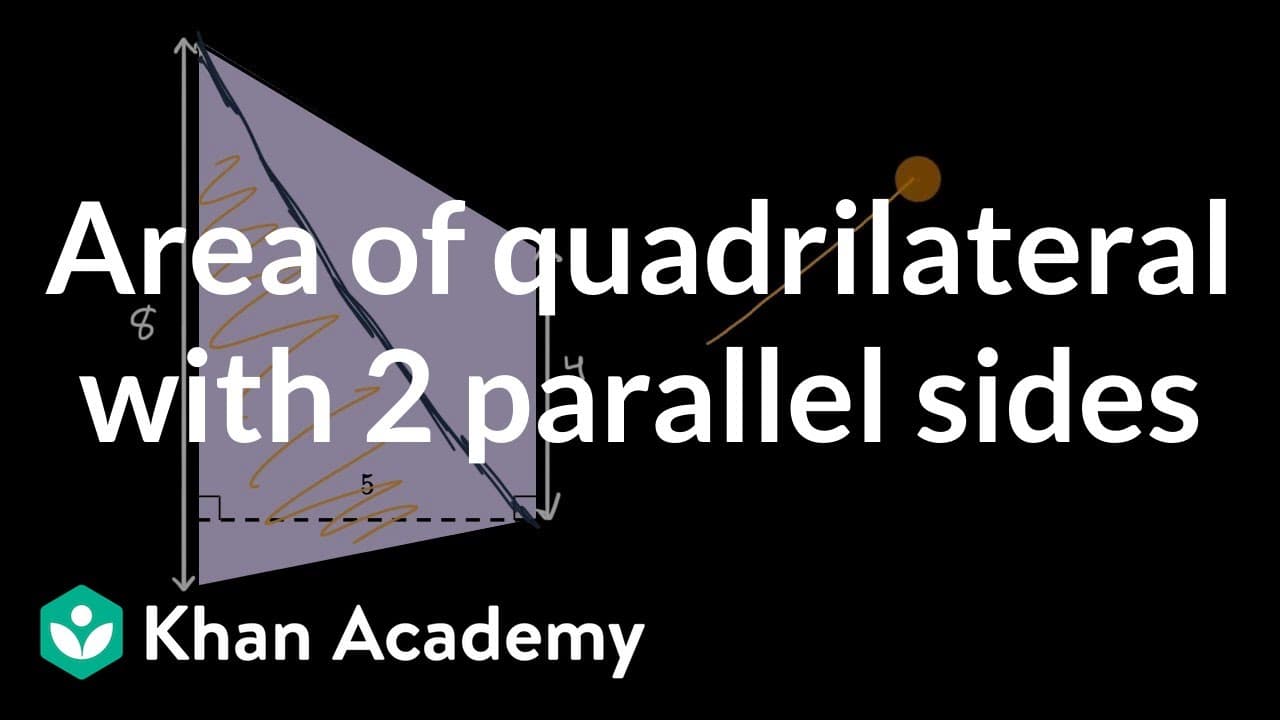
To find the area of a quadrilateral with two parallel sides, divide it into two triangles. Calculate each triangle's area using the formula 1/2 times base times height, then sum both areas for the total quadrilateral area.
Transcript
- [Instructor] What we're going to try to do in this video is find the area of this figure. And we can see it's a quadrilateral. It has 1, 2, 3, 4 sides. And we know that this side and this side that they're parallel to each other. You can see that they both form right angles with this dotted line. So pause this video and see if you can find the ar... Read More
Key Insights
- 🔺 The area of a quadrilateral can be found by dividing it into two triangles and calculating the area of each triangle separately.
- ⌛ The formula for finding the area of a triangle is 1/2 times base times height.
- 🍹 The sum of the areas of the two triangles is equal to the total area of the quadrilateral.
Install to Summarize YouTube Videos and Get Transcripts
Explore YouTube Video Summarizer or Get YouTube Transcript Extractor
Questions & Answers
Q: How can we find the area of a quadrilateral?
To find the area of a quadrilateral, we can divide it into two triangles and calculate their individual areas using the formula 1/2 times base times height. The areas of the triangles can then be added together to find the total area of the quadrilateral.
Q: How do we determine the base and height of each triangle?
In the video, the base and height of each triangle are identified by drawing a line to create a right angle within the quadrilateral. The length of the line forming the right angle is considered the height, while the length of the base is measured horizontally or vertically.
Q: Is there another way to express the formula for finding the area of the quadrilateral?
Yes, the formula can be expressed as 1/2 times the sum of the lengths of the two bases, multiplied by the height. This formula considers the average of the length of the two bases and simplifies the calculation.
Q: What is the significance of factoring out 1/2 and 5 in the formula?
Factoring out 1/2 and 5 in the formula allows us to simplify the calculation further. By grouping the terms, the formula becomes 1/2 times the sum of the lengths of the two bases, multiplied by 5.
Summary & Key Takeaways
-
The video demonstrates how to find the area of a quadrilateral by dividing it into two triangles.
-
Each triangle is then analyzed separately, with the base and height measurements identified.
-
The areas of the two triangles are calculated and then added together to find the total area of the quadrilateral.
Read in Other Languages (beta)
Share This Summary 📚
Summarize YouTube Videos and Get Video Transcripts with 1-Click
Try YouTube Summary with ChatGPT & Claude or YouTube Transcript Generator
Explore More Summaries from Khan Academy 📚



Summarize YouTube Videos and Get Video Transcripts with 1-Click
Try YouTube Summary with ChatGPT & Claude or YouTube Transcript Generator