What Are the Key Rules for Finding Derivatives?
TL;DR
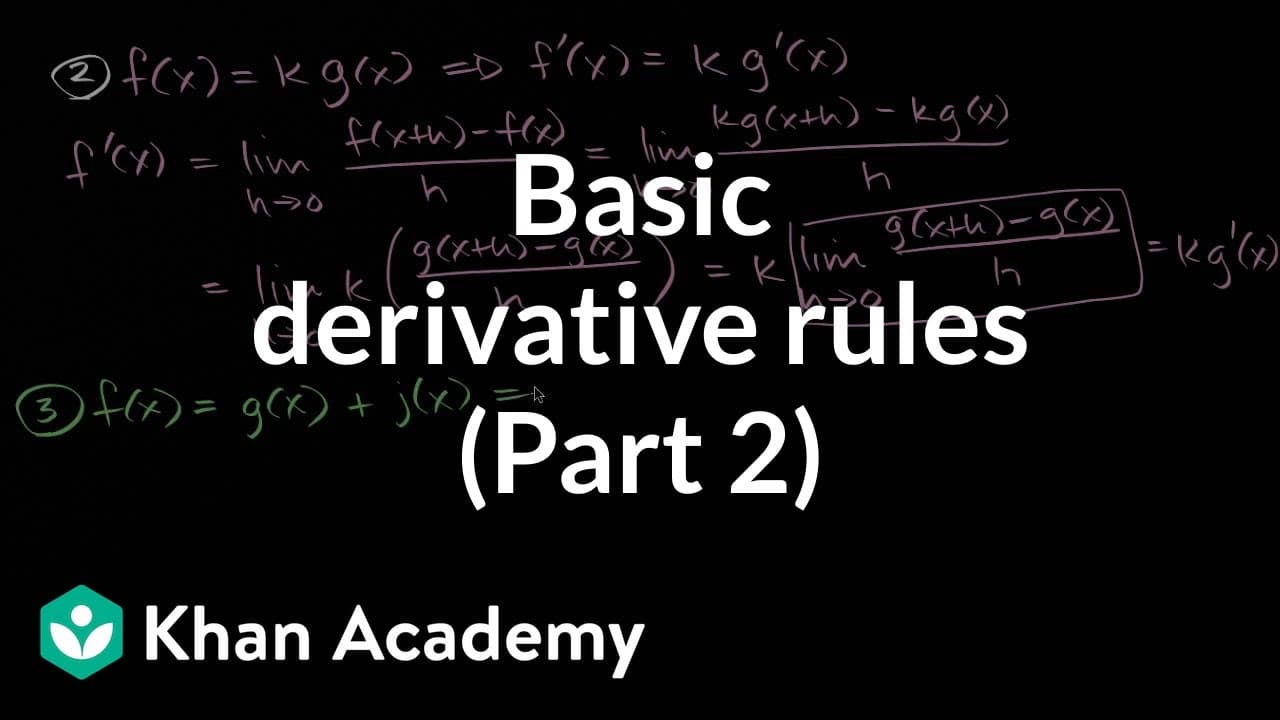
Derivatives of constant functions are always zero. If a function is multiplied by a constant, its derivative equals that constant multiplied by the derivative of the other function. Additionally, the derivative of a sum or difference of functions is the sum or difference of their respective derivatives, crucial concepts for mastering calculus.
Transcript
- [Voiceover] In the last video we introduced you to the derivative property right over here that if my function is equal to some constant that the derivative is going to be zero at any X, and we made a graphical argument and we also used the definition of the limits to feel good about that. Now let's give a few more of these properties and these a... Read More
Key Insights
- 0️⃣ Derivatives of constant functions are always zero.
- ✖️ The derivative of a function multiplied by a constant is equal to that constant multiplied by the derivative of the function.
- 🍹 The derivative of a function that is the sum of two other functions is equal to the sum of the derivatives of the two functions.
- 🤘 The same rule applies when the sum is replaced with a difference, but the signs of the derivatives change accordingly.
- 💯 These core properties of derivatives are essential in finding derivatives in calculus.
- ❓ Graphical and algebraic arguments can be used to explain the properties.
- ❓ Knowing and understanding these properties will be beneficial for solving derivative problems in the future.
Install to Summarize YouTube Videos and Get Transcripts
Explore YouTube Video Summarizer or Get YouTube Transcript Extractor
Questions & Answers
Q: What is the derivative of a constant function?
The derivative of a constant function is always zero, as there is no change in slope.
Q: How do we find the derivative of a function multiplied by a constant?
To find the derivative of a function multiplied by a constant, we can simply multiply the constant by the derivative of the function.
Q: What is the derivative of a function that is the sum of two other functions?
The derivative of a function that is the sum of two other functions is equal to the sum of the derivatives of the two functions.
Q: Is the derivative of a function that is the difference of two other functions the same as the sum of their derivatives?
No, the derivative of a function that is the difference of two other functions is equal to the difference of their derivatives.
Summary & Key Takeaways
-
The derivative of a constant function is always zero.
-
If a function is equal to a constant multiplied by another function, the derivative of the first function is equal to that constant multiplied by the derivative of the second function.
-
If a function is the sum or difference of two other functions, the derivative of the first function is equal to the sum or difference of the derivatives of the two functions.
Read in Other Languages (beta)
Share This Summary 📚
Summarize YouTube Videos and Get Video Transcripts with 1-Click
Try YouTube Summary with ChatGPT & Claude or YouTube Transcript Generator
Explore More Summaries from Khan Academy 📚



Summarize YouTube Videos and Get Video Transcripts with 1-Click
Try YouTube Summary with ChatGPT & Claude or YouTube Transcript Generator