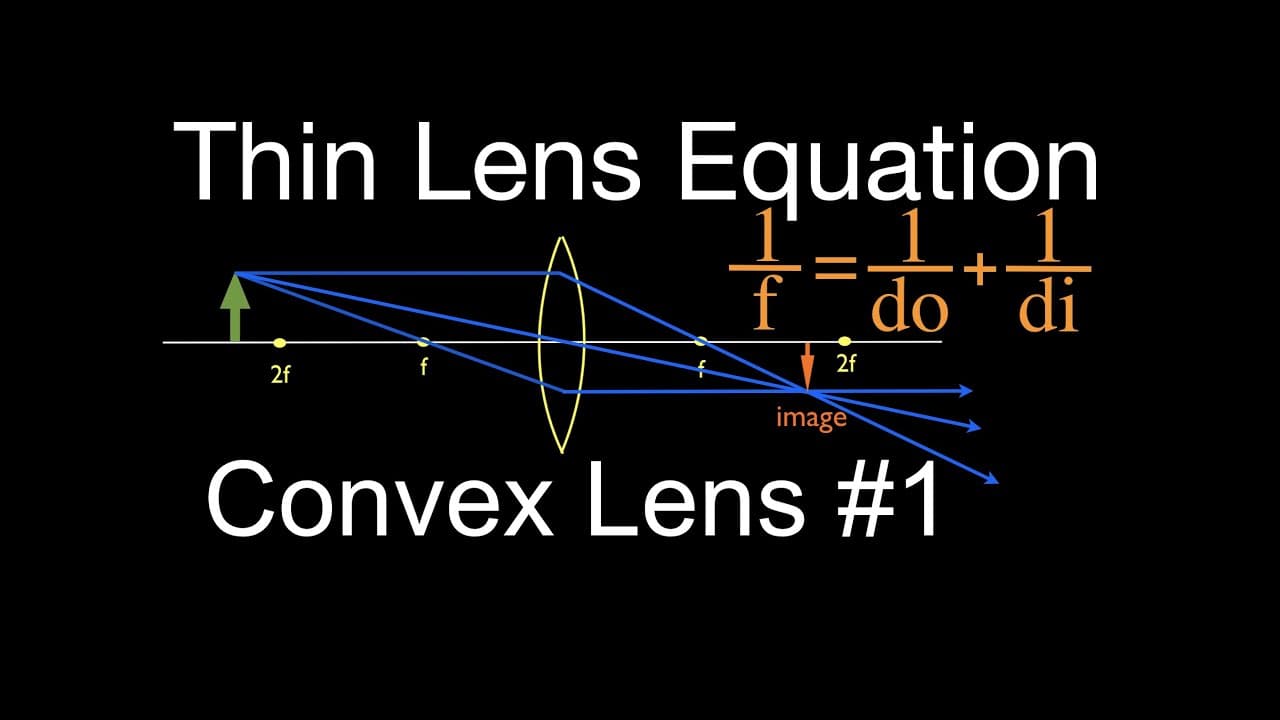
Thin Lens Equation (1of 6) Convex Lens, Object Distance Greater Then f.
TL;DR
- Calculate image distance, height, and orientation for convex lenses using the thin lens equation.
Transcript
okay in today's video I am going to go over how to use the thin lens equation to calculate the image distance the image height and the image orientation for convex lenses in this case we're going to have the object distance is greater than F so we know that if it's greater than F we have a certain case and if it's at F there's a certain case there ... Read More
Key Insights
- 🤔 The thin lens equation is fundamental in determining image properties for convex lenses.
- 🤘 Understanding the focal length sign is crucial for accurate lens calculations.
- ❎ Negative magnification values indicate an inverted image compared to the object.
- 🧘 Positioning the image relative to F and 2F helps in verifying calculated results.
- 🦮 Step-by-step calculations using real values provide a practical guide.
- 🤔 Ensuring all information is accurately inputted in the thin lens equation is essential.
- ❓ The image size and orientation can be accurately predicted through the calculations' results.
Install to Summarize YouTube Videos and Get Transcripts
Explore YouTube Video Summarizer or Get YouTube Transcript Extractor
Questions & Answers
Q: How can the thin lens equation be used to calculate image properties for convex lenses?
The thin lens equation, 1/F = 1/do + 1/di, helps in determining image distance, height, and orientation for convex lenses. Following the steps of the equation with given values yields accurate results.
Q: What does a negative magnification value signify in lens calculations?
A negative magnification value in lens calculations indicates the image is inverted compared to the object. This inversion is crucial in determining the orientation of the image formed by the lens system.
Q: Why is it important to consider the focal length sign in lens calculations?
The sign of the focal length is critical as it signifies the nature of the lens. Positive focal length pertains to convex lenses, while negative focal length corresponds to concave lenses. This distinction helps in accurate calculations.
Q: How does the position of the image relative to the lens elements affect calculations?
The position of the image relative to the lens elements, such as F and 2F, influences the image properties. For convex lenses, if the image is between F and 2F, it indicates a specific size and orientation, aiding in verifying calculated results.
Summary & Key Takeaways
-
Detailed explanation on using the thin lens equation for convex lenses.
-
Step-by-step guide on calculating image distance, height, and orientation.
-
Demonstrated calculations with real numbers for better understanding.
Read in Other Languages (beta)
Share This Summary 📚
Summarize YouTube Videos and Get Video Transcripts with 1-Click
Try YouTube Summary with ChatGPT & Claude or YouTube Transcript Generator
Explore More Summaries from Step by Step Science 📚
Summarize YouTube Videos and Get Video Transcripts with 1-Click
Try YouTube Summary with ChatGPT & Claude or YouTube Transcript Generator