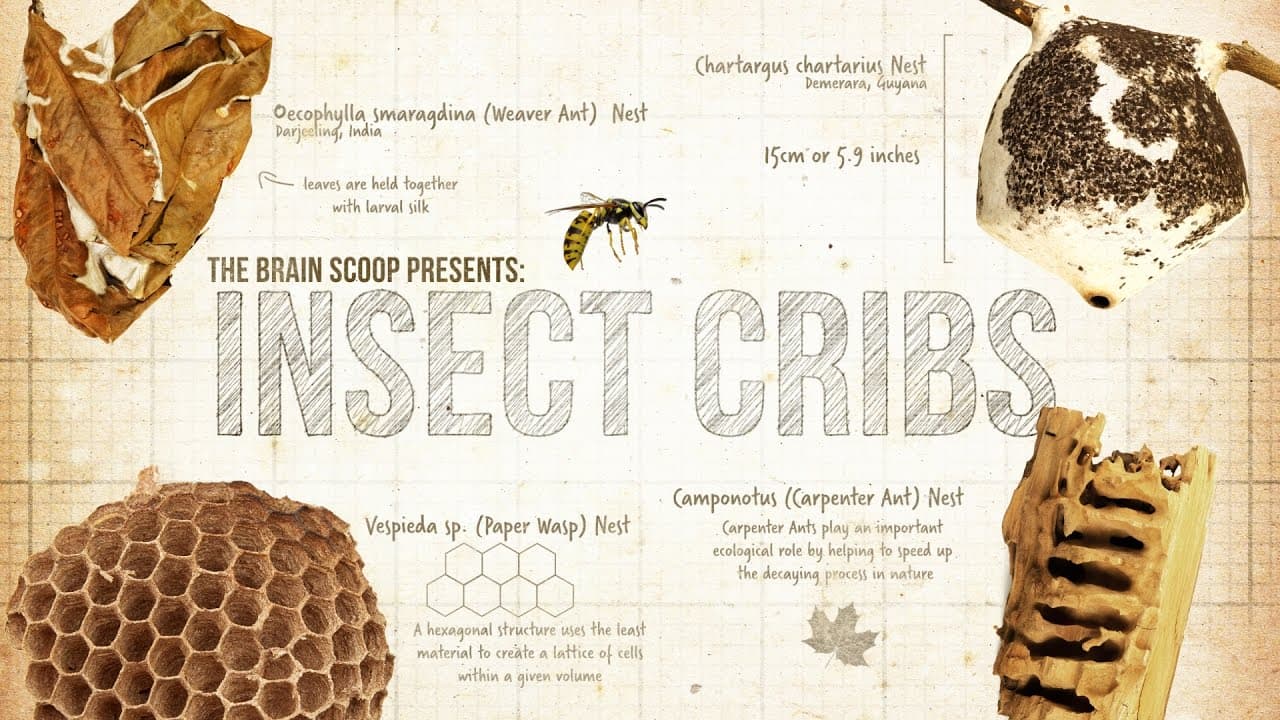
Inside Insect Nests
TL;DR
Insect societies vary from eusocial bees to solitary wasps, showcasing intriguing behaviors and interactions in their habitats.
Transcript
Honey bees are the ultimate social creatures and they've evolved to organize themselves in complex and interesting ways in order toprogress and optimize the productivity of their species In fact, they're what we call "eusocial" animals This is a term given to organisms that live in multi-generational groups, cooperatively take care of their young, ... Read More
Key Insights
- 🤰 Eusocial insects like bees and ants exhibit complex social structures with specialized roles and reproductive hierarchies.
- 🤰 Insect behaviors, such as floating fire ants and carpenter ants' decapitation of prey, reveal unique adaptations for survival and ecosystem functions.
- 🌱 Mutualistic relationships between insects and plants, like stinging ants and certain tree species, showcase co-evolution and resource sharing.
- 👷 Solitary wasps, like potter wasps, exhibit sub-social behaviors by constructing mud vessels for their offspring, showcasing diverse parenting strategies in insects.
- 😉 Gall wasps and their plant interactions have historical significance, as their galls were used in early ink and dye production.
- 🪹 Mud daubers, while solitary, can unintentionally cause damage in human environments, such as airline safety concerns with their nest-building habits.
- 👑 Termite colonies, with queen termites as reproductive slaves, demonstrate extreme reproductive output and intricate social structures within insect societies.
Install to Summarize YouTube Videos and Get Transcripts
Explore YouTube Video Summarizer or Get YouTube Transcript Extractor
Questions & Answers
Q: What defines eusocial insects like honey bees from other species?
Eusociality in insects involves multi-generational groups, caste systems, and division of labor, with specialized roles like worker bees and a single reproducer queen, such as Beyonce in honey bee colonies.
Q: How do fire ants showcase resilience in their colonies?
Fire ants band together and float on water during floods, with a queen capable of laying a thousand eggs a day, making them challenging to eradicate and highly adaptable insects.
Q: How do carpenter ants contribute to ecosystems despite being pests?
Carpenter ants play a role in accelerating decay processes by feeding on dead insects rather than wood, showcasing a unique ecological function within their social structures.
Q: How do stinging ants and specific tree species maintain a mutually beneficial relationship?
Certain tree species have adapted to provide shelter and support for stinging ants, who in turn protect the trees from herbivores, demonstrating a symbiotic relationship with evolutionary adaptations.
Summary & Key Takeaways
-
Eusocial bees, like honey bees, have intricate social structures with a queen bee for reproduction and specialized worker roles.
-
Fire ants exhibit resilience, floating during floods and creating complex colonies, seen through molten aluminum castings.
-
Carpenter ants bore through wood but do not eat it, feasting on decapitated insects and aphids for nutrition.
Read in Other Languages (beta)
Share This Summary 📚
Summarize YouTube Videos and Get Video Transcripts with 1-Click
Try YouTube Summary with ChatGPT & Claude or YouTube Transcript Generator
Explore More Summaries from thebrainscoop 📚

Summarize YouTube Videos and Get Video Transcripts with 1-Click
Try YouTube Summary with ChatGPT & Claude or YouTube Transcript Generator