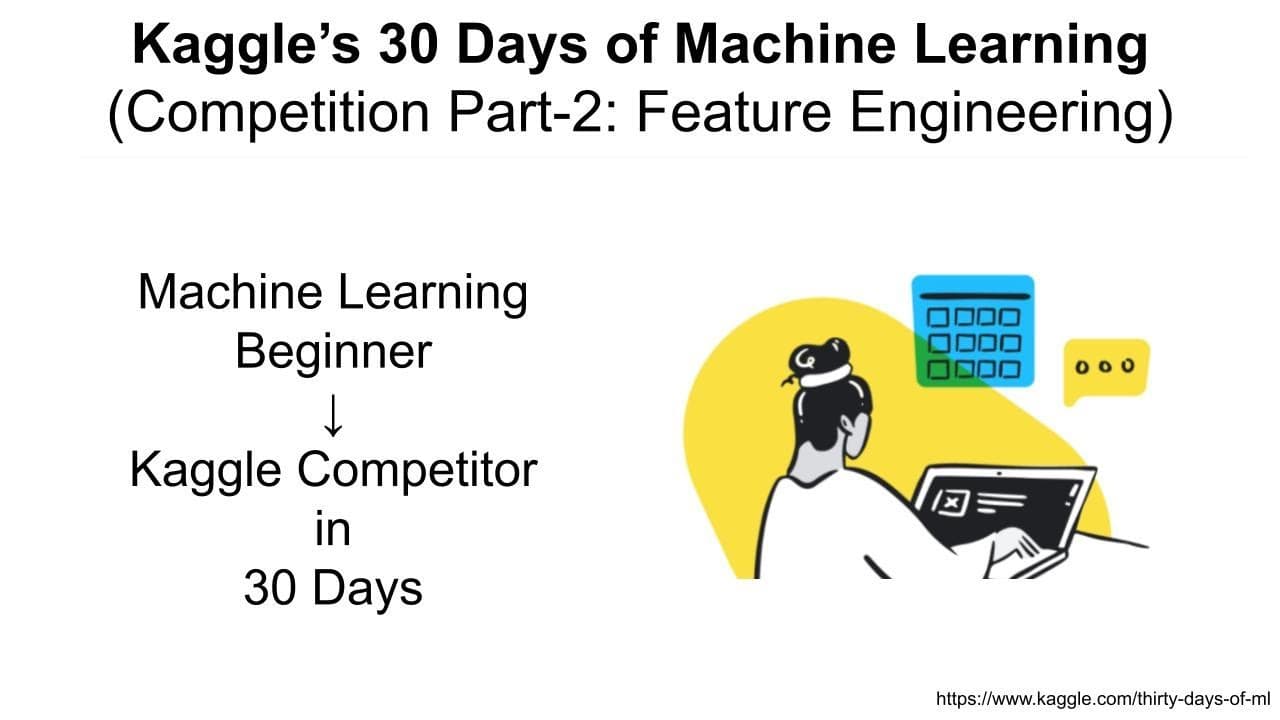
Kaggle's 30 Days Of ML (Competition Part-2): Feature Engineering (Categorical & Numerical Variables)
TL;DR
This video discusses feature engineering in machine learning competitions and provides examples of different techniques to improve model performance.
Transcript
hello everyone and welcome to my youtube channel this is part two of the competition from 30 days of ml so i have decided to uh divide uh the videos into parts instead of days now um and there will be several parts for the competition today we are going to take a look into feature engineering before we dive into that i will show you something at th... Read More
Key Insights
- 🎰 Feature engineering is crucial for improving model performance in machine learning competitions.
- 🧑💻 Techniques like standardization, normalization, log transformation, and polynomial features can help capture meaningful patterns in the data.
- 😅 Binning numerical features and performing one-hot encoding on categorical variables are additional feature engineering methods that can be explored.
Install to Summarize YouTube Videos and Get Transcripts
Explore YouTube Video Summarizer or Get YouTube Transcript Extractor
Questions & Answers
Q: Why is it important to focus on feature engineering in machine learning competitions?
Feature engineering plays a crucial role in improving model performance as it involves transforming and creating new features from the existing dataset, helping the model to capture patterns and relationships more effectively.
Q: How does standardization of numerical features impact the model's performance?
Standardization of numerical features involves subtracting the mean value and dividing by the standard deviation. This process helps to bring the features to a similar scale, preventing any particular feature from dominating the others and allowing the model to give equal importance to all features.
Q: What is the purpose of polynomial features in feature engineering?
Polynomial features involve creating new features by multiplying existing features together. This technique can help capture non-linear relationships between variables, allowing the model to better fit complex patterns in the data.
Q: How does one-hot encoding impact categorical variables in feature engineering?
One-hot encoding converts categorical variables into binary features, assigning a "1" for the presence of a particular category and "0" for all other categories. This allows the model to interpret categorical variables as numerical features, enabling it to learn from the presence or absence of different categories.
Summary & Key Takeaways
-
The video introduces the concept of feature engineering in machine learning competitions and emphasizes the importance of focusing on one's own model instead of blindly copying others.
-
The video demonstrates how to implement feature engineering techniques such as standardization, normalization, log transformation, and polynomial features using Python libraries.
-
The video also mentions the possibility of binning numerical features and performing one-hot encoding on categorical variables as further feature engineering methods.
Read in Other Languages (beta)
Share This Summary 📚
Summarize YouTube Videos and Get Video Transcripts with 1-Click
Try YouTube Summary with ChatGPT & Claude or YouTube Transcript Generator
Explore More Summaries from Abhishek Thakur 📚



Summarize YouTube Videos and Get Video Transcripts with 1-Click
Try YouTube Summary with ChatGPT & Claude or YouTube Transcript Generator