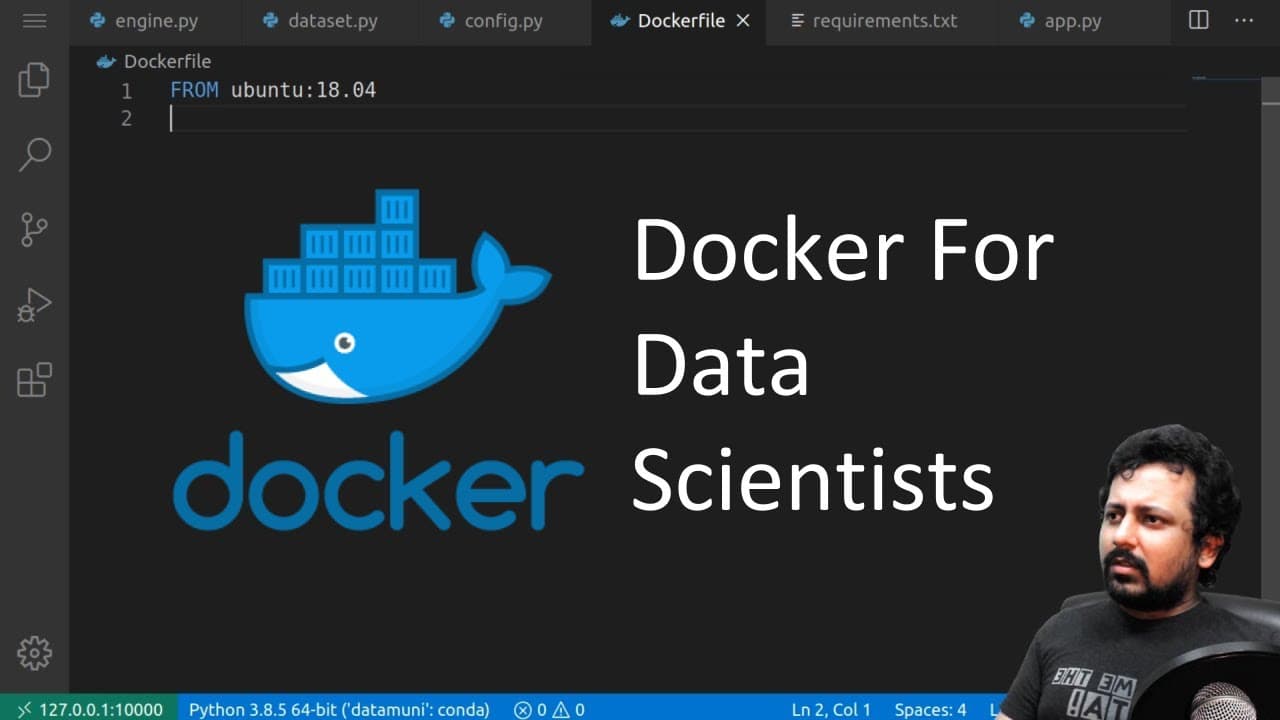
Docker For Data Scientists
TL;DR
Learn how to use Docker to train and deploy machine learning models, including how to set up the environment and build a Docker image.
Transcript
hello everyone and welcome to my new video in this video i'm going to show you how you can use docker to train machine learning and deep learning models and how you can use docker to expose an end point using flask so in order to serve the deep learning or machine learning model that you have trained so this is not an in-depth introduction video of... Read More
Key Insights
- 💨 Docker provides a convenient way to package and deploy machine learning models, ensuring consistency across different environments.
- 👻 Volume mounting allows for easy sharing of files between the local machine and the Docker container, enabling data persistence and collaboration.
- 😫 The process of training and deploying machine learning models using Docker requires setting up the environment, building a Docker image, and running the desired commands within the container.
- 🎰 Dockerizing machine learning workflows simplifies development, testing, and deployment, making it easier to share models and collaborate with teammates.
- 😒 The use of Docker allows for easy scaling and parallelization of model training by leveraging multiple GPUs or CPUs.
- 🚂 Saving trained models outside the Docker container ensures that they can be accessed and used beyond the lifespan of the container.
- 🎰 Deploying machine learning models using Docker eliminates the "works on my machine" problem, ensuring consistent results across different systems.
Install to Summarize YouTube Videos and Get Transcripts
Explore YouTube Video Summarizer or Get YouTube Transcript Extractor
Questions & Answers
Q: What is the purpose of using Docker for training machine learning models?
Docker allows for easy deployment of machine learning models, ensuring consistency across different environments. It provides isolation, reproducibility, and scalability, making it ideal for training and deploying models.
Q: Can you explain the process of mounting volumes in Docker?
Mounting volumes allows you to share files between your local machine and the Docker container. By specifying the local path and the container path using the "-v" flag, you can access and modify files without rebuilding the container.
Q: Why is it recommended to save the trained model outside the Docker container?
Saving the trained model outside the Docker container ensures that the model is not lost when the container is terminated. By using volume mounting, you can persist the model and access it even after the container is stopped or deleted.
Q: How can Docker help with deploying machine learning models?
Docker simplifies the deployment process by providing a consistent environment for running the model. It allows you to package the model, its dependencies, and a Flask API into a container, making it easier to distribute and deploy the model in different environments.
Summary & Key Takeaways
-
The video covers the use of Docker for training and deploying machine learning models, focusing on training deep learning models and deploying them using Flask.
-
The presenter demonstrates downloading a dataset and using code from a previous video on sentiment classification using BERT.
-
The required files for training (model files, engine, dataset, etc.) are copied into the Docker container, and the necessary dependencies are installed using a requirements.txt file.
-
The presenter shows how to train the model both locally and within the Docker container, and also explains how to mount volumes to persist data between the container and the local machine.
Read in Other Languages (beta)
Share This Summary 📚
Summarize YouTube Videos and Get Video Transcripts with 1-Click
Try YouTube Summary with ChatGPT & Claude or YouTube Transcript Generator
Explore More Summaries from Abhishek Thakur 📚

Summarize YouTube Videos and Get Video Transcripts with 1-Click
Try YouTube Summary with ChatGPT & Claude or YouTube Transcript Generator