How Does C++ Convert Source Code to Executable Files?

TL;DR
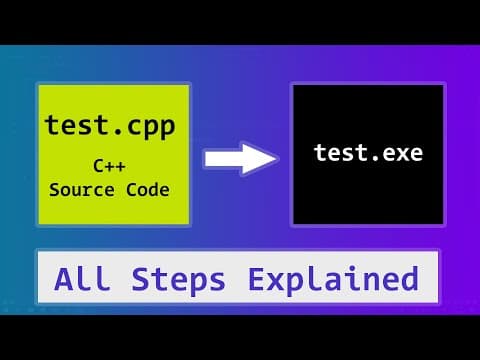
C++ programs are converted into executable files through a process involving compilers, linkers, and archivers. First, the compiler transforms source code into object files, then the archiver groups these into libraries, and finally, the linker resolves references to create an executable. IDEs simplify this workflow by providing a graphical interface for managing these tools.
Transcript
Hi this is anil and welcome to your second video tutorial on c++ programming. So in this tutorial we are gonna see some basic terms and the software's used in the development of c++, the compilers, archivers, linkers, toolsets, ide's and also we are gonna see how c++ works or you know what is the process to get an executable or an exe file from an ... Read More
Key Insights
- ❓ C++ programs are created using compilers, linkers, and archivers, collectively known as toolsets.
- 👨💻 Compilers convert C++ source code into object files with executable code and symbol references.
- 👥 Archivers group object files into static libraries for convenient use.
- 📚 Linkers resolve symbol references in object files and libraries to produce executables or dynamic libraries.
- 👨💻 Executables are standalone programs, while dynamic libraries provide reusable code for applications.
- 🫥 Various command line tools are available for different toolsets, such as GCC, Visual C++, and Intel.
- 🍻 IDEs (Integrated Development Environments) provide a graphical interface for managing source files and automating the compilation and linking processes.
Install to Summarize YouTube Videos and Get Transcripts
Explore YouTube Video Summarizer or Get YouTube Transcript Extractor
Questions & Answers
Q: What are the three basic tools used in building C++ applications?
The three basic tools are compilers, linkers, and archivers. Compilers convert C++ source files into object files containing executable code and symbol references. Archivers group object files into a static library. Linkers resolve symbolic references to produce executables or dynamic libraries.
Q: What is the role of a compiler in C++ programming?
A compiler takes C++ source files as input and produces object files. These object files contain machine executable code, as well as symbolic references to functions and data used in the program. The compiler translates the C++ code into a format that can be understood by the computer.
Q: How does the linker contribute to the development process?
The linker takes a collection of object files and libraries and resolves their symbolic references. It produces either an executable file or a dynamic library. The linker ensures that all the references to functions and data in the object files are correctly resolved, resulting in a usable program.
Q: What is the difference between an executable and a dynamic library?
An executable is a program that can be executed by the operating system, such as Notepad or Wordpad. It can run independently. A dynamic library, also known as a shared library or DLL (Dynamic Link Library) file on Windows, cannot be run on its own but can be utilized by application files. It provides reusable code for multiple programs.
Summary & Key Takeaways
-
This tutorial introduces the basic terms and software used in C++ development, such as compilers, archivers, linkers, and toolsets.
-
It explains how C++ works by converting source files to executable files using compilers, archivers, and linkers.
-
The tutorial also discusses the concept of executables and dynamic libraries.
Read in Other Languages (beta)
Share This Summary 📚
Summarize YouTube Videos and Get Video Transcripts with 1-Click
Try YouTube Summary with ChatGPT & Claude or YouTube Transcript Generator
Explore More Summaries from LearningLad 📚


Summarize YouTube Videos and Get Video Transcripts with 1-Click
Try YouTube Summary with ChatGPT & Claude or YouTube Transcript Generator