Contract Law 32 II Hill v Gateway 2000 (acceptance by non-return)
TL;DR
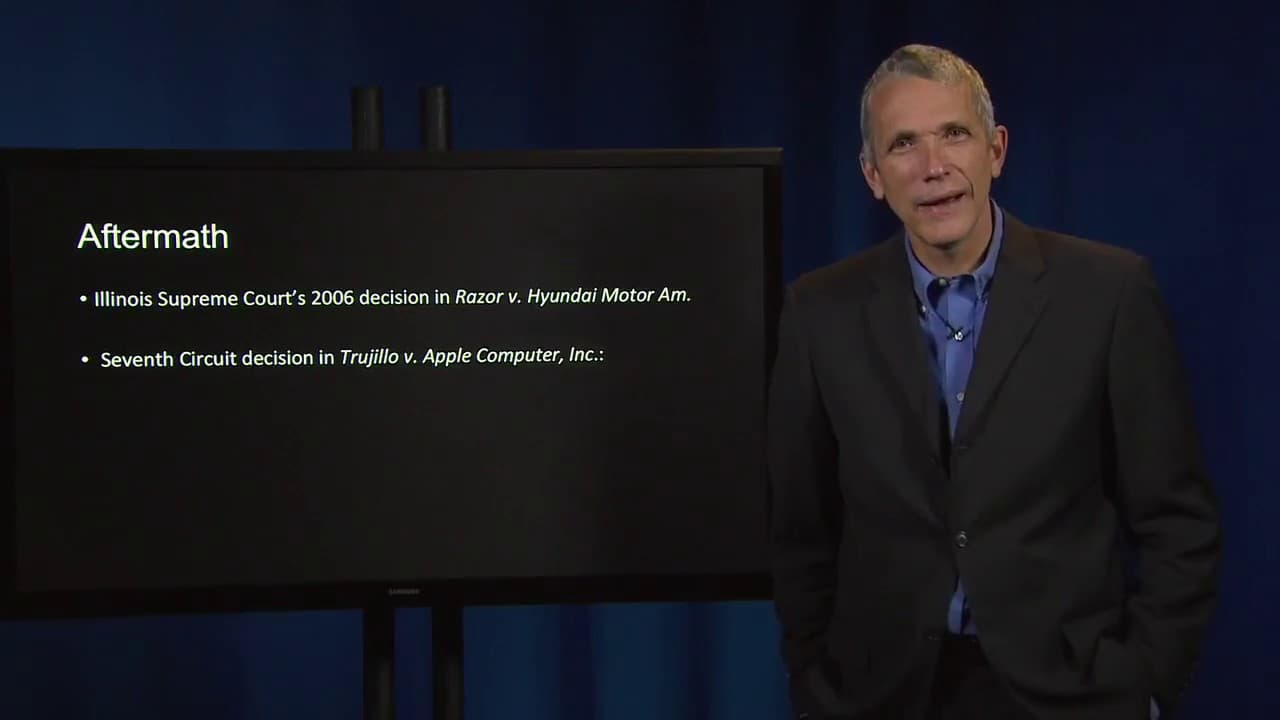
Two court cases reached opposite conclusions on whether customers are bound by terms and conditions in shipment documents when purchasing products over the phone or online.
Transcript
you've probably purchased something over the phone or online at some point in your life after giving your credit card information and any and pain for the item it's shipped to you often that shipment contains in addition to whatever you bought a document containing terms and conditions of the sale such documents often include warranty information a... Read More
Key Insights
- 🍉 Court cases Hill and Clocha had opposing conclusions on whether customers are bound by terms and conditions in shipment documents.
- 🍉 Judge Easterbrook's opinion in Hill relied on the principle that acceptance can be implied by keeping the product after receiving the terms and conditions.
- 🍉 The court in Clocha rejected Hill's reasoning and argued that additional terms do not become part of the contract unless the customer explicitly agrees.
- 🖐️ UCC Section 2-207, the Battle of the Forms provision, played a role in determining whether the additional terms were binding.
Install to Summarize YouTube Videos and Get Transcripts
Explore YouTube Video Summarizer or Get YouTube Transcript Extractor
Questions & Answers
Q: Are customers bound by the terms and conditions in shipment documents when purchasing products over the phone or online?
It depends on the court's interpretation. In the Hill case, the judge ruled that keeping the product after receiving the terms and conditions binds the customer. However, in the Clocha case, the court held that explicit agreement is necessary.
Q: What factors influenced the rulings in these court cases?
In Hill, the judge was influenced by a previous influential case, pro CD versus Zeidanburg, which shaped their opinion. The judge in Hill considered when the contract between the customer and the company was actually formed. The court in Clocha disagreed with Hill and referred to UCC Section 2-207.
Q: What is UCC Section 2-207 and how does it relate to these cases?
UCC Section 2-207 is the Battle of the Forms provision. According to this provision, additional terms in a contract are considered proposals for additions to the contract unless both parties are merchants and explicitly agree to them. In Clocha, the court interpreted this section to determine that the customer was not bound by the additional terms.
Q: Is it fair to use rolling contracts and expect customers to accept or return terms that accompany ordered goods?
This is a matter of policy and opinion. The court cases presented opposite viewpoints on this issue. The policy justifications for enforcing the accept or return terms include simplifying the purchase process, while the alternative is clearly communicating all terms at the time of sale.
Summary & Key Takeaways
-
Two court cases, Hill and Clocha, involved customers purchasing computers over the phone and receiving shipments containing terms and conditions, including arbitration clauses.
-
In Hill, the judge ruled that by keeping the computer after receiving the terms and conditions, the customer was bound by the arbitration clause.
-
However, in Clocha, the court disagreed and stated that the customer was not bound by the terms and conditions unless they expressly agreed to them.
Read in Other Languages (beta)
Share This Summary 📚
Summarize YouTube Videos and Get Video Transcripts with 1-Click
Try YouTube Summary with ChatGPT & Claude or YouTube Transcript Generator
Explore More Summaries from YaleCourses 📚



Summarize YouTube Videos and Get Video Transcripts with 1-Click
Try YouTube Summary with ChatGPT & Claude or YouTube Transcript Generator