Special Relativity | Lecture 1
Transcript
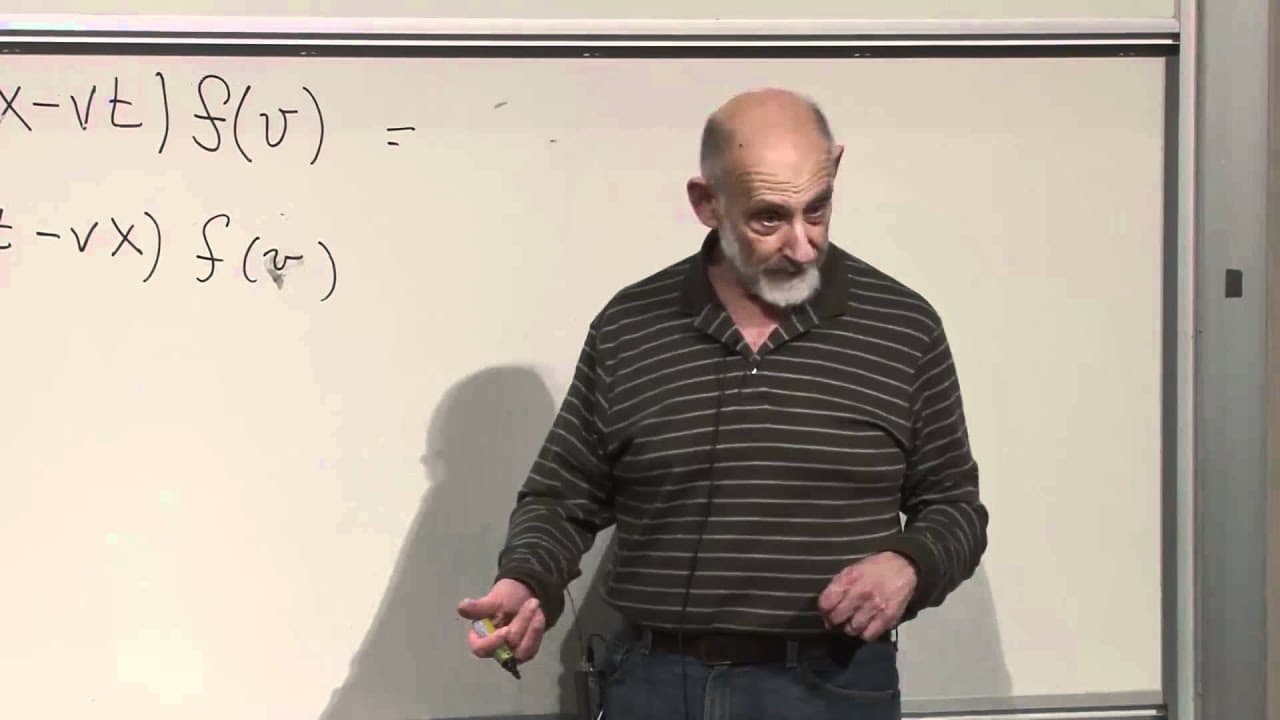
stanford university the subject this quarter is a collection of things but mostly special relativity and field theory we're coming back now not quantum field theory we're not prepared for quantum field theory yet we've learned classical mechanics those who have uh participated up till now classical mechanics the general structure of classical mecha... Read More
Install to Summarize YouTube Videos and Get Transcripts
Explore YouTube Video Summarizer or Get YouTube Transcript Extractor
Summary
This video is a lecture from Stanford University on the topic of special relativity and classical field theory. The speaker discusses the differences between classical mechanics and quantum mechanics, and introduces the concept of reference frames. He then delves into the principle of relativity and explains how the speed of light plays a crucial role in unifying these different frames of reference. The lecture ends with a exploration of the synchronization of clocks and the relationship between coordinates in different reference frames.
Questions & Answers
Q: What is the main subject being taught this quarter?
The main subject being taught this quarter is special relativity and field theory, specifically in the context of classical field theory.
Q: What subjects have the students previously learned?
The students have previously learned classical mechanics and some elements of quantum mechanics.
Q: Why is quantum mechanics not being covered this quarter?
Quantum mechanics is not being covered this quarter because more foundation in classical physics is needed before delving into quantum mechanics and quantum field theory.
Q: What is the goal for this quarter's study?
The goal for this quarter's study is to understand and explore the special theory of relativity and classical field theory in the context of electromagnetism.
Q: Has everyone already learned about special relativity?
Most of the students have already learned about special relativity.
Q: Are the students willing to review special relativity?
Yes, the students are willing to review special relativity as an essential foundation for the course.
Q: What is a reference frame?
A reference frame is a coordinate system used to specify the position and orientation of an object or event. It consists of spatial coordinates (x, y, z) and a time coordinate (t).
Q: How does a moving reference frame differ from a stationary reference frame?
In a moving reference frame, the coordinates of an event will be different due to the relative motion. Additionally, the concept of simultaneity may differ between different reference frames.
Q: What is the principle of relativity?
The principle of relativity states that the laws of physics are the same in every reference frame that is in uniform motion relative to each other.
Q: What did Einstein add to the principle of relativity?
Einstein added the law that the speed of light is constant in every reference frame, regardless of its motion or the motion of the light source.
Q: How does the constancy of the speed of light affect the relationship between reference frames?
The constancy of the speed of light means that the coordinate transformations between reference frames must involve a factor that ensures the speed of light remains the same. This factor, denoted as 'f', depends on the velocity between the two frames.
Takeaways
In this video lecture, the speaker explains the concepts of special relativity and classical field theory. He emphasizes the importance of understanding reference frames and the principle of relativity, as well as the role of the speed of light in unifying different frames of reference. The lecture highlights the need for synchronized clocks and the transformation of coordinates to account for the relativistic effects. Overall, it provides a solid foundation for further study in special relativity and field theory.
Read in Other Languages (beta)
Share This Summary 📚
Summarize YouTube Videos and Get Video Transcripts with 1-Click
Try YouTube Summary with ChatGPT & Claude or YouTube Transcript Generator
Explore More Summaries from Stanford 📚

Summarize YouTube Videos and Get Video Transcripts with 1-Click
Try YouTube Summary with ChatGPT & Claude or YouTube Transcript Generator