Negative fractional exponent examples | Algebra I | Khan Academy
TL;DR
Fractional exponents with negative powers can be simplified by taking the reciprocal and raising it to the positive exponent.
Transcript
Let's do some slightly more complicated fractional exponent examples. So we already know that if I were to take 9 to the 1/2 power, this is going to be equal to 3, and we know that because 3 times 3 is equal to 9. This is equivalent to saying, what is the principal root of 9? Well, that is equal to 3. But what would happen if I took 9 to the negati... Read More
Key Insights
- 🫚 A fractional exponent indicates taking the principal root of a number.
- 🤨 Negative exponents can be simplified by taking the reciprocal and raising it to the positive exponent.
- 🫚 Understanding the concept of principal roots is crucial in evaluating fractional exponents.
- ✊ Negative numbers raised to odd powers result in negative values.
- ❓ The process of simplifying fractional exponents involves step-by-step analysis.
- 🤘 Taking the reciprocal of a negative number can change the sign of the result.
- 🍵 Fractional exponents with negative powers can be handled by breaking them down into separate steps.
Install to Summarize YouTube Videos and Get Transcripts
Explore YouTube Video Summarizer or Get YouTube Transcript Extractor
Questions & Answers
Q: How do you simplify a fractional exponent with a negative power?
To simplify a fractional exponent with a negative power, you can rewrite it as the reciprocal of the base raised to the positive exponent. For example, 9 to the power of -1/2 becomes 1/9 to the power of 1/2.
Q: What is the principal root of 9?
The principal root of 9 is 3. This can be found by raising 9 to the power of 1/2, resulting in 3.
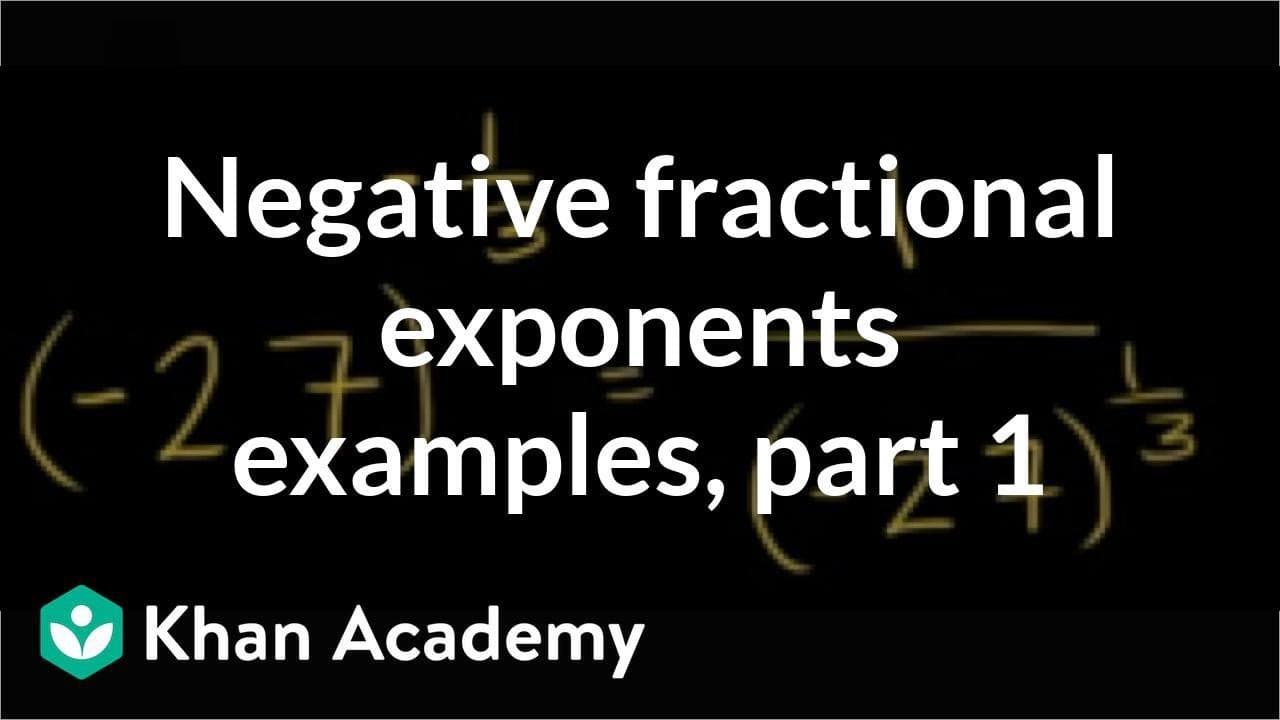
Q: How do you simplify negative 27 to the power of -1/3?
To simplify negative 27 to the power of -1/3, start by taking the reciprocal and rewriting it as 1/negative 27 to the power of 1/3. Then, find the number that, when multiplied by itself three times, equals negative 27, which is -3.
Q: What is the simplified form of negative 27 to the power of -1/3?
The simplified form of negative 27 to the power of -1/3 is -1/3. This can be found by simplifying it as 1/negative 27 to the power of 1/3, and determining that the number is -3.
Summary & Key Takeaways
-
Taking 9 to the power of 1/2 gives us 3, representing the principal root of 9.
-
When taking 9 to the power of -1/2, it is equivalent to 1/9 to the power of 1/2, which simplifies to 1/3.
-
Negative 27 to the power of -1/3 can be simplified to 1/negative 27 to the power of 1/3, leading us to find that the number is -3.
Read in Other Languages (beta)
Share This Summary 📚
Summarize YouTube Videos and Get Video Transcripts with 1-Click
Try YouTube Summary with ChatGPT & Claude or YouTube Transcript Generator
Explore More Summaries from Khan Academy 📚



Summarize YouTube Videos and Get Video Transcripts with 1-Click
Try YouTube Summary with ChatGPT & Claude or YouTube Transcript Generator