What Is Camber in Highway Design and Its Types?
TL;DR
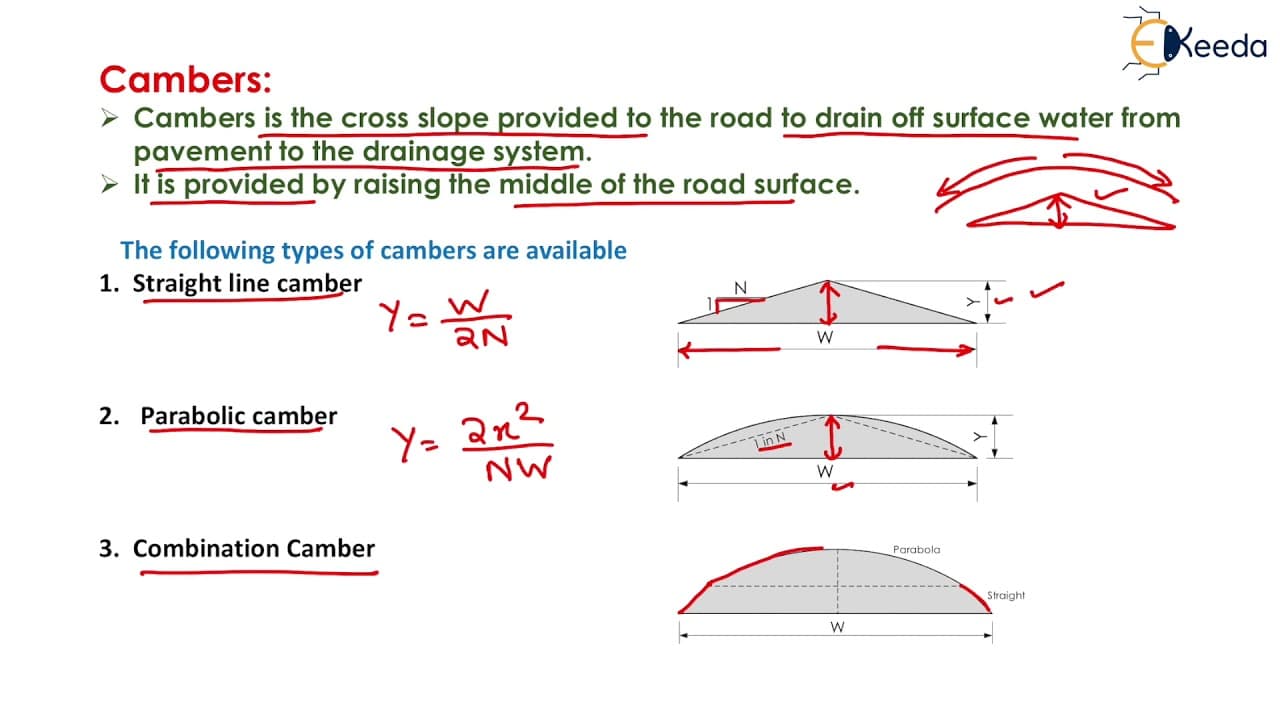
Camber is the cross slope of a road designed to drain surface water, typically shaped like a parabola or triangle. The main types of camber include straight line, preferred for cement pavements; parabolic, ideal for high-speed vehicles; and combination camber, used in express highways. Camber values differ based on pavement type and the intensity of rainfall.
Transcript
hello students today we are going to study camber now what do you mean by camber camber is the cross slope provided to the road to drain off surface water from the pavement to the drainage system now you all had seen that is the cross section of road is like this now why we made the cross-section of the road just like a parabola to drain off the wa... Read More
Key Insights
- 💦 Camber is essential for road design to facilitate proper drainage of surface water.
- 🫥 Different types of camber, such as straight line, parabolic, and combination camber, serve specific purposes.
- 🧑🏭 The choice of camber type depends on factors like pavement material and road function.
- ⚾ Indian Road Congress provides guidelines for camber values based on pavement type and rainfall intensity.
- 🚄 Straight line camber is preferred for rigid pavements, while parabolic camber is suitable for high-speed vehicle movement.
- 💦 The profile of a road with camber resembles a parabola or triangular shape to efficiently drain water.
- 🙂 Camber values for different pavement materials vary for heavy rainfall areas compared to light rainfall areas.
Install to Summarize YouTube Videos and Get Transcripts
Explore YouTube Video Summarizer or Get YouTube Transcript Extractor
Questions & Answers
Q: What is camber in road design and why is it important?
Camber refers to the cross slope on roads to drain water efficiently. It is crucial to prevent water accumulation and maintain road safety by reducing the risk of hydroplaning.
Q: How is the value of camber computed for different types like straight line and parabolic camber?
The value of camber, indicated by y, can be calculated based on the width of the road and the slope ratio. For straight line camber, y equals half the road width divided by the slope ratio, while for parabolic camber, y is derived from a formula involving x and the slope ratio.
Q: Why is straight line camber preferred for cement concrete pavement?
Straight line camber is preferred for cement concrete pavement because it provides minimal camber, which is suitable for rigid pavements. This profile ensures efficient water drainage without excessive slope.
Q: When is parabolic camber preferred in road design?
Parabolic camber is preferred for high-speed vehicle movement as it offers a flat central portion, ideal for increased velocity. This type of camber is suited for expressways and roads where vehicles travel at high speeds.
Summary & Key Takeaways
-
Camber is the slope provided on roads to drain surface water to the drainage system.
-
Different types of camber include straight line, parabolic, and combination camber.
-
The choice of camber type depends on the pavement material and purpose of the road.
Read in Other Languages (beta)
Share This Summary 📚
Summarize YouTube Videos and Get Video Transcripts with 1-Click
Try YouTube Summary with ChatGPT & Claude or YouTube Transcript Generator
Explore More Summaries from Ekeeda 📚






Summarize YouTube Videos and Get Video Transcripts with 1-Click
Try YouTube Summary with ChatGPT & Claude or YouTube Transcript Generator