How To Calculate The Missing Side Length of a Triangle
TL;DR
Learn different methods to calculate missing side lengths in triangles using the Pythagorean theorem, trigonometric ratios, and the law of sines and cosines.
Transcript
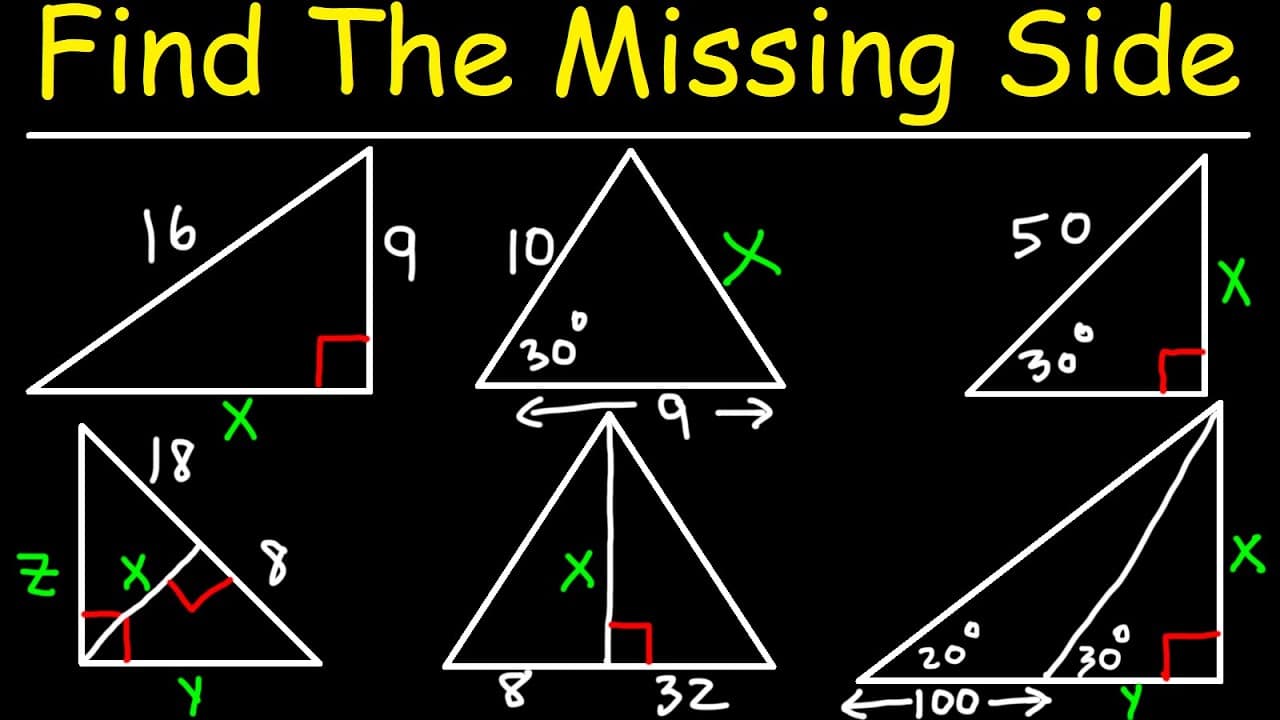
in this video we're going to talk about how to calculate the missing side length of a triangle and we're going to go through many different examples starting from the easy ones to the much harder ones so let's start with this example what we have is a right triangle and we have two sides of the right triangle to find the missing side we could use s... Read More
Key Insights
- 👻 The Pythagorean theorem is a fundamental concept in geometry that allows for the calculation of missing side lengths in right triangles.
- 🔺 Trigonometric ratios provide a trigonometric perspective on calculating missing side lengths in triangles by utilizing the relationships between angles and side lengths.
- 👮 The law of sines and the law of cosines are powerful tools for finding missing side lengths in triangles when given specific information about angles and side lengths.
- 🎟️ Understanding the concept of geometric mean can simplify the calculation of missing side lengths in certain scenarios.
Install to Summarize YouTube Videos and Get Transcripts
Explore YouTube Video Summarizer or Get YouTube Transcript Extractor
Questions & Answers
Q: What is the Pythagorean theorem?
The Pythagorean theorem states that in a right triangle, the square of the hypotenuse is equal to the sum of the squares of the other two sides. It can be expressed as a^2 + b^2 = c^2, where c is the hypotenuse and a and b are the other two sides.
Q: How can trigonometric ratios be used to calculate missing side lengths?
Trigonometric ratios such as sine, cosine, and tangent can be used when given an angle and one known side length. By setting up the appropriate trigonometric ratio equation and solving for the missing side length, the value can be determined.
Q: When should the law of sines be used?
The law of sines should be used when given two angles and one known side length. By setting up the equation (sin A / a = sin B / b = sin C / c) and solving for the missing side length, its value can be found.
Q: How does the law of cosines work?
The law of cosines can be used to find a missing side length when given two known side lengths and the included angle. The formula is c^2 = a^2 + b^2 - 2ab cos(C), where c is the missing side length and a, b, and C are the known side lengths and included angle, respectively.
Q: How can the geometric mean be used to calculate a missing side length?
In certain cases, such as when the altitude of a triangle goes to the hypotenuse, the missing side length can be found using the geometric mean of the known side lengths. The geometric mean is the square root of the product of the two known side lengths.
Summary & Key Takeaways
-
The Pythagorean theorem states that in a right triangle, the square of the hypotenuse (the side opposite the right angle) is equal to the sum of the squares of the other two sides.
-
Trigonometric ratios such as sine, cosine, and tangent can be used to calculate missing side lengths of triangles when given an angle and one known side length.
-
The law of sines can be used to find a missing side of a triangle when given two angles and one known side length.
-
The law of cosines can be used to find a missing side of a triangle when given two side lengths and the included angle.
Read in Other Languages (beta)
Share This Summary 📚
Summarize YouTube Videos and Get Video Transcripts with 1-Click
Try YouTube Summary with ChatGPT & Claude or YouTube Transcript Generator
Explore More Summaries from The Organic Chemistry Tutor 📚



Summarize YouTube Videos and Get Video Transcripts with 1-Click
Try YouTube Summary with ChatGPT & Claude or YouTube Transcript Generator