How to Calculate Volume Using Semicircular Cross-Sections
TL;DR
To find the volume of a 3D figure with semicircular cross-sections, sum the volumes of individual discs or use a definite integral. The cross-sections are derived from the area of semicircles based on the region beneath a specific graph, leading to a precise calculation involving π.
Transcript
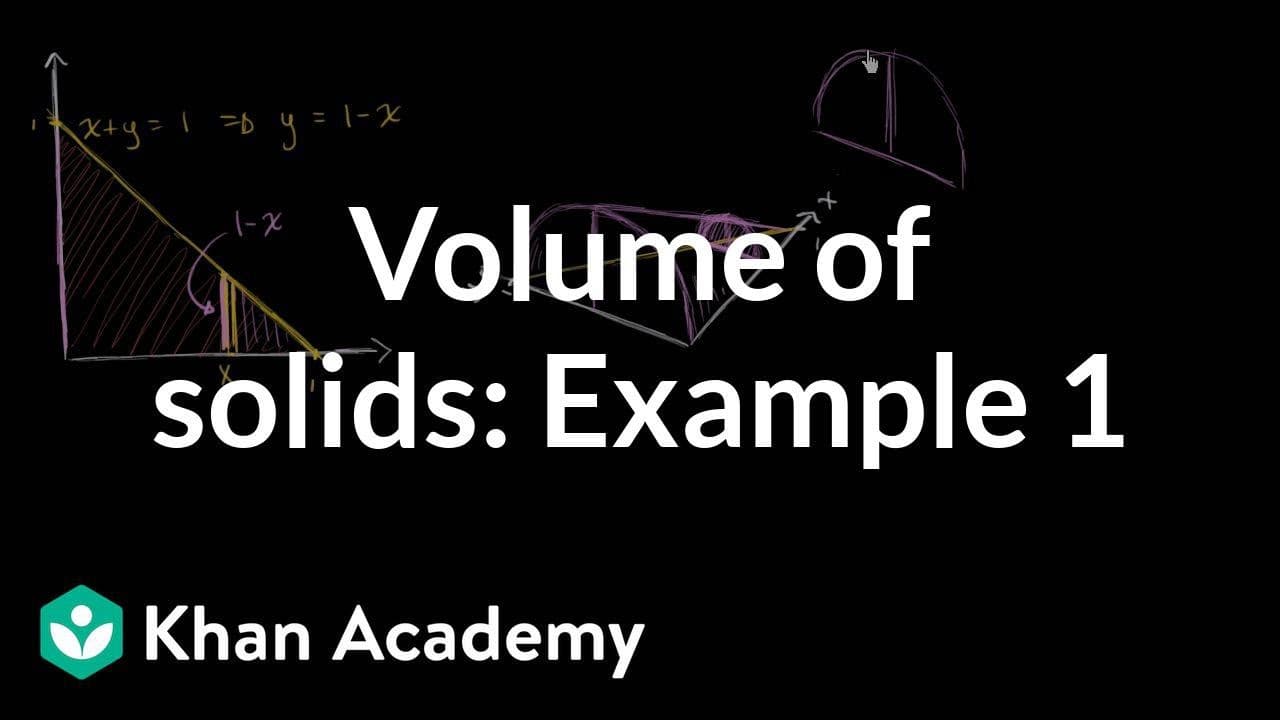
- [Voiceover] This right over here is the graph of x plus y is equal to one. Let's say the region that's below this graph but still in the first quadrant, that this is the base of a three dimensional figure. So this region right over here is the base of a three dimensional figure. What we know about this three dimensional figure is if we were to ta... Read More
Key Insights
- ⚾ The base of a three-dimensional figure can be represented by the region below a specific graph in the first quadrant.
- 😵 Cross-sections parallel to the y-axis form semi-circles.
- 🔇 The volume of the figure can be calculated by approximating it with a sum of volumes of discs or by taking the definite integral of the cross-sectional area formula.
- ☺️ The diameter of the semi-circles is determined by the difference between one minus x and the x-axis.
- ☺️ The radius of the semi-circles is half the diameter, which is equal to one minus x over two.
- ☠️ The cross-sectional area formula for the semi-circles is pi over two times the square of one minus x over two.
- 😵 The volume of a single disc is the cross-sectional area multiplied by the depth (dx).
- 🫰 To find the volume of the entire figure, the definite integral of the cross-sectional area formula is taken from x equals zero to x equals one.
Install to Summarize YouTube Videos and Get Transcripts
Explore YouTube Video Summarizer or Get YouTube Transcript Extractor
Questions & Answers
Q: What is the base of the three-dimensional figure?
The base of the figure is the region below the graph of x plus y is equal to one in the first quadrant.
Q: What shape are the cross-sections parallel to the y-axis?
The cross-sections parallel to the y-axis are semi-circles.
Q: How can the volume of the figure be approximated?
By dividing the figure into discs and summing their volumes, or by taking the limit of infinitely thin discs using the definite integral.
Q: What is the formula for the cross-sectional area?
The cross-sectional area formula is pi over two times the square of one minus x over two.
Summary & Key Takeaways
-
The video discusses the base of a three-dimensional figure, which is the region below the graph of x plus y is equal to one in the first quadrant.
-
The cross-sections parallel to the y-axis are semi-circles, and different perspectives of the figure are shown.
-
The volume of the figure can be approximated by dividing it into discs and summing their volumes, or by taking the definite integral of the cross-sectional area formula.
Read in Other Languages (beta)
Share This Summary 📚
Summarize YouTube Videos and Get Video Transcripts with 1-Click
Try YouTube Summary with ChatGPT & Claude or YouTube Transcript Generator
Explore More Summaries from Khan Academy 📚



Summarize YouTube Videos and Get Video Transcripts with 1-Click
Try YouTube Summary with ChatGPT & Claude or YouTube Transcript Generator