Polynomial end behavior | Polynomial and rational functions | Algebra II | Khan Academy
TL;DR
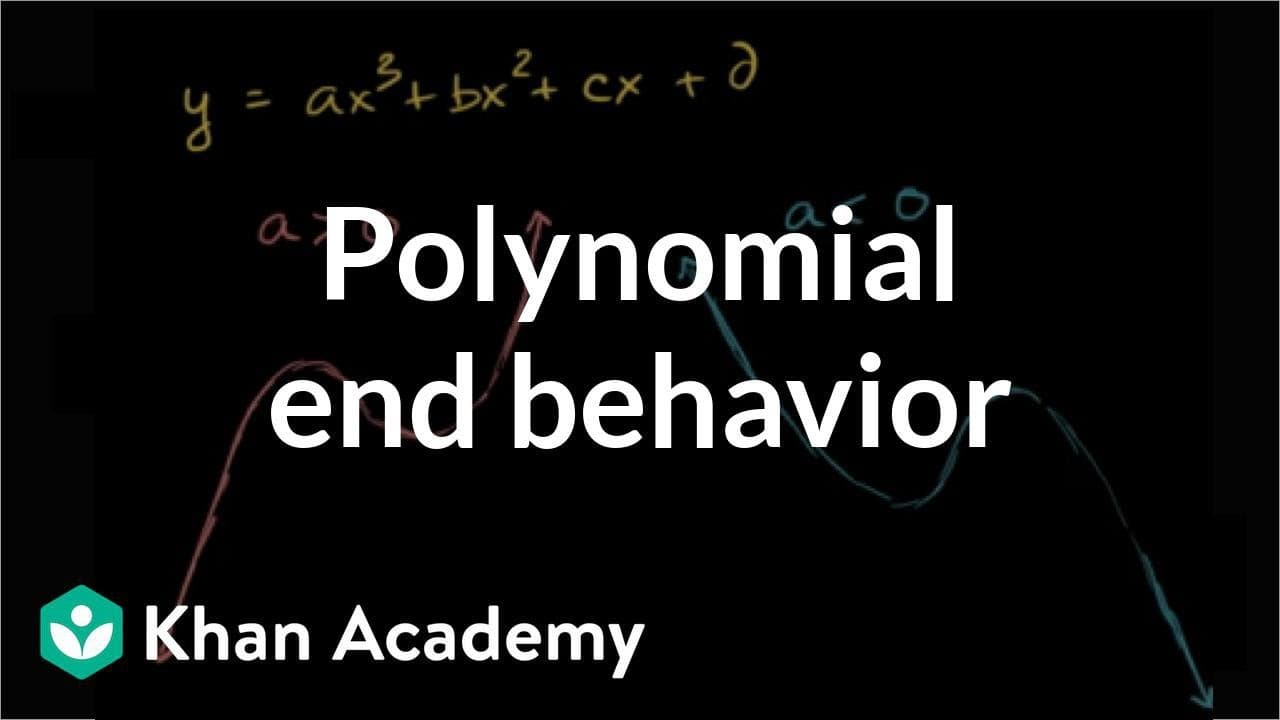
This video explains how the end behavior of polynomials can be predicted based on the degree and coefficient values.
Transcript
What I want to do in this video is talk a little bit about polynomial end behavior. And this is really just talking about what happens to a polynomial if as x becomes really large or really, really, really negative. For example, we're familiar with quadratic polynomials where y is equal to ax squared plus bx plus c. We know that if a is greater tha... Read More
Key Insights
- 🥺 The end behavior of a polynomial can be determined based on the leading term's exponent and coefficient.
- ❤️🩹 For even degree polynomials, the end behavior resembles that of quadratic functions.
- ❤️🩹 Odd degree polynomials have end behavior similar to cubic functions.
- ❤️🩹 The end behavior provides insights into the overall shape and behavior of polynomials.
- ❤️🩹 The end behavior is dependent on the values of the coefficient a.
- ❤️🩹 The middle behavior of polynomials can exhibit various patterns and fluctuations, but it is not the main focus when analyzing end behavior.
- 📈 Understanding end behavior helps in graphing and interpreting polynomial functions.
Install to Summarize YouTube Videos and Get Transcripts
Explore YouTube Video Summarizer or Get YouTube Transcript Extractor
Questions & Answers
Q: How does the end behavior of a quadratic polynomial differ based on the value of a?
If a is greater than 0, the graph will open upwards, and if a is less than 0, it will open downwards. This determines the direction of the curve.
Q: Can a third degree polynomial have a decreasing end behavior?
No, if a is greater than 0, the polynomial will have an increasing end behavior, and if a is less than 0, it will still have an increasing end behavior but with a flipped graph.
Q: What is the significance of even and odd degrees in predicting end behavior?
Even degree polynomials have end behavior similar to quadratic functions, while odd degree polynomials have end behavior similar to cubic functions.
Q: Is it possible for polynomials to have different behavior in between the end behavior?
Yes, polynomials can have various shapes and features in between the end behavior, but this video focuses on understanding and predicting the behavior at the extremes.
Summary & Key Takeaways
-
The end behavior of a polynomial describes what happens to the function as x becomes very large or very small.
-
For quadratics, if a is greater than 0, the graph opens upwards, and if a is less than 0, it opens downwards.
-
Third degree polynomials exhibit similar behavior, with a positive a leading to increasing values and a negative a leading to decreasing values.
Read in Other Languages (beta)
Share This Summary 📚
Summarize YouTube Videos and Get Video Transcripts with 1-Click
Try YouTube Summary with ChatGPT & Claude or YouTube Transcript Generator
Explore More Summaries from Khan Academy 📚



Summarize YouTube Videos and Get Video Transcripts with 1-Click
Try YouTube Summary with ChatGPT & Claude or YouTube Transcript Generator