Atmospheric Pressure Problems - Physics & Fluid Statics
TL;DR
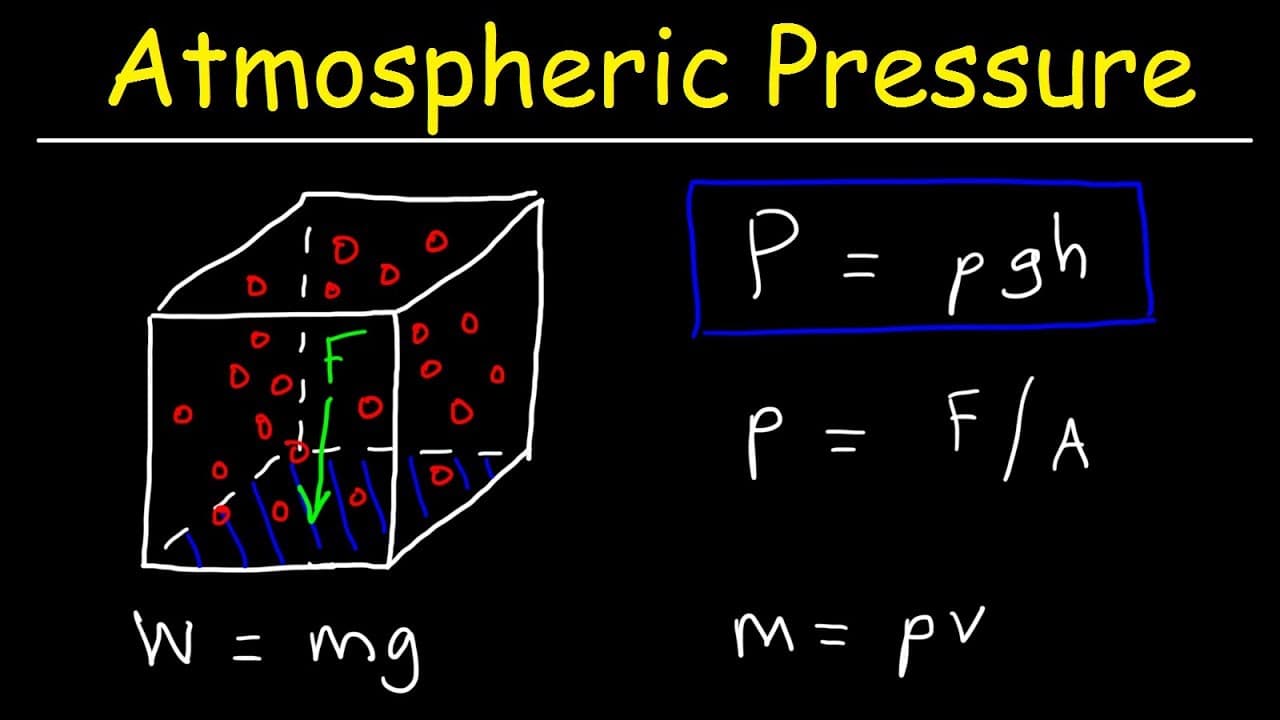
Atmospheric pressure is the weight of the air molecules above a given area, and it is measured in pascals or newtons per square meter.
Transcript
now what exactly is atmospheric pressure we're going to focus on that in this video but first we need to know what pressure is pressure is the ratio between force and area every force exerted on a surface will apply a pressure on that surface let's say if we have a book that's resting on a table so here's the book and let's say this is the table on... Read More
Key Insights
- 👱 Atmospheric pressure is the weight of the air molecules above a given surface.
- 🥳 Pressure is the ratio between force and area.
- 🤢 Atmospheric pressure at sea level is one atmosphere or 101,325 pascals.
- 🏋️ Increasing the area does not change the pressure, but it increases the weight force exerted by the atmosphere.
- ✖️ Pressure can be calculated by multiplying atmospheric pressure by the area.
- 👱 The pressure exerted by the air inside a closed box depends on the weight force of the air molecules and the area of the bottom surface.
- 👱 The mass of air in a vertical column can be determined by multiplying the pressure by the length and width of the column and dividing by gravitational acceleration.
Install to Summarize YouTube Videos and Get Transcripts
Explore YouTube Video Summarizer or Get YouTube Transcript Extractor
Questions & Answers
Q: What is atmospheric pressure?
Atmospheric pressure is the weight of all the air molecules above a given area, and it is measured in pascals or newtons per square meter.
Q: How does atmospheric pressure change with area?
While increasing the area will result in a greater weight force exerted by the atmosphere, the pressure remains a fixed value.
Q: How can we calculate the force exerted by the atmosphere over a specific area?
The force exerted by the atmosphere can be calculated by multiplying the atmospheric pressure by the area.
Q: What is the pressure exerted by the air inside a closed rectangular box?
The pressure exerted by the air inside the box can be determined by dividing the weight force of the air molecules by the area of the bottom surface.
Q: How is the weight of the air calculated for a vertical column with a specific pressure?
To calculate the mass of air in a vertical column, multiply the pressure by the length and width of the column and divide by the gravitational acceleration.
Q: Why is it important to use pascals instead of atmospheres when calculating pressure?
In physics calculations, it is important to use pascals as the unit of pressure because it is the standard unit in the International System of Units (SI).
Summary & Key Takeaways
-
Pressure is the ratio between force and area, and atmospheric pressure is based on the weight of the atmosphere exerted on a surface.
-
Atmospheric pressure at sea level is one atmosphere (1 atm), which is equal to 101,325 pascals or newtons per square meter.
-
The force exerted by the atmosphere can be calculated by multiplying atmospheric pressure by the area.
Read in Other Languages (beta)
Share This Summary 📚
Summarize YouTube Videos and Get Video Transcripts with 1-Click
Try YouTube Summary with ChatGPT & Claude or YouTube Transcript Generator
Explore More Summaries from The Organic Chemistry Tutor 📚


Summarize YouTube Videos and Get Video Transcripts with 1-Click
Try YouTube Summary with ChatGPT & Claude or YouTube Transcript Generator