What Is the Difference Between Art and Craft?
TL;DR
The distinction between art and craft emerged during the Renaissance in Florence, where individual creativity gained value over collective production. In many cultures, traditional works are highly regarded, and the value placed on innovation is not universal. Recent trends are leading to a broader understanding of aesthetic production, acknowledging the significance of both art and traditional crafts.
Transcript
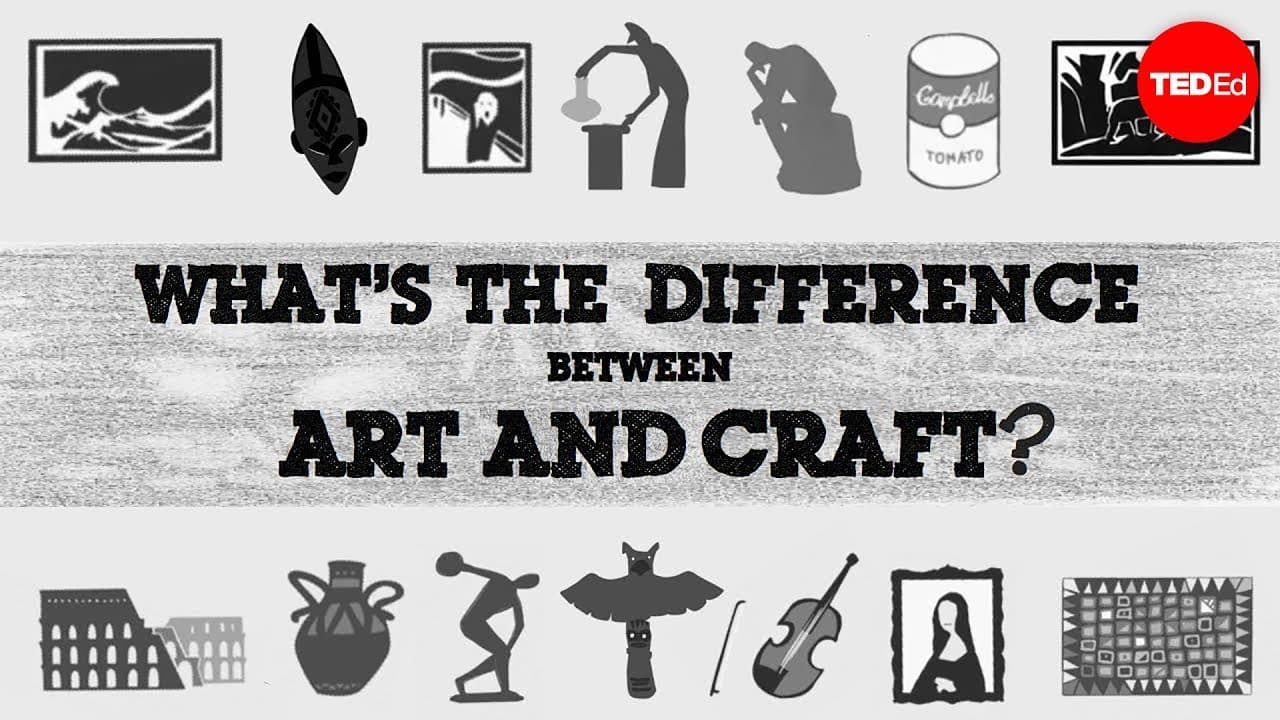
When you hear the word art, what comes to mind? A painting, like the Mona Lisa, or a famous sculpture or a building? What about a vase or a quilt or a violin? Are those things art, too, or are they craft? And what's the difference anyway? It turns out that the answer is not so simple. A spoon or a saddle may be finely wrought, while a monument may ... Read More
Key Insights
- 🫵 Artists and artisans were previously viewed collectively, without individual recognition.
- 〽️ The Renaissance in Florence marked the beginning of the distinction between art and craft.
- 💁 Innovation is not universal; some cultures value tradition in their visual forms.
- 🥰 Art historians have re-evaluated non-Western art, recognizing its value in preserving traditions.
- 🥰 Inclusion of quilts and wood carvings in museums challenges traditional art categories.
- 🥰 The shift from art and craft to visual arts reflects a broader perspective on aesthetic production.
- ❓ The value of aesthetic objects and their makers is influenced by culture and history.
Install to Summarize YouTube Videos and Get Transcripts
Explore YouTube Video Summarizer or Get YouTube Transcript Extractor
Questions & Answers
Q: How did the distinction between art and craft originate?
The separation began in Renaissance Florence with the rise of individual creativity and the value placed on artists over collective production.
Q: Why were non-Western cultures initially classified as primitive by art historians?
Art historians mistakenly viewed lack of innovation as a deficit, not realizing the cultural importance of preserving visual traditions inherent in these works.
Q: How has the inclusion of quilts and wood carvings in museums challenged traditional art categories?
By recognizing these forms as visual arts, museums are broadening their scope and reflecting a more diverse representation of aesthetic production.
Q: Why is it suggested to use a term like visual arts instead of art and craft?
Using visual arts acknowledges a wider range of aesthetic production and eliminates the limitations imposed by the historical distinctions between art and craft.
Summary & Key Takeaways
-
Artists and artisans were once collectively viewed as makers without individual recognition.
-
The distinction between art and craft began in Florence during the Renaissance.
-
Some cultures value tradition over innovation in defining visual forms.
Read in Other Languages (beta)
Share This Summary 📚
Summarize YouTube Videos and Get Video Transcripts with 1-Click
Try YouTube Summary with ChatGPT & Claude or YouTube Transcript Generator
Explore More Summaries from TED-Ed 📚






Summarize YouTube Videos and Get Video Transcripts with 1-Click
Try YouTube Summary with ChatGPT & Claude or YouTube Transcript Generator