Determining whether real world model is linear or exponential
TL;DR
A small piece of land in a remote village has seen a linear increase in cost over time.
Transcript
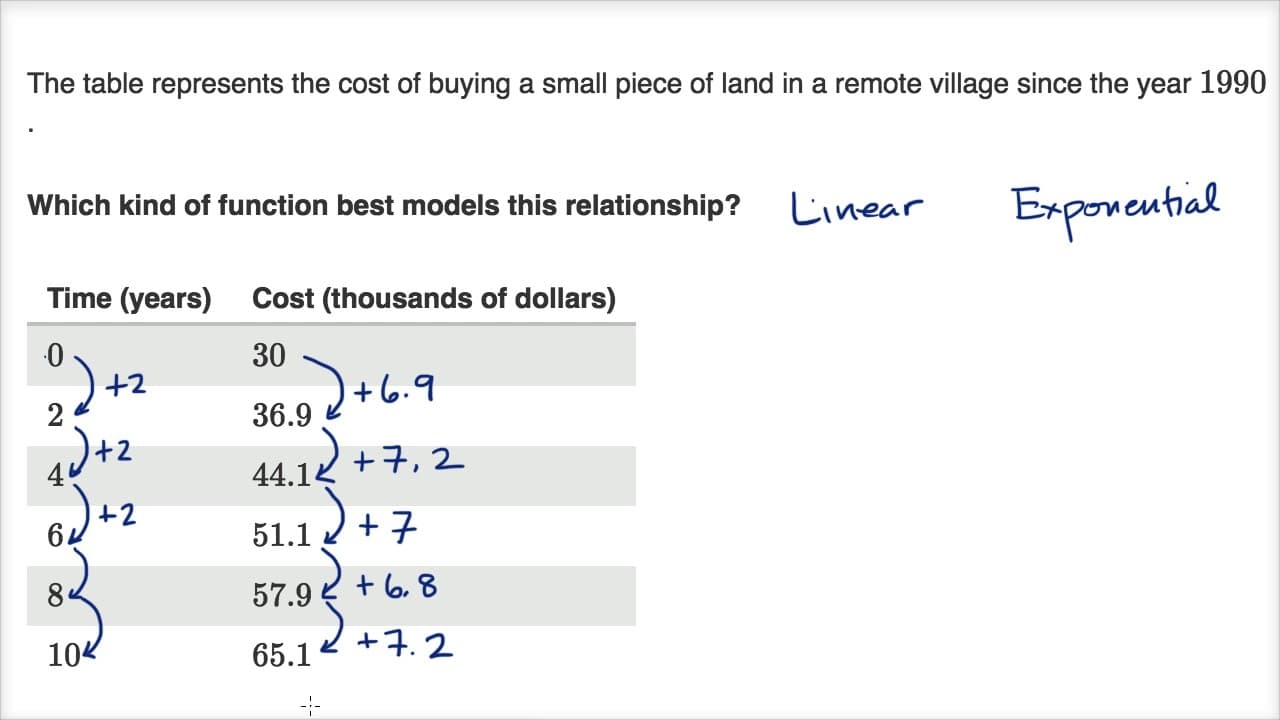
- [Instructor] The table represents the cost of buying a small piece of land in a remote village since the year 1990. Which kind of function best models this relationship? And I'm using, this is an example from the Khan Academy exercises, and we're really trying to pick between whether a linear model or a linear function models this relationship or... Read More
Key Insights
- 🏝️ The cost of a small piece of land in a remote village has been increasing over time.
- ⌛ The relationship between time and cost can be modeled using either a linear or exponential function.
- ⌛ By analyzing the differences in cost between consecutive time intervals, a linear model appears to be a better fit for the data.
- 😚 Real-world data may not perfectly align with a specific model, but can still exhibit close patterns.
- 🇨🇷 The linear model predicts an approximate increase of $7,000 in cost for every two years.
- ❓ Exponential models were considered but did not provide as accurate a fit to the data.
- 😚 Plotting the data points on a coordinate plane would result in a line or close approximation.
Install to Summarize YouTube Videos and Get Transcripts
Explore YouTube Video Summarizer or Get YouTube Transcript Extractor
Questions & Answers
Q: What are the two possible models for representing the relationship between time and land cost?
The two possible models are linear and exponential. Linear models show a constant increase, while exponential models show a multiplier effect.
Q: How can you determine whether the relationship is linear or exponential?
By analyzing the differences in cost between consecutive time intervals, you can see if the increase is constant (linear) or if there is a consistent multiplier (exponential).
Q: Why is the linear model a better fit for this data?
The differences in cost for each time interval are close to a constant value, suggesting a linear relationship. The data points would also form a line or closely align with one.
Q: Is it possible to have an exact linear or exponential model in real-world situations?
Real-world data will never perfectly fit a linear or exponential model. However, the data can still exhibit patterns that are close to one of these models.
Summary & Key Takeaways
-
The provided data represents the cost of buying a small piece of land in a remote village since 1990.
-
The question is whether a linear or exponential model best represents the relationship between time and cost.
-
By analyzing the differences in cost for each time interval, it is determined that a linear model is more appropriate.
Read in Other Languages (beta)
Share This Summary 📚
Summarize YouTube Videos and Get Video Transcripts with 1-Click
Try YouTube Summary with ChatGPT & Claude or YouTube Transcript Generator
Explore More Summaries from Khan Academy 📚



Summarize YouTube Videos and Get Video Transcripts with 1-Click
Try YouTube Summary with ChatGPT & Claude or YouTube Transcript Generator