How to Calculate Molar Mass Using Osmotic Pressure
TL;DR
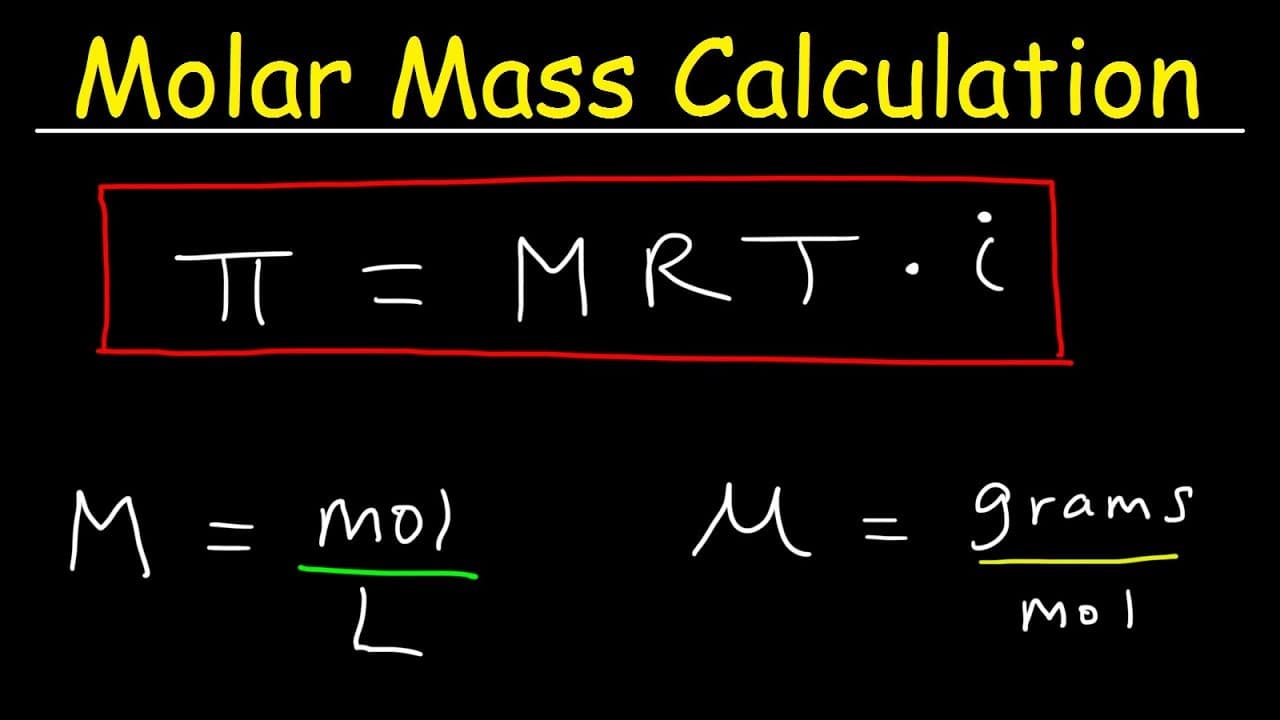
To calculate the molar mass of a solute using osmotic pressure, apply the formula: molar mass = mass of solute (g) / moles of solute. First, use the osmotic pressure equation (π = MRTi) to find the molarity of the solution, which helps in determining the moles, allowing for the final calculation of molar mass in grams per mole.
Transcript
in this video we're going to talk about how to calculate the molar mass of a solute using osmotic pressure so anytime you wish to calculate the molar mass of a solute here is the general equation that you need to use it's simply the mass divided by the moles now you want the mass to be in grams and moles is just moles so the unit for molar mass is ... Read More
Key Insights
- 💆 Molar mass of a solute can be calculated using the mass and moles of the solute.
- 💆 Osmotic pressure is a useful technique to accurately measure molar mass.
- 🧑🏭 The van't Hoff factor accounts for the dissociation of ionic solutes.
- 🛩️ Osmotic pressure requires a small amount of solute to produce a significant pressure, making it highly accurate.
- 😥 Other methods like measuring boiling point and freezing point are less sensitive and accurate.
- ☺️ Osmotic pressure equation: pi = molarity x gas constant x temperature x van't Hoff factor.
- 💆 Osmotic pressure can be used to calculate the molarity of the solution, which is then used to find the moles of the solute and the molar mass.
Install to Summarize YouTube Videos and Get Transcripts
Explore YouTube Video Summarizer or Get YouTube Transcript Extractor
Questions & Answers
Q: What is the general equation to calculate molar mass of a solute?
The general equation is mass divided by moles, where the mass is in grams and the moles are in moles. The unit for molar mass is grams per mole.
Q: How can osmotic pressure be used to calculate molar mass?
Osmotic pressure is calculated using the equation pi = molarity x gas constant x temperature x van't Hoff factor. By solving for molarity and using it in the molar mass equation, we can find the molar mass.
Q: What is the significance of the van't Hoff factor in osmotic pressure calculations?
The van't Hoff factor accounts for the dissociation of ionic solutes into ions. It represents the number of ions produced in the solution. For non-dissociating solutes, the van't Hoff factor is 1.
Q: Why is osmotic pressure a more accurate method to measure molar mass compared to other techniques?
Osmotic pressure requires a small amount of solute to produce a significant pressure, making it highly sensitive and accurate. Other methods like measuring freezing point or boiling point require larger amounts of solute for accurate measurements.
Summary & Key Takeaways
-
To calculate the molar mass of a solute, use the equation: mass divided by moles (grams per mole).
-
Osmotic pressure (pi) equation: pi = molarity x gas constant x temperature x van't Hoff factor.
-
Use osmotic pressure to find the molarity of the solution, which can then be used to calculate the moles of the solute and the molar mass.
Read in Other Languages (beta)
Share This Summary 📚
Summarize YouTube Videos and Get Video Transcripts with 1-Click
Try YouTube Summary with ChatGPT & Claude or YouTube Transcript Generator
Explore More Summaries from The Organic Chemistry Tutor 📚





Summarize YouTube Videos and Get Video Transcripts with 1-Click
Try YouTube Summary with ChatGPT & Claude or YouTube Transcript Generator