How to Convert Metric Units Step-by-Step
TL;DR
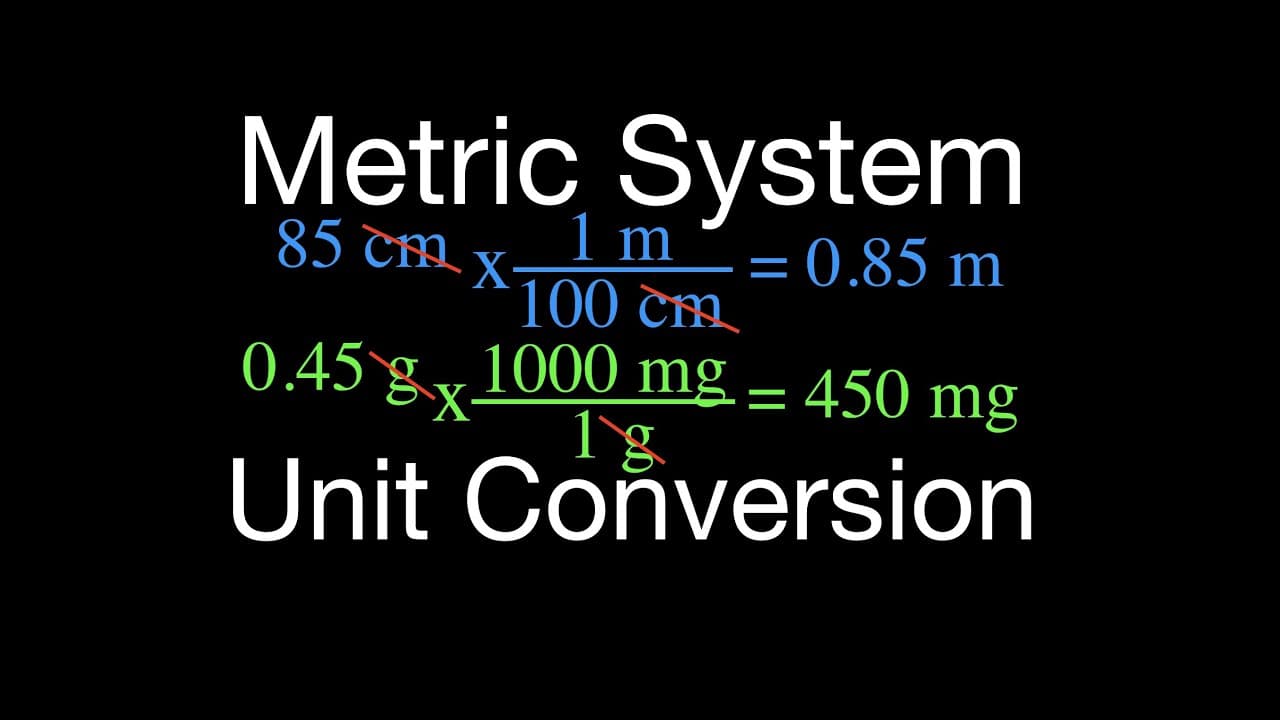
To convert metric units, always start by writing down the relevant conversion factors, such as 1 kilometer equals 1,000 meters. Use these factors in a multiplication or division format to cancel out the original units and arrive at the desired unit. Practicing this method with examples like kilometers to meters or grams to kilograms will help solidify your understanding of metric conversions.
Transcript
okay as you can see in today's video we're going to be going over how to do some metric conversions or you could call it dimensional analysis or how to convert from one metric unit to another and we actually won't do all metrics but here we go we're going to convert our first problem is to convert 1.75 kilometers to meters now the first thing that ... Read More
Key Insights
- 🧑🏭 Conversion factors establish the relationship between different metric units for accurate conversions.
- 👋 Writing down the given value and conversion factors before beginning a conversion process is a good practice.
- 🇦🇪 Cancelling units in fractions simplifies the conversion process and ensures accurate results.
- 📈 Understanding the metric system basics is essential for successful metric conversions.
- 📈 Converting between different metric units requires careful consideration of the relationships between them.
- 📈 Easy-to-follow step-by-step examples help clarify the metric conversion process.
- 🧑🏭 Utilizing conversion factors and clear notation simplify complex metric conversion problems.
Install to Summarize YouTube Videos and Get Transcripts
Explore YouTube Video Summarizer or Get YouTube Transcript Extractor
Questions & Answers
Q: Why is it essential to write down the conversion factor before doing metric conversions?
Writing down the conversion factor helps establish a clear relationship between the units being converted, reducing confusion and ensuring accurate calculations.
Q: How do you decide which unit goes on the top or bottom during a conversion fraction?
The unit you want to cancel out goes in the bottom, while the unit you want to convert to goes on the top to facilitate easy cancellation and conversion.
Q: What is the significance of understanding the metric system when performing conversions?
Understanding the metric system is crucial for accurate conversions as it provides a standardized way to relate different units and ensure consistency in calculations.
Q: Why is it important to include multiplication and division signs when setting up a conversion problem?
Including multiplication and division signs helps structure the conversion process clearly, ensuring that each step is followed accurately for the correct conversion outcome.
Summary & Key Takeaways
-
Understand the importance of conversion factors in metric conversions to avoid confusion.
-
Step-by-step guide on converting kilometers to meters, grams to kilograms, centimeters to meters, and more.
-
Detailed explanations on each conversion process with clear examples and calculations.
Read in Other Languages (beta)
Share This Summary 📚
Summarize YouTube Videos and Get Video Transcripts with 1-Click
Try YouTube Summary with ChatGPT & Claude or YouTube Transcript Generator
Explore More Summaries from Step by Step Science 📚
Summarize YouTube Videos and Get Video Transcripts with 1-Click
Try YouTube Summary with ChatGPT & Claude or YouTube Transcript Generator