How to Convert Binary Numbers to Hexadecimal
TL;DR
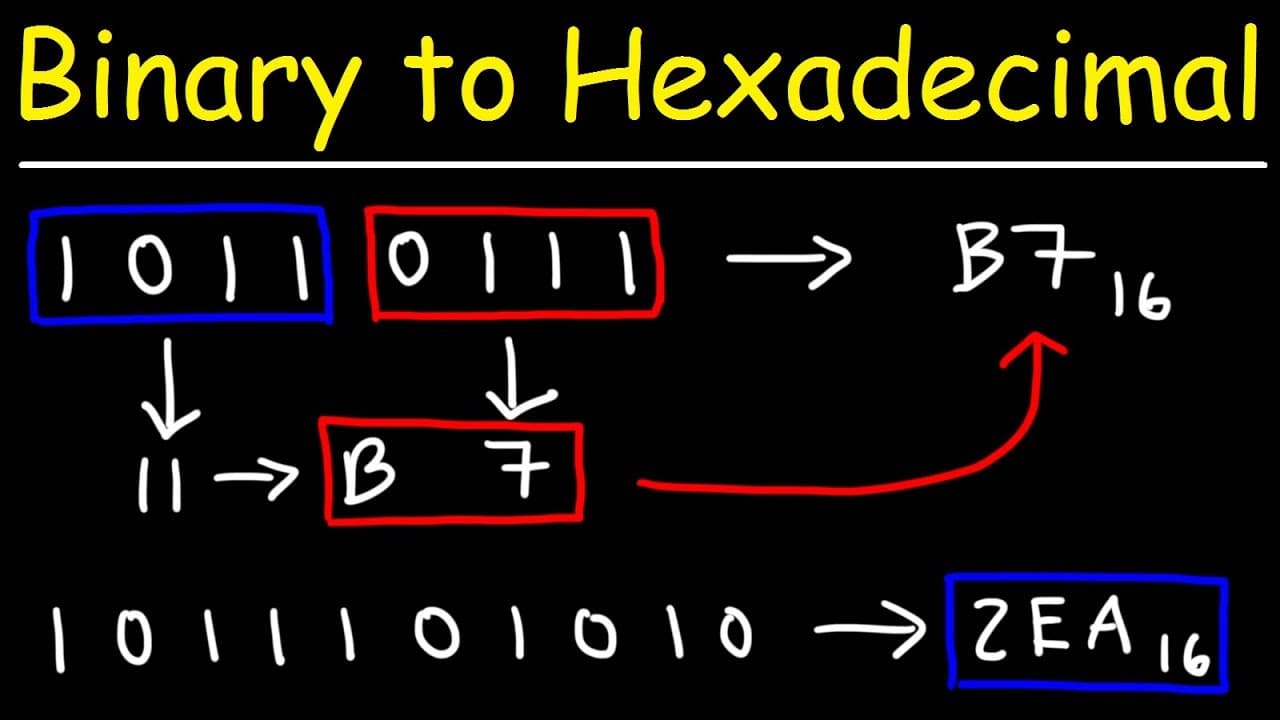
To convert binary numbers to hexadecimal, group the binary digits into sets of four. Convert each group to its decimal equivalent, and then replace decimal values greater than 9 with hexadecimal letters (A-F). Ensure proper alignment by adding leading zeros if necessary for complete groups.
Transcript
in this video we're gonna talk about how to convert a binary number into a hexadecimal number so let's start with this example let's say we have the binary number 1 0 1 1 0 1 1 1 how can we convert this into a hexadecimal number the first thing you want to do is separate the binary numbers in groups of 4 so this is the first group of 4 and this is ... Read More
Key Insights
- 💌 Converting binary to hexadecimal involves breaking binary digits into groups of four and replacing decimal values greater than 9 with corresponding hexadecimal letters.
- ✊ Binary numbers can be easily converted to decimal by multiplying each digit by the appropriate power of 2 and adding the results.
- ✅ It is possible to check the accuracy of binary to hexadecimal conversion by converting both numbers to decimal and comparing the results.
- 😒 Hexadecimal uses the numbers 0-9 and letters A-F to represent values greater than 9.
Install to Summarize YouTube Videos and Get Transcripts
Explore YouTube Video Summarizer or Get YouTube Transcript Extractor
Questions & Answers
Q: How can I convert a binary number to a hexadecimal number?
To convert a binary number to hexadecimal, divide the binary digits into groups of four. Convert each group to decimal and then replace the decimal values greater than 9 with corresponding letters.
Q: What is the significance of separating binary digits into groups of four?
Separating binary digits into groups of four is necessary because each hexadecimal digit represents four binary digits. This allows for easier conversion between the two systems.
Q: Can you explain how to convert a binary number to a decimal number?
To convert a binary number to decimal, multiply each binary digit by the corresponding power of 2 and add the results. For example, in the binary number 1010, we have 1 * 2^3 + 0 * 2^2 + 1 * 2^1 + 0 * 2^0 = 10 in decimal.
Q: How do you check if the conversion from binary to hexadecimal is correct?
To verify the accuracy of the conversion, you can convert both the binary number and the hexadecimal number to decimal. If the decimal values are the same, then the conversion is correct.
Summary & Key Takeaways
-
Binary numbers can be converted to hexadecimal by separating the binary digits into groups of four.
-
Convert each group of binary digits into decimal values and then convert those values into hexadecimal equivalents.
-
Make sure to add zeros if needed and replace decimal values greater than 9 with corresponding hexadecimal letters.
Read in Other Languages (beta)
Share This Summary 📚
Summarize YouTube Videos and Get Video Transcripts with 1-Click
Try YouTube Summary with ChatGPT & Claude or YouTube Transcript Generator
Explore More Summaries from The Organic Chemistry Tutor 📚




Summarize YouTube Videos and Get Video Transcripts with 1-Click
Try YouTube Summary with ChatGPT & Claude or YouTube Transcript Generator