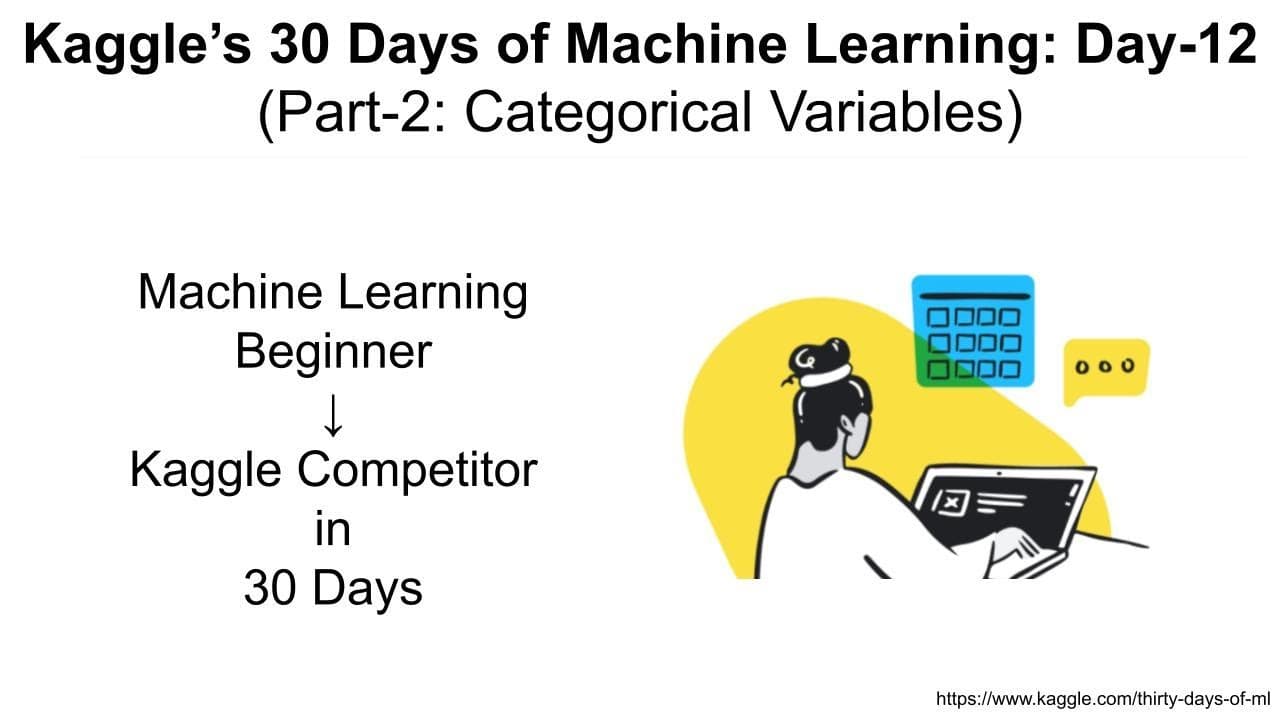
Kaggle's 30 Days Of ML (Day-12 Part-2): Handling Categorical Variables
TL;DR
Learn how to handle categorical variables in machine learning, including different encoding techniques such as ordinal encoding and one-hot encoding.
Transcript
hello everyone and welcome to day 12 part 2 of kaggle's 30 days of machine learning challenge in the previous part we learned about how to handle missing values in a data set in this part we are going to learn about categorical variables so why is this important so so far we have been training machine learning models after removing a lot of feature... Read More
Key Insights
- 🎰 Categorical variables can have a significant impact on the performance of machine learning models.
- 😅 Different encoding techniques, such as ordinal encoding and one-hot encoding, should be chosen based on the cardinality of the categorical variables.
- ✋ Ordinal encoding reduces dimensionality and is suitable for variables with high cardinality.
- 😅 One-hot encoding creates new binary features and is preferred for variables with low cardinality.
- 🏷️ Label encoding assigns unique labels to each category, allowing for easy comparison and handling of categorical variables.
- 🍵 Handling categorical variables requires careful consideration of the specific dataset and the model being used.
- 😅 Tree-based models can handle both ordinal and one-hot encoded categorical variables effectively.
Install to Summarize YouTube Videos and Get Transcripts
Explore YouTube Video Summarizer or Get YouTube Transcript Extractor
Questions & Answers
Q: What are the two types of categorical variables?
The two types of categorical variables are nominal (no order associated) and ordinal (order associated) variables.
Q: How can categorical variables be encoded in machine learning?
Categorical variables can be encoded using techniques such as ordinal encoding, one-hot encoding, and label encoding.
Q: When is one-hot encoding preferred over ordinal encoding?
One-hot encoding is preferred for categorical variables with low cardinality, where the number of unique categories is relatively small.
Q: What is the advantage of ordinal encoding over one-hot encoding?
Ordinal encoding is useful for categorical variables with high cardinality, where the number of unique categories is large, as it reduces the dimensionality of the data.
Q: Can all models handle categorical variables encoded with different techniques?
Tree-based models like decision trees, random forests, and gradient boosting can handle both ordinal and one-hot encoded categorical variables. However, some models may require specific handling for different types of categorical variables.
Q: What is the purpose of handling categorical variables in machine learning?
Handling categorical variables is important as they contain valuable information that can contribute to the accuracy and performance of machine learning models.
Q: What is the difference between label encoding and ordinal encoding?
Label encoding assigns a unique numeric label to each category, while ordinal encoding assigns numeric values based on the order or priority of the categories.
Q: Are there any advanced techniques for handling categorical variables?
Yes, advanced techniques like entity embeddings are available for handling categorical variables, but they may require more in-depth knowledge and expertise.
Summary & Key Takeaways
-
Categorical variables are divided into two types: nominal (no order associated) and ordinal (order associated) variables.
-
Different encoding techniques can be used for categorical variables, such as ordinal encoding, one-hot encoding, and label encoding.
-
One-hot encoding is suitable for variables with low cardinality, while ordinal encoding is useful for variables with high cardinality.
Read in Other Languages (beta)
Share This Summary 📚
Summarize YouTube Videos and Get Video Transcripts with 1-Click
Try YouTube Summary with ChatGPT & Claude or YouTube Transcript Generator
Explore More Summaries from Abhishek Thakur 📚



Summarize YouTube Videos and Get Video Transcripts with 1-Click
Try YouTube Summary with ChatGPT & Claude or YouTube Transcript Generator